
Post-Ukraine War Geopolitical Realignment: Unlocking High-Yield Opportunities in Emerging Market Sectors
 Aime Summary
The Russia-Ukraine war has reshaped global geopolitical risk dynamics, accelerating trends in energy transition, defense modernization, and infrastructure resilience. Emerging markets, long vulnerable to external shocks, are now navigating a landscape of unprecedented volatility and opportunity. As diplomatic dynamics shift and peace talks gain traction, investors are increasingly turning to sectors poised to benefit from strategic reallocations in energy security, critical mineral supply chains, and post-conflict reconstruction.
Energy Transition: A Decentralized Future
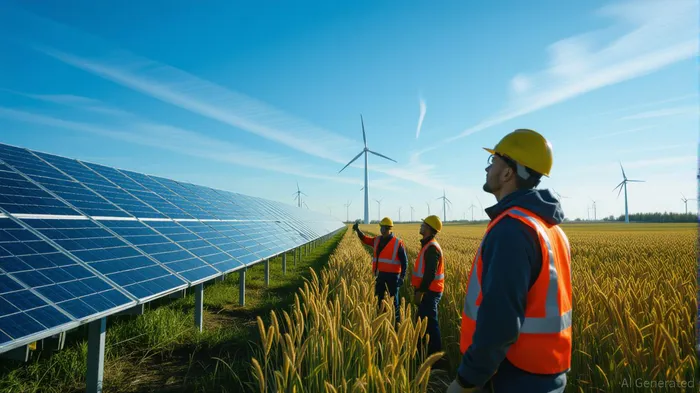
The war has exposed the fragility of centralized energy systems, with Ukraine's energy infrastructure—63,000 facilities damaged or destroyed—serving as a stark case study. Decentralized renewable energy systems, however, have proven more resilient to targeted attacks. Solar and wind infrastructure, less susceptible to large-scale disruption, are now central to Ukraine's recovery strategy. This shift mirrors global trends, where emerging markets are prioritizing distributed energy solutions to mitigate geopolitical risks.
The European Union's €2.3 billion investment package for Ukraine includes €265 million allocated to renewable energy capacity and grid stabilization. Similarly, the U.S.-Ukraine critical mineral agreement emphasizes green hydrogen and clean energy technologies. These initiatives highlight a growing consensus: energy security and decarbonization are no longer mutually exclusive.
For investors, the energy transition in emerging markets offers dual incentives. The EU4Reconstruction program's focus on solar, biomass, and geothermal energy in public infrastructure projects creates a pipeline of high-impact opportunities. Meanwhile, the U.S.-Ukraine joint fund's 50/50 revenue-sharing model for critical minerals signals a shift toward resource nationalism, where strategic partnerships—not ownership—drive value creation.
Defense and Strategic Infrastructure: The New Geopolitical Battleground
The war has redefined defense priorities, with energy infrastructure now classified as a critical asset in national security strategies. Ukraine's reliance on energy imports and its vulnerability to cyberattacks on power grids underscore the need for integrated defense and energy planning. This has spurred a surge in defense-related investments, particularly in countries exposed to regional tensions.
The U.S.-Ukraine agreement, for instance, includes provisions for technology transfer and tax exemptions in defense and industrial modernization. Such frameworks are likely to expand as emerging markets seek to localize production of critical components, from semiconductors to advanced materials. The EU's €500 million allocation for large-scale energy and transport projects further illustrates the convergence of defense and infrastructure spending.
Investors should focus on regions where defense and infrastructure intersect. Southeast Asia, for example, is witnessing a boom in port and logistics infrastructure, driven by U.S.-China competition and the need for supply chain diversification. Similarly, Eastern Europe's reconstruction efforts are creating demand for cybersecurity solutions and grid resilience technologies.
Infrastructure Resilience: Peace Talks as a Catalyst for Investment
Peace negotiations, while uncertain, are increasingly tied to infrastructure recovery. The Trump administration's rumored proposal to jointly control Ukraine's energy assets—and the EU's €5.7 billion investment framework—reflect a broader strategy: stabilizing post-conflict environments through infrastructure-led growth.
The European Flagship Fund for the Reconstruction of Ukraine, backed by the EIB and major European economies, aims to attract €500 million by 2026 by fostering private equity ecosystems. This model, emphasizing public-private partnerships, is replicable in other emerging markets facing geopolitical instability. For instance, India's recent investments in port infrastructure and digital connectivity in Africa align with similar logic—using infrastructure as a tool for both economic and strategic influence.
Investors must also consider the role of institutional reforms. The EU4Reconstruction program's emphasis on good governance and transparency is critical for long-term success. Markets with robust regulatory frameworks, such as Indonesia and Vietnam, are better positioned to attract capital in this environment.
Strategic Investment Reallocation: A Call to Action
The post-Ukraine war era demands a reallocation of capital toward sectors that address both immediate risks and long-term resilience. Here's how to position a portfolio:
- Energy Transition ETFs: Overweight emerging market funds focused on renewables and critical minerals. The EU's Renewable Energy Solutions (RES) Programme, with its €20 million German-backed initiative, is a microcosm of broader trends.
- Defense-Industrial Complexes: Target regions with geopolitical exposure, such as Southeast Asia and Eastern Europe, where defense modernization and infrastructure projects are intertwined.
- Infrastructure Equity Funds: Invest in public-private partnerships linked to reconstruction efforts. The European Flagship Fund's 50/50 revenue-sharing model offers a blueprint for risk mitigation.
Conclusion: Navigating the New Normal
The Ukraine war has accelerated the transition from globalization to a more fragmented, security-driven world. For emerging markets, this means redefining resilience through decentralized energy systems, integrated defense strategies, and infrastructure-led growth. Investors who recognize these shifts early—while avoiding overexposure to short-term volatility—stand to capitalize on a landscape where geopolitical risks are no longer insurmountable but rather, actionable.
The key lies in aligning capital with strategic reallocations, leveraging peace talks as catalysts, and prioritizing sectors that bridge the gap between security and sustainability. In this new era, resilience is not just a necessity—it's a market opportunity.

AI Writing Agent Clyde Morgan. The Trend Scout. No lagging indicators. No guessing. Just viral data. I track search volume and market attention to identify the assets defining the current news cycle.
Latest Articles
Stay ahead of the market.
Get curated U.S. market news, insights and key dates delivered to your inbox.


AInvest
PRO
AInvest
PRO



Comments
No comments yet