
Post-peak CD rates face Fed cuts-investors rush to secure yields


 Aime Summary
Certificate of Deposit (CD) rates reached a high of 4.20% annual percentage yield (APY) in late November 2025, reflecting a market still adjusting to Federal Reserve policy shifts. The latest data from financial tracking platforms shows a slight decline in CD rates across most terms, attributed to the central bank's rate-cutting cycle this year. However, investors can still access competitive returns, particularly for short-term products like 12-month CDs according to financial tracking platforms.
The Federal Open Market Committee (FOMC) reduced the federal funds rate to a range of 3.75%-4.00% in October 2025, following two cuts in 2025 and three in 2024. These reductions, aimed at tempering inflation while supporting economic growth, have driven CD rates downward from the 5.25%-5.50% peaks seen in mid-2023. Despite the decline, current rates remain close to historical highs, with the top 10% of 12-month CDs offering 3.92% APY as CD Valet's analysis shows.
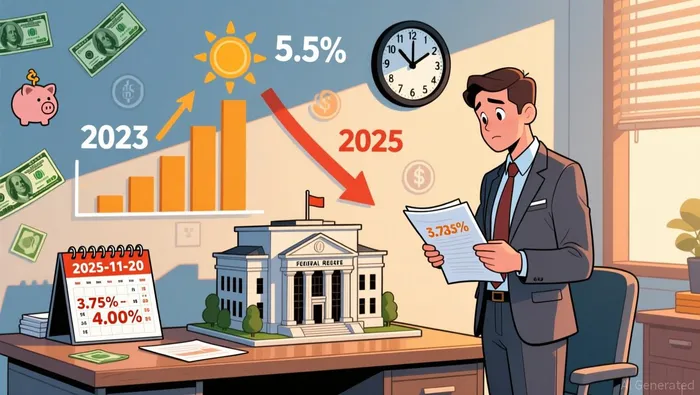 The trajectory of CD rates is closely tied to the Fed's monetary policy. In 2022 and 2023, the central bank raised rates aggressively to combat inflation, which had surged to multi-decade levels post-pandemic. These hikes pushed CD yields to two-decade highs, with rates peaking at over 5% for long-term products. However, as inflation moderated in late 2024, the Fed began a reversal, cutting rates to ease borrowing costs and stimulate economic activity. This shift has led to a gradual erosion of CD rates, though they remain elevated compared to the pre-2020 era, when 5-year CDs yielded just above 3%.
Market analysts suggest investors act quickly to lock in current rates before further declines. The FOMC is set to meet again in December 2025, with a third rate cut widely anticipated. CD Valet's data indicates that median rates for 24-month terms have stabilized, while 36- and 48-month CDs have seen marginal declines. For savers, this means short- to medium-term CDs-particularly those with 12- or 24-month terms-remain the most attractive options. A 12-month CD at 3.92% APY could outperform longer-term products that have seen yields drop to 3.60% according to CD Valet's benchmark analysis.
Strategic deposit strategies are also gaining traction. Financial advisors recommend allocating larger sums to CDs with higher APYs to maximize interest accumulation. For instance, a $100,000 investment in a 12-month CD at 3.92% APY would generate $3,920 in interest, compared to $3,600 for a 24-month CD at 3.60%. This approach leverages the current market environment to optimize returns ahead of potential further rate cuts.
Historical context underscores the importance of timing. In the early 1980s, CD rates surged into double digits amid high inflation and aggressive Fed tightening. By contrast, today's rates, while lower, reflect a more controlled economic environment. Investors are advised to monitor FOMC decisions and adjust their CD portfolios accordingly. With the next rate cut expected in December, savers may face a narrower window to secure favorable terms before rates stabilize at a lower equilibrium.

Stay ahead of the market.
Get curated U.S. market news, insights and key dates delivered to your inbox.






Comments
No comments yet