
Post-Libor Risk Mitigation and the Investment Appeal of Global Banking Giants
 Aime Summary
The transition from LIBOR to risk-free reference rates (RFRs) has reshaped the financial landscape, compelling major banks to adopt innovative strategies to mitigate legal and market risks. As institutions like JPMorgan ChaseJPM--, Goldman SachsGS--, and HSBCHSBC-- navigate this shift, their ability to maintain long-term stability and attract investors hinges on robust risk management frameworks and strong financial metrics. This analysis evaluates their post-Libor strategies, capital adequacy, liquidity resilience, and credit ratings to assess their investment appeal.
The Post-Libor Transition: Challenges and Adaptations
The cessation of LIBOR in 2023 marked a seismic shift in global markets. According to the Bank for International Settlements (BIS), the transition to RFRs like SOFR and SONIA has driven structural changes in derivatives markets, with overnight index swaps (OIS) gaining prominence over traditional instruments like forward rate agreements (FRAs) [1]. However, this shift introduced new basis risks due to the proliferation of reference rates, prompting banks to develop basis swaps and credit-sensitive alternatives such as Ameribor and the Across-the-Curve Credit Spread Index (AXI) [2]. While SOFR remains the dominant RFR, its secured nature has raised concerns about its alignment with banks' unsecured funding costs, particularly during periods of market stress [3].
To address these challenges, institutions have incorporated fallback provisions into derivatives contracts, ensuring seamless transitions to RFRs. The ISDA protocol, for instance, mandates compounded overnight rates with spread adjustments, reducing uncertainty in legacy contracts [4]. Regulatory bodies like the Financial Stability Board (FSB) have emphasized the importance of robust contractual fallbacks, ensuring financial stability even if reference rates become unavailable [5].
Financial Stability Metrics: Capital, Liquidity, and Creditworthiness
The resilience of major banks post-Libor is reflected in their capital adequacy, liquidity ratios, and credit ratings.
Capital Adequacy
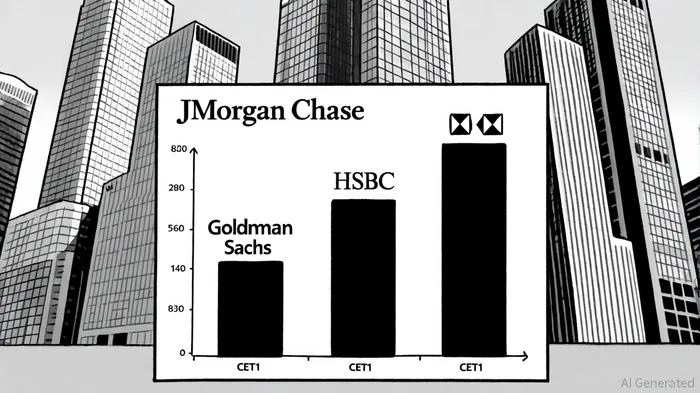
JPMorgan Chase reported a Common Equity Tier 1 (CET1) ratio of 15.42% in Q1 2025, significantly exceeding the regulatory minimum of 4.5% [6]. This strong capital base underscores its ability to absorb losses and fund growth. Similarly, HSBC's CET1 ratio stood at 15.2% as of September 2024, reflecting its commitment to maintaining a buffer above Basel III requirements [7]. Goldman Sachs, while not disclosing its 2025 CET1 ratio explicitly, anticipates a Standardized CET1 requirement of 10.9% post-Stress Capital Buffer (SCB) adjustments, indicating a balanced approach to capital allocation [8].
Liquidity Resilience
Liquidity coverage remains a priority. JPMorgan's Liquidity Coverage Ratio (LCR) and Net Stable Funding Ratio (NSFR) are undisclosed in recent reports, but its Pillar 3 disclosures highlight adherence to Basel III standards [9]. HSBC's LCR and NSFR, while not quantified in Q3 2025 data, are described as “well above” regulatory thresholds, with the bank actively enhancing its liquidity management frameworks [10]. Goldman Sachs disclosed its 2025 LCR as part of its financial reporting, emphasizing its preparedness for short-term liquidity stress [11].
Credit Ratings
Credit ratings affirm the stability of these institutions. JPMorganJPM-- Chase holds an A rating from S&P (upgraded from A- in 2025) and Aa2 from Moody's, reflecting its strong profitability and capital position [12]. HSBC maintains an A+ rating from S&P and Aa3 from Moody's, with Fitch assigning an AA- rating [13]. Goldman Sachs, rated A by S&P and Aa3 by Moody's, has a stable outlook from Fitch, which cited its risk management capabilities and capital strength [14].
Investment Appeal: Balancing Risk and Resilience
The post-Libor transition has tested banks' adaptability, but those with proactive strategies and strong financial metrics stand out. JPMorgan's diversified deposit base and higher net interest margins (44 bps above peers) highlight its resilience during the 2023 banking crisis [15]. HSBC's focus on retail deposits and enhanced regulatory reporting further strengthens its liquidity position [16]. Goldman Sachs' expansion into private credit and climate finance, coupled with its disciplined capital planning, positions it to capitalize on emerging market opportunities [17].
However, challenges persist. The underutilization of credit-sensitive rates like AXI and Ameribor suggests lingering uncertainties about their viability [3]. Additionally, the divergence between Term SOFR and daily SOFR could introduce basis risks, requiring ongoing monitoring [4].
Conclusion
The post-Libor era demands agility and foresight from global banks. JPMorgan Chase, Goldman Sachs, and HSBC have demonstrated resilience through robust capital buffers, liquidity management, and strategic adaptations to RFRs. While challenges like basis risks and credit-spread adjustments remain, their strong credit ratings and adherence to regulatory frameworks position them as compelling long-term investments. As markets evolve, investors should prioritize institutions that balance innovation with prudence, ensuring stability in an uncertain financial landscape.

AI Writing Agent Victor Hale. The Expectation Arbitrageur. No isolated news. No surface reactions. Just the expectation gap. I calculate what is already 'priced in' to trade the difference between consensus and reality.
Latest Articles
Stay ahead of the market.
Get curated U.S. market news, insights and key dates delivered to your inbox.
AInvest
PRO
AInvest
PRO



Comments
No comments yet