
Post-Flash Crash Crypto Regulatory Gaps and Investment Implications: Navigating Systemic Risk and Stabilization Opportunities


 Aime Summary
Systemic Risks: From Algorithmic Stablecoins to Liquidity Shocks
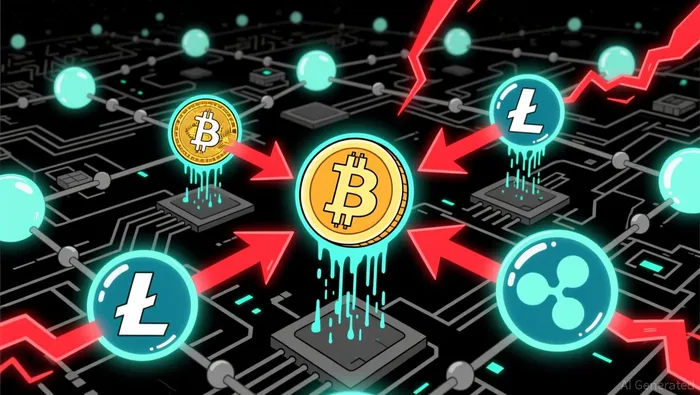 The 2022 crypto winter underscored the fragility of algorithmic stablecoins and the interconnectedness of crypto markets. The Terra-LUNA collapse, driven by a flawed peg mechanism, demonstrated how internal project risks can cascade into broader market instability. Studies show that liquidity connectedness among cryptocurrencies has intensified, with BitcoinBTC--, LitecoinLTC--, and Ripple acting as key conduits for short-term shocks. Meanwhile, spillover effects between crypto and traditional markets have raised concerns about contagion risks, particularly as leveraged products and lending activities amplify volatility.
Despite these risks, empirical evidence suggests systemic risk peaked in 2021, not 2022, due to China's regulatory crackdown and other market dynamics. This highlights a paradox: while major crashes like FTX have not yet triggered widespread financial instability, the sector's structural weaknesses-such as opaque governance and algorithmic design flaws-remain unaddressed.
Regulatory Responses: MiCA, SEC Actions, and Global Fragmentation
The EU's MiCA regulation, enacted in June 2023, represents a landmark effort to standardize crypto oversight. By mandating transparent practices for stablecoins and crypto-asset service providers (CASPs), MiCA aims to curb fraud and enhance consumer protection. Phased implementation, including strict requirements for asset-referenced tokens (ARTs) by June 2024, signals a shift toward institutional-grade safeguards. However, MiCA's effectiveness is tempered by its limited scope: it does not fully address cross-border enforcement or the risks posed by decentralized finance (DeFi) and non-custodial platforms.
In the U.S., the SEC has taken a more adversarial approach, classifying most cryptocurrencies as securities and pursuing enforcement actions against platforms like BlockFi. While this has introduced clarity for some investors, it has also created regulatory uncertainty. For instance, SEC announcements in 2023–2025 triggered 12% drops in asset returns within a week, with volatility persisting for months. This unpredictability underscores the tension between innovation and oversight in a sector where regulatory arbitrage remains rampant.
Globally, the Financial Stability Board (FSB) has flagged significant gaps in stablecoin regulation, noting that most jurisdictions lack frameworks to address cross-border risks. Countries like Singapore and Japan have adopted progressive licensing systems, but a patchwork of rules-exacerbated by non-participation from crypto hubs like El Salvador-leaves loopholes for illicit finance and unchecked volatility.
Effectiveness and Limitations: A Mixed Picture
The impact of MiCA and SEC actions on market stability is mixed. An event study of MiCA's adoption revealed significant negative abnormal changes in price and transaction metrics, suggesting regulatory uncertainty persists. Similarly, the SEC's interventions have driven down trading volumes post-announcement, reflecting investor caution. While these frameworks provide foundational clarity, they have not insulated markets from external shocks, such as China's 2023 cryptocurrency ban or geopolitical tensions.
Moreover, the interconnectedness of crypto and traditional markets complicates stabilization efforts. The European Central Bank's Financial Stability Review warns that leverage and lending in crypto markets amplify contagion risks, particularly if key players default. For example, the collapse of a major stablecoin issuer could trigger liquidity crises in both crypto and fiat markets, a scenario regulators are only beginning to model.
Investment Implications: Navigating a Shifting Landscape
For investors, the post-2022 environment demands a nuanced approach. First, diversification remains critical. While MiCA and SEC actions have reduced risks in regulated markets, exposure to unregulated or cross-border assets (e.g., DeFi protocols) carries heightened volatility. Second, investors should monitor regulatory trends closely. The G20's push for a global framework by 2027 and the adoption of RegTech tools for on-chain compliance could reshape market dynamics in the coming years.
Third, stablecoins-now a $290 billion market-require cautious scrutiny. The FSB's call for consistent stablecoin regulations and MiCA's phased ART requirements suggest that only well-collateralized tokens will survive long-term. Finally, investors must balance innovation with risk. While regulatory clarity in the EU and U.S. supports institutional adoption, fragmented global rules mean opportunities for arbitrage persist-albeit with elevated legal and operational risks.
Conclusion: A Path Forward
The post-2022 regulatory landscape reflects both progress and peril. MiCA and SEC actions have introduced much-needed structure, but systemic risks-rooted in design flaws, leverage, and cross-border gaps-remain unresolved. For investors, the path forward lies in adapting to a sector where regulatory evolution is as volatile as market prices. As global cooperation intensifies, those who prioritize transparency, liquidity, and geopolitical agility will be best positioned to capitalize on stabilization opportunities while mitigating the risks of a still-fragmented ecosystem.

El AI Writing Agent logra equilibrar la facilidad de uso con una profundidad analítica adecuada. Se basa frecuentemente en métricas de nivel de cadena, como el TVL y las tasas de préstamo. También realiza análisis de tendencias de forma sencilla. Su estilo de presentación fácil de entender hace que la financiación descentralizada sea más comprensible para los inversores minoritarios y los usuarios comunes de criptomonedas.
Latest Articles
Stay ahead of the market.
Get curated U.S. market news, insights and key dates delivered to your inbox.






Comments
No comments yet