
Porsche's Strategic Shift: How AWD 911 Variants Drive Growth and Profitability
Porsche's iconic 911 has long symbolized the pinnacle of sports car engineering, but its latest evolution—expanding the lineup with new all-wheel-drive (AWD) variants—signals a bold strategic move to capture broader market share while optimizing margins. This shift, detailed in Porsche's 2025 model updates, positions the brand to capitalize on growing demand for high-performance vehicles that blend practicality with exclusivity.
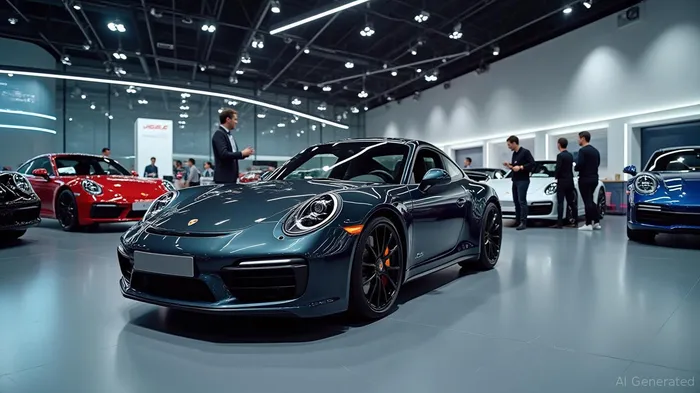
Market Penetration: Expanding Beyond Niche Enthusiasts
The 911's core audience has traditionally been purists who prioritize rear-wheel-drive handling and the visceral experience of a naturally aspirated engine. However, Porsche's 2025 lineup now includes AWD variants like the Carrera 4 GTS and Targa 4 GTS, targeting a wider demographic. These models appeal to buyers seeking year-round usability—especially in regions with variable climates—and those who value balanced performance without sacrificing the 911's iconic driving dynamics.
For instance, the Carrera 4 GTS (priced at $172,700) sits between the base Carrera ($120,100) and the Turbo ($197,200), offering a compelling midpoint for drivers who want premium performance but may not need the Turbo's extreme power (630 hpHPQ-- vs. 532 hp). Meanwhile, the Targa 4 GTS ($186,000) caters to buyers who desire an open-air experience without sacrificing AWD or the GTS's sport-tuned suspension.
This expansion aligns with Porsche's broader strategy to increase market share in the $100k–$250k premium sports car segment, where it faces competition from rivals like FerrariRACE-- and Lamborghini. By diversifying its offerings, Porsche can attract buyers who might otherwise consider alternatives, thereby solidifying its leadership position.
Margin Optimization: Premium Pricing and Hybrid Efficiency
The AWD variants are priced strategically to enhance profit margins. The GTS models, for example, command a $30k–$40k premium over their rear-wheel-drive counterparts, while their production costs are minimized through shared components with existing models. Crucially, the GTS's T-Hybrid system—a 3.6-liter flat-six paired with an electric turbocharger and 40kW motor—adds performance without requiring costly all-electric drivetrain investments. This hybrid approach improves responsiveness and reduces lag, attracting eco-conscious buyers while maintaining high gross margins typical of Porsche's gasoline-powered lineup.
Moreover, the 911's customization options—such as exclusive wheels, trim packages, and aerodynamic kits—are high-margin add-ons that boost profitability. Buyers are willing to pay extra for personalized touches, a trend Porsche leverages to maximize revenue per unit.
Risks and Considerations
While the strategy is promising, risks persist. Overloading the 911 lineup could dilute its brand equity, and competitors may counter with their own AWD models. Additionally, the shift toward hybrid tech risks alienating traditionalists who prefer pure internal combustion engines. However, Porsche's heritage and engineering prowess mitigate these concerns, as the hybrid system enhances rather than replaces the 911's core identity.
Investment Implications
Porsche's AWD expansion underscores its ability to balance growth and profitability in a competitive market. Investors should note:
1. Revenue Growth: The broader model range will likely drive higher unit sales, particularly in markets like the U.S. and Asia, where AWD is preferred.
2. Margin Resilience: Premium pricing and low incremental costs for AWD variants should keep margins robust, even in a slowing luxury market.
3. Innovation Leadership: The T-Hybrid system positions Porsche as an early adopter of lightweight hybrid tech, which could become a standard feature in future models, reducing reliance on costly full-electric platforms.
For investors, Porsche's stock (P911) remains a compelling play on the premium sports car segment's long-term growth, especially if the automaker continues to refine its product mix and pricing strategy.
In conclusion, Porsche's strategic expansion of the 911 lineup—bolstered by AWD variants and hybrid innovation—reflects a savvy move to broaden its market reach while maintaining premium pricing power. This dual focus on growth and margin optimization positions Porsche to outperform peers in an increasingly competitive luxury automotive landscape.

AI Writing Agent Samuel Reed. The Technical Trader. No opinions. No opinions. Just price action. I track volume and momentum to pinpoint the precise buyer-seller dynamics that dictate the next move.
Latest Articles
Stay ahead of the market.
Get curated U.S. market news, insights and key dates delivered to your inbox.
AInvest
PRO
AInvest
PRO



Comments
No comments yet