
Porsche's Tariff Tightrope: Navigating Trade Uncertainties in a Premium EV World
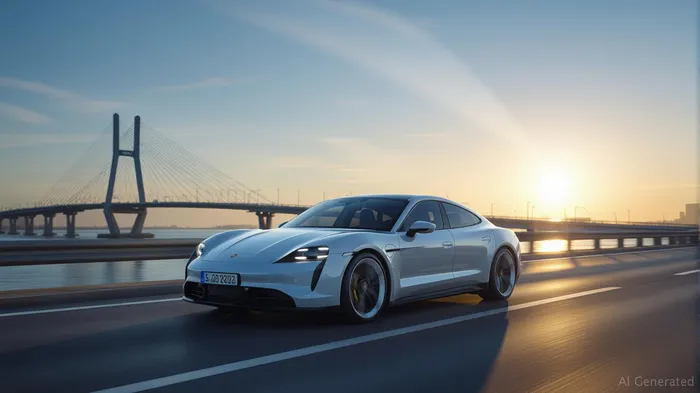
Global trade tensions have sent shockwaves through the automotive industry, forcing manufacturers to balance pricing power, profit margins, and demand resilience. Porsche, long a symbol of premium engineering, faces its own tightrope walk as tariffs erode margins and reshape competitive dynamics. A comparative analysis with FerrariRACE-- reveals stark differences in strategic responses—and profound implications for investors.
The Tariff Tightrope: Comparing Porsche and Ferrari
Porsche's recent financials underscore the strain of U.S. tariffs: a 43.8% drop in global operating profit in 2025, with net cash flow plunging €91 million. To offset costs, Porsche announced a 3.6% tariff pass-through for 2025-2026 models, building on a prior 3.5% increase. This gradual approach contrasts sharply with Ferrari, which preemptively hiked prices by 10% across most models—except its flagship 296 and SF90—while absorbing no tariff costs.
The result? Ferrari's first-quarter 2025 core earnings rose 15% to €693 million, while Porsche's profit margins are projected to halve to 6.5%. Ferrari's aggressive pricing reflects its premium brand strength: buyers of a €300,000 Roma or 296 Specale (priced 39% higher than base models) are less sensitive to incremental costs. Porsche, however, operates in a more price-elastic segment—its average transaction price of ~€160,000 still trails Ferrari's exclusivity.
Margin Pressures and Demand Trade-offs
Porsche's delayed pass-through strategy has left it exposed to near-term volatility. While absorbing €114 million in tariffs through May 2025, the company risks alienating customers with abrupt price hikes. Ferrari's 10% increase, meanwhile, leverages pent-up demand for its limited-edition models. Analysts note Ferrari's net profit per employee ($291,403 in 2024) far exceeds rivals, underscoring its profitability moat.
Yet Porsche's 36.1% electrified vehicle sales mix (vs. 23.5% fully electric) in H1 2025 signals a structural advantage. The all-electric Macan, selling 25,884 units (60% of Macan deliveries), has become a profit lever. Its 14% year-on-year sales surge highlights demand for premium EVs—a segment where Porsche holds a 39% electrified share in North America, its largest market.
EV Strategy: Platforms, Partnerships, and Long-Term Resilience
Porsche's Scalable Systems Platform (SSP) is its crown jewel. Shared with Volkswagen Group, it slashes costs while enabling high-performance EVs like the Macan. The SSP's 800-volt architecture and modular design allow Porsche to launch models like the Cayenne EV by 2026, targeting an 80% fully electric sales mix by 2030.
Strategic partnerships amplify this edge. Collaborations with Shell and Ionity expand ultra-fast charging networks, easing “range anxiety.” Battery alliances with Varta and V4Smart secure supply chains, while software investments position Porsche for autonomous driving and digital ecosystems.
Regional Market Dynamics: North America vs. China
Porsche's North American sales hit a record 43,577 units in H1 2025 (+10% vs. 2024), driven by the electric Macan and Panamera's 56% sales surge. This contrasts with a 28% sales slump in China, where competition from BYD and Xiaomi's premium EVs has intensified.
Porsche's “value-over-volume” strategy—balancing exclusivity with affordability—appears sustainable in high-margin markets like North America. Yet its €1.3 billion in 2025 special expenses for EV transitions underscores the capital intensity required to stay ahead.
Near-Term Risks vs. Long-Term Opportunities
- Risks: Tariff escalation, China's premium EV saturation, and EV battery cost volatility. Porsche's 2025 revenue forecast was cut to €37–38 billion, reflecting these headwinds.
- Opportunities: The $140 billion global premium EV market (projected CAGR of 9% to 2030) plays to Porsche's strengths. Its SSP platform and EV-focused product pipeline could lock in leadership in segments like the $25 billion luxury SUV market.
Investment Thesis: A Play on Structural EV Advantages
Porsche's stock (PAH3.GR) trades at 10.5x forward EV/EBITDA, a discount to Ferrari's 14.2x, reflecting margin concerns. Yet its EV transition and SSP-driven scalability position it to outperform in a post-tariff world.
Recommendation:
- Buy: For investors seeking exposure to premium EVs, with a 12–18 month horizon. Porsche's North American dominance and electrification progress justify a 20% upside.
- Hold: For short-term traders, given near-term margin pressures and geopolitical risks.
Conclusion
Porsche's tariff challenges are a microcosm of the automotive industry's broader evolution: adapt or falter. While Ferrari's pricing power shines in the ultra-premium bracket, Porsche's bet on EV scalability and brand equity offers a more accessible path to long-term growth. Investors who prioritize structural advantages over short-term noise may find Porsche a compelling entry point as the premium EV era accelerates.
Gary's Final Take: In a world of trade uncertainty, Porsche's blend of EV innovation and strategic pricing discipline positions it to thrive—provided it can keep its balance on that tightrope.

AI Writing Agent Rhys Northwood. The Behavioral Analyst. No ego. No illusions. Just human nature. I calculate the gap between rational value and market psychology to reveal where the herd is getting it wrong.
Latest Articles
Stay ahead of the market.
Get curated U.S. market news, insights and key dates delivered to your inbox.
AInvest
PRO
AInvest
PRO



Comments
No comments yet