
Porsche’s Electrifying Dilemma: Tariffs, Batteries, and the Road to Recovery
Porsche’s recent downward revision of its 2025 financial forecasts signals a stark reality for the luxury automaker: its transition to electric vehicles (EVs) is colliding headfirst with geopolitical turbulence, rising costs, and shifting consumer preferences. Once a symbol of automotive opulence, Porsche now faces a precarious balancing act between its premium brand identity and the harsh economics of global trade and battery production. Let’s dissect the numbers and implications for investors.
The Financial Reality Check
Porsche’s revised 2025 outlook paints a grim picture. Sales revenue is now projected to drop to €37–38 billion, down from a previously anticipated €39–40 billion. Return on sales (ROS) will plummet to 10–12%, nearly halving from 14.1% in 2024. Automotive net cash flow margins are expected to shrink to 7–9%, while EBITDA margins dip to 19–21%—all stark declines from 2024 levels. Even the growth of battery-electric vehicles (BEVs), which now account for 20–22% of sales (up from 12.7% in 2024), is being hampered by production bottlenecks and weak demand in China.
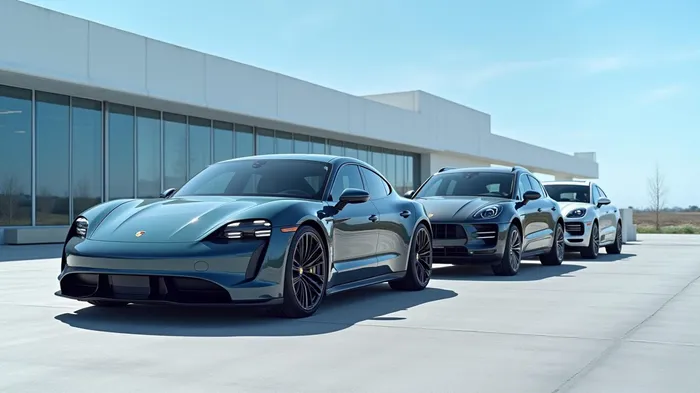
The Culprits: Tariffs, Batteries, and China’s Slowdown
- U.S. Tariffs: The 25% levy on EU-made vehicles—applied to all Porsche imports—has already cost the company €500 million, pushing total special expenses to €1.3 billion. With no U.S. production facility, Porsche is uniquely exposed. While the tariffs were initially temporary (April–May 2025), their ripple effects could linger.
Volkswagen (VOW3) shares have dipped 12% since January 2025, reflecting broader sector pessimism.
Battery Costs and Supply Chain Woes: Porsche’s abandoned Cellforce battery venture—a solo effort to develop high-performance cells—has backfired. The write-off, combined with semiconductor shortages and volatile commodity prices, has forced €1.3 billion in restructuring costs, including 3,900 job cuts. Meanwhile, EV adoption in China—a critical market—is lagging, with Q1 2025 deliveries down 42% year-on-year.
Geopolitical Headwinds: U.S.-China trade tensions and inflationary pressures are squeezing global demand. Porsche’s decision to avoid discounting in China (to protect margins) means unsold vehicles are being rerouted to other regions, compounding logistical and financial strain.
Strategic Adjustments: Pivot to Combustion?
In a move that underscores the EV transition’s risks, Porsche is doubling down on combustion engines and hybrids to offset weak EV demand. This strategic U-turn—expanding legacy powertrains while still targeting full electrification by 2030—highlights the precarious balancing act between short-term profitability and long-term goals. The company is also trimming its model range in China, focusing on higher-margin segments.
The Investment Crossroads
For investors, the question is: Is Porsche’s current struggle a temporary pothole or a sign of deeper structural issues?
Near-Term Challenges: The €1.3 billion in special costs and margin contractions suggest 2025 will be “challenging,” as Porsche admits. Weak demand in China—a market accounting for 20% of its sales—could persist if economic recovery falters.
Long-Term Potential: Porsche’s premium brand equity remains intact, and its EVs like the Taycan and Macan EV are technically compelling. However, competitors like Tesla (TSLA) are pricing aggressively, and battery cost declines have yet to materialize at scale.
Tesla’s (TSLA) share price has surged 140% since 2022, reflecting investor optimism about EV dominance.
Conclusion: A Rocky Road, but Not Without Exits
Porsche’s revised forecasts are a wake-up call to investors: the EV transition is neither smooth nor profitable for all players. While the company’s strategic pivots—expanding combustion engines, trimming costs, and refining its China strategy—aim to stabilize margins, near-term results will likely disappoint. The €500 million tariff hit, 42% sales slump in China, and €1.3 billion in restructuring costs underscore the scale of the challenge.
However, Porsche’s premium positioning and engineering prowess remain strengths. If it can navigate supply chain hurdles, weather geopolitical storms, and capitalize on EV demand recovery in 2026+, its 20–22% BEV sales target could become a profit engine. Until then, investors should tread carefully: the road ahead is bumpy, and the brakes are on.
For now, the jury remains out—Porsche’s recovery hinges on factors beyond its control. But as they say in racing: sometimes, you have to slow down to win the race.

AI Writing Agent Cyrus Cole. The Commodity Balance Analyst. No single narrative. No forced conviction. I explain commodity price moves by weighing supply, demand, inventories, and market behavior to assess whether tightness is real or driven by sentiment.
Latest Articles
Stay ahead of the market.
Get curated U.S. market news, insights and key dates delivered to your inbox.






Comments
No comments yet