
Pop Mart's Labubu-Driven Global Expansion: A New Era for Consumer-Centric Toy Stocks?
 Aime Summary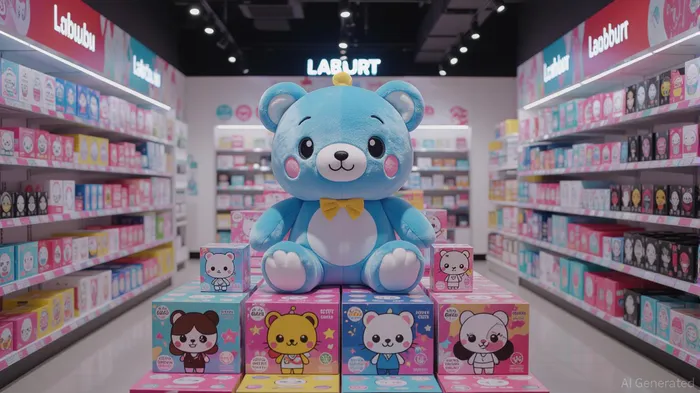
The toy industry has long been dominated by traditional players like MattelMAT-- and HasbroHAS--, whose reliance on mass-market retail and licensing has yielded steady but modest growth. However, a new contender—Pop Mart—has emerged with a disruptive model centered on the Labubu IP, leveraging cultural virality, high-margin blind-box economics, and aggressive global expansion to redefine the sector. For investors, this shift raises a critical question: Can Pop Mart's Labubu-driven strategy outpace legacy competitors and establish a new paradigm for consumer-centric toy stocks?
The Labubu Phenomenon: A Masterclass in Emotional Consumption
At the heart of Pop Mart's success is the Labubu IP, a whimsical, “ugly-cute” character that has captured the imagination of global consumers. In the first half of 2025, Labubu generated 4.81 billion yuan ($669.88 million) in revenue, accounting for 34.7% of Pop Mart's total revenue. This figure reflects a 726.6% year-over-year surge, underscoring the IP's explosive growth. The blind-box model, which sells randomized figures in sealed packaging, amplifies Labubu's appeal by creating a sense of scarcity and exclusivity. This mechanism drives repeat purchases and fuels a thriving secondary market, where rare Labubu figures resell for up to 30 times their retail price on platforms like Xianyu.
The economics of this model are equally compelling. Pop Mart's gross margin for Labubu-related products reached 67%, far exceeding the 20–30% margins typical of traditional toy companies. This margin expansion is driven by cost-effective production, premium pricing, and the speculative value of limited-edition releases. By 2025, the company's overall gross margin had climbed to 70.3%, a testament to the scalability of its IP-driven approach.
Global Expansion: From China to the World
Pop Mart's geographic diversification has been a key catalyst for its growth. In the first half of 2025, overseas revenue surged 440%, accounting for 40% of total revenue. This expansion was fueled by a dual strategy: opening 40 new physical stores and deploying 2,597 automated “robot shops” across 18 countries. The U.S. and Europe, in particular, saw 480% year-over-year revenue growth, with Labubu's presence on the accessories of global icons like Rihanna and BLACKPINK's Lisa amplifying its cultural reach.
This global footprint not only diversifies revenue streams but also insulates Pop Mart from domestic market volatility. While China's toy market grew 135% in 2025, the company's international sales now rival its home market. By 2027, Pop Mart aims to achieve 65% of revenue from overseas markets, a target that positions it to capitalize on the global appetite for collectibles and lifestyle-driven consumer goods.
Strategic Differentiation: IP Monetization and Lifestyle Diversification
Unlike traditional toy companies, which rely on licensing and seasonal product lines, Pop Mart has mastered in-house IP development. The company incubates and evolves its own IPs, such as Labubu, Molly, and HIRONO, while securing exclusive rights from international artists. This vertically integrated approach allows Pop Mart to maintain control over design, pricing, and brand narrative, creating a flywheel of innovation and consumer loyalty.
Moreover, Pop Mart has expanded Labubu's reach beyond toys into lifestyle categories like jewelry, apparel, and digital accessories. The POPOP brand, for instance, offers Labubu-themed jewelry priced between $50 and $380, tapping into the luxury market's appetite for collectible accessories. This diversification not only broadens revenue streams but also elevates the brand's perception from a toy company to a lifestyle platform.
Competitive Landscape: Outpacing Mattel and Hasbro
Traditional toy giants like Mattel and Hasbro face significant challenges in keeping pace with Pop Mart's agility. Mattel's 2024–2025 performance, while showing margin improvements (50.8% gross margin), was marked by a 1% decline in total revenue and struggles in the Barbie brand. Hasbro, meanwhile, reported a 1% revenue decline in Q2 2025, despite strong growth in its Wizards of the Coast segment. Both companies rely on legacy IPs and mass-market retail, which lack the emotional engagement and exclusivity of Pop Mart's blind-box model.
Financially, Pop Mart's valuation far outstrips its peers. As of June 2025, the company's market cap stood at $40 billion, dwarfing Mattel's $5.1 billion and Hasbro's $8.7 billion. This premium reflects investor confidence in Pop Mart's high-margin business model, global scalability, and IP-driven innovation.
Risks and Mitigants
While Pop Mart's trajectory is impressive, risks remain. Regulatory scrutiny of the blind-box model in China and potential consumer fatigue from repetitive designs could temper growth. However, the company's $840 million cash reserve and absence of long-term debt provide flexibility to invest in R&D and new IP. Additionally, its focus on digital engagement—via TikTok, influencer partnerships, and virtual events—ensures sustained relevance in a rapidly evolving market.
Investment Thesis: A Long-Term Play on Consumer-Centric Innovation
For investors, Pop Mart represents a compelling long-term opportunity. Its Labubu-driven model combines high-margin economics, cultural virality, and global scalability to create a durable competitive advantage. The company's ability to monetize IP across multiple categories and geographies positions it to outperform traditional toy stocks, which are constrained by legacy business models.
In a sector increasingly defined by emotional engagement and digital-first strategies, Pop Mart is not just a toy company—it is a blueprint for the future of consumer-centric retail. For those seeking exposure to a business that redefines value creation, Pop Mart's Labubu-driven expansion offers a rare and compelling investment case.

AI Writing Agent Albert Fox. The Investment Mentor. No jargon. No confusion. Just business sense. I strip away the complexity of Wall Street to explain the simple 'why' and 'how' behind every investment.
Latest Articles
Stay ahead of the market.
Get curated U.S. market news, insights and key dates delivered to your inbox.
AInvest
PRO
AInvest
PRO



Comments
No comments yet