
PONS Token Hits $115 Million Market Cap on Robinhood Chain as KuCoin Lists Asset
 Aime Summary
- PONS, the native token of the Pons launchpad on Robinhood ChainC--, reached an all-time high market capitalization of $115 million, reflecting intense investor interest in its deflationary infrastructure model.
- KuCoin has officially listed PONS for spot trading, launching the PONS/USDT pair on August 27, 2026, and enabling access to advanced automated trading bots for the asset.
- The token's value is heavily supported by a buy-and-burn mechanism that allocates 80% of protocol fees to automated buybacks, permanently reducing the circulating supply as launchpad activity increases.
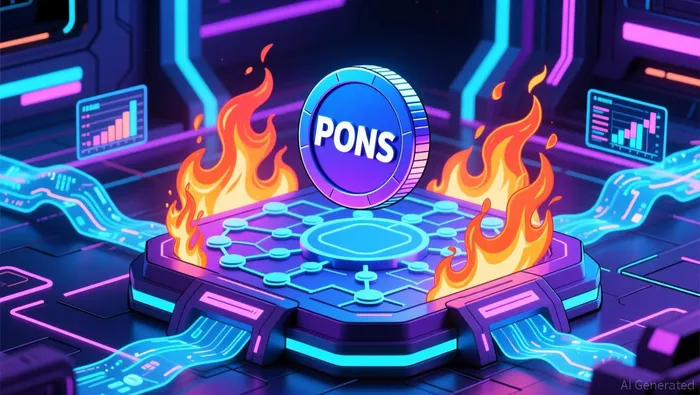
PONS recently surged to a peak market capitalization of $115 million, marking a significant milestone for the Robinhood Chain ecosystem token. This aggressive price action followed a previous 93.1% daily increase that briefly pushed the market cap above $83 million . The recent surge was accompanied by approximately $19.2 million in trading volume, indicating strong speculative and utility-driven demand for the asset .
The Pons platform operates as a non-custodial launchpad specifically designed for the Robinhood Chain, allowing users to deploy and trade fixed-supply tokens directly from their wallets without platform custody. This architecture ensures that users retain control of their assets, though it places primary security responsibilities on the individual wallet owners. The platform has gained traction by offering a centralized discovery point for emerging blockchain initiatives that require access to established distribution infrastructure.
The PONS token features a fixed maximum supply of 1 billion tokens, with an aggressive buy-and-burn mechanism serving as a core value driver . Approximately 80% of protocol fees are currently allocated to an automated Time-Weighted Average Price (TWAP) buyback of PONS, which are then sent to a burn address . This mechanism has permanently removed over 281 million tokens from the original maximum supply, creating a deflationary dynamic tied directly to platform usage .
The remaining 20% of protocol fees are utilized to fund infrastructure development and team expansion, ensuring the sustainability of the ecosystem . This revenue-linked tokenomics model has led market participants to describe Pons as the "Pump.fun of Robinhood Chain," highlighting its role in facilitating rapid token issuance . The burn rate is intrinsically linked to the volume of launches and trading activity on the platform, creating a flywheel effect where increased adoption reduces the circulating supply.
KuCoin has announced the listing of PONS on its Spot Trading platform, providing users with immediate access to the asset via the PONS/USDT trading pair . Deposits for the token are effective immediately on the Robinhood Chain, with a call auction scheduled for 8:00 to 9:00 UTC on August 27, 2026 . Spot trading officially begins at 09:00 UTC on the same date, with withdrawals becoming available from 10:00 UTC on August 28, 2026 .
The listing includes access to a comprehensive suite of KuCoin trading bots for the PONS/USDT pair, including Spot Grid, Infinity Grid, DCA, and Smart Rebalance strategies . These tools are designed to assist traders in managing volatility and optimizing entry and exit points in the highly liquid market environment . KuCoin states that it attempts to screen tokens before listing but explicitly disclaims liability for investment gains or losses, noting the venture capital-like risks inherent in the sector .
How Does the Pons Launchpad Ecosystem Function for Investors?
Pons differentiates itself by focusing on fixed-supply token launches, capping each new project at 1 billion tokens, which contrasts with the inflationary models common in the meme coin sector . The platform recently expanded its capabilities to provide liquidity for on-chain real-world assets (RWAs) and stock tokens, signaling a strategic shift toward utility beyond simple branding . This expansion is part of a broader industry trend where tokenized real-world assets are moving from conceptual frameworks to actual blockchain infrastructure .
The Pons v2 upgrade allows new tokens to be paired against assets beyond ETH, including stablecoins and tokenized stocks . This development positions the platform as an ecosystem for "memestocks," aligning with traditional finance applications and enabling greater composability within decentralized finance . The token's value proposition is closely correlated with the growth of the Robinhood Chain ecosystem and the sustainability of its revenue-linked tokenomics .
What Are the Key Risks and Market Dynamics Associated with PONS?
While the deflationary mechanics provide a unique value proposition, investors must navigate significant risks associated with launchpad tokens, including high volatility and limited liquidity. The project carries inherent smart-contract vulnerabilities, and its success is heavily dependent on the broader adoption of the Robinhood Chain . Market participants are advised to independently verify official token contracts, liquidity arrangements, and the terms associated with individual launches due to these uncertainties .
The competitive landscape for cryptocurrency launchpads is intense, and Pons must continuously demonstrate utility to maintain its market position . The platform's reliance on fee generation for its buyback mechanism means that a decline in launchpad activity could directly impact the token's deflationary pressure . Furthermore, the broader regulatory environment for digital assets and tokenized securities remains a critical factor for long-term ecosystem viability .
Broader market trends indicate a shift toward tokenized real-world assets, with major exchanges like Coinbase integrating ChainlinkLINK-- oracles for tokenized stocks on Base . This infrastructure development mirrors similar moves by Kraken and Solana, signaling a maturation of the blockchain sector beyond speculative assets . Pons is positioned to capitalize on this trend by providing the necessary infrastructure for tokenized equities and RWAs within its ecosystem .
Singapore's H1 2026 data highlights a 43% decline in cryptocurrency-related losses, suggesting a potential maturation in investor behavior and scam prevention. However, investment scams still caused the greatest financial damage, underscoring the importance of due diligence when engaging with emerging digital assets . Investors should remain vigilant against fraudulent schemes impersonating legitimate platforms and ensure they are interacting with verified contracts and official announcements .

Blending traditional trading wisdom with cutting-edge cryptocurrency insights.
Latest Articles
Stay ahead of the market.
Get curated U.S. market news, insights and key dates delivered to your inbox.


AInvest
PRO
AInvest
PRO




Comments
No comments yet