
Pons Surges Amid RWA Launchpad Competition And Senate Clarity Act Debate
 Aime Summary
- Pons ($PONS) surged 75% following the launch of nine new real-world asset (RWA) pairings on Robinhood Chain, including tokens linked to major equities like Amazon and Microsoft.
- Uniswap launched its own launchpad on Robinhood Chain, outperforming Pons in daily token volume and driving significant trading activity to its v4 protocol.
- Senate Majority Leader John Thune filed to schedule a procedural vote on the Clarity Act, aiming to establish a comprehensive federal regulatory framework for digital assets.
- Trump Media & Technology Group and Crypto.com terminated a $6.42 billion digital-asset treasury venture, citing unfavorable market conditions and shifting priorities .
Pons ($PONS) experienced a significant price surge, rising 75.68% in 24 hours to trade near $0.0324, driven by a fresh catalyst within the Robinhood ecosystem . The primary driver for this movement was the announcement that nine new real-world asset (RWA) pairings went live on Pons v2 . These include tokens linked to major equities such as Amazon, Microsoft, and Meta, expanding the platform's offering of stock-linked tokens trading on-chain . Over 250,000 tokens have now launched on the platform, signaling growing adoption of its RWA infrastructure .
Market data indicates high volatility consistent with thin liquidity . Trading volume reached $11.86 million, representing 48.4% of the market cap in a single day . Technical analysis shows a breakout from an ascending channel held since early August, with price spiking to $0.0349 before consolidating . The hourly RSI reads 61.94, suggesting momentum is present but not yet overbought . On the daily chart, price remains above the 20 EMA at $0.0282, maintaining a mildly bullish structure .
Key resistance levels are identified at $0.0442 and $0.0698, while support sits near $0.0243 and $0.0157 . Despite the bullish short-term structure, risks remain significant . The token has a circulating supply of 772.75 million out of a total 1 billion, with a market cap near $24.4 million . Liquidity against market cap is low at 10.55%, meaning slippage can be severe during volume spikes . The move relies heavily on sustained interest in the RWA narrative and specific integration progress, which lacks detailed public disclosure beyond the initial pairing announcements .
The competitive landscape for launchpads has intensified significantly with the entry of UniswapUNI-- Labs . Uniswap launched Pools.trade on August 5 on Robinhood Chain, immediately surpassing competitor Pons in daily token launches with 10,506 tokens compared to Pons' 7,210 . The new launchpad charges no fee, utilizing a 0.25% LP fee that autocompounds into locked liquidity, contrasting with Pons' 1% pool fee structure .
This launch marks a strategic shift for Uniswap, as it now operates a product in direct competition with applications built on its protocol . Founder Hayden Adams defended the move, arguing that high spreads like Pons' 1% fee facilitate extraction and worsen liquidity . He emphasized that Uniswap intends to continue supporting other launchpad builders .
The launch has driven substantial volume to Uniswap v4 on Robinhood Chain, which surpassed v3 in volume by August 6 . Meanwhile, Pons saw its token price drop 49% over the week prior to the RWA announcement . The event underscores the evolving relationship between core DeFi protocols and the applications that build upon them, raising questions about protocol neutrality and market competition .
On the legislative front, U.S. Senate Majority Leader John Thune (R-SD) has moved to advance a major legislative package that would create a comprehensive regulatory framework for cryptocurrencies . The legislation, known as the Clarity Act, aims to define when digital tokens are classified as securities or commodities and determine which federal regulators oversee them . If passed, this bill would mark a significant victory for the crypto industry and the current administration .
Thune filed to set up a key procedural vote on the bill for when the Senate returns from its August recess in mid-September . This procedural step is critical as it paves the way for a full floor vote . Senate Republican leadership believes they can secure the 60 votes required for passage, which involves winning the support of at least eight Democrats in addition to all voting Republicans .
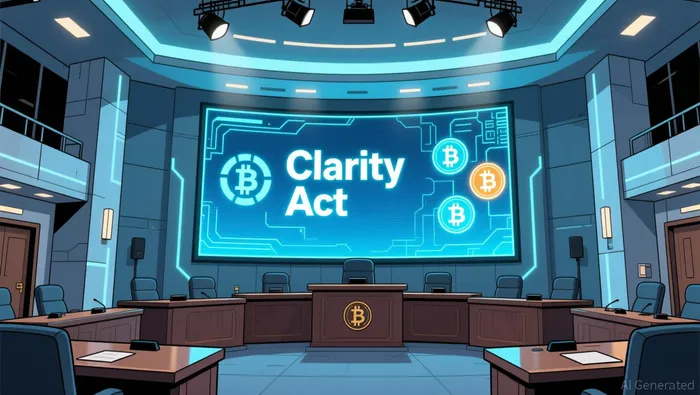
The Clarity Act represents the first attempt at a unified federal rulebook for digital assets in the United States . By clarifying regulatory jurisdictions, the bill seeks to reduce legal uncertainty that has historically hindered institutional adoption and innovation within the U.S. crypto market . The upcoming vote in September will be a decisive test of bipartisan support for crypto regulation .
Political dynamics surrounding the bill are complex, with Democratic senators linking their support to divestiture requirements for officials with crypto ties . This political friction coincided with the termination of a $6.42 billion digital-asset treasury venture between Trump Media & Technology Group and Crypto.com . The companies cited market conditions and shifting stakeholder priorities as reasons for the reversal .
The deal would have created Trump Media Group CRO Strategy, a publicly traded company focused on accumulating Crypto.com’s Cronos token . The cancellation occurs as Washington debates ethics restrictions for the crypto industry, with the White House rejecting allegations of conflicts of interest . The cancellation removes a major commercial link between the Trump media company and the crypto industry, though it does not resolve the broader legislative debate over ethics and regulatory oversight .
In the infrastructure space, BTCPay Server restricted public remote connections to Lightning Network nodes after attackers exploited a critical vulnerability to steal credentials and move funds. The update rotates macaroon credentials to mitigate further risk . This restriction prevents external wallets, such as Zeus, from connecting through BTCPay Server domains or Tor onion addresses on Docker deployments .
The vulnerability allowed unauthenticated remote attackers to obtain "macaroon" credential files used to control LND . Version 2.4.2 installs LND version 0.21.1 and automatically regenerates these credentials on standard installations . Operators are advised to check for unauthorized payments, unexpected channel closures, and balance discrepancies .
At least two operators, including BTCPay Foundation CEO Zach Herbert and Citadel21, reported losses . Herbert clarified that while its hot wallet was unaffected, its Lightning channels were closed and funds swept . These incidents affect software surrounding BitcoinBTC-- rather than the underlying protocol, following recent security issues with Coldcard hardware wallets .

Blending traditional trading wisdom with cutting-edge cryptocurrency insights.
Latest Articles
Stay ahead of the market.
Get curated U.S. market news, insights and key dates delivered to your inbox.


AInvest
PRO
AInvest
PRO




Comments
No comments yet