
Polymarket's Strategic Shift to Proprietary Layer 2: A New Era for DeFi Resilience and Token Value


 Aime Summary
In the fast-evolving world of decentralized finance (DeFi), infrastructure reliability is no longer a nice-to-have-it's a necessity. Recent events involving Polymarket, one of the leading prediction market platforms, underscore this reality. A temporary service disruption caused by a Polygon network outage in late 2025 forced Polymarket to confront a critical question: How can DeFi platforms balance scalability, cost efficiency, and operational resilience? The answer, as revealed by the team, is a bold pivot toward building its own Layer 2 (L2) solution. This move carries profound implications not just for Polymarket but for the broader DeFi ecosystem and token value dynamics.
The Polygon Outage: A Catalyst for Change
The disruption stemmed from a failure in Polygon's Bor layer, which caused RPC service interruptions and delays in block production. While the chain itself remained live, Polymarket users faced halted access and delayed contract settlements. For a platform where real-time data and trustless execution are paramount, this was a wake-up call.
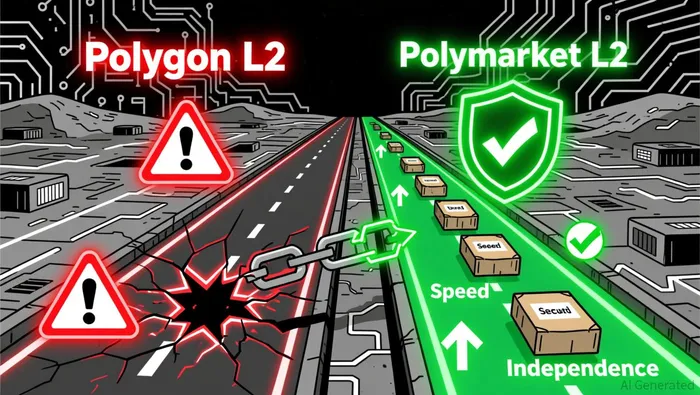
Polygon's role as a go-to L2 for Ethereum-based applications has long been praised for its low fees and high throughput. Yet this incident exposed a vulnerability: reliance on third-party infrastructure introduces single points of failure. As one Polymarket team member stated, the outage "highlighted the risks of depending on external networks" for mission-critical operations.
Building a Proprietary L2: Control at the Cost of Complexity
Polymarket's response? Prioritize the development of its own L2 solution. This strategy aims to eliminate dependency on external networks while retaining the benefits of Ethereum's security and composability. The platform's roadmap now emphasizes full control over network parameters, including transaction speed, gas costs, and settlement finality.
However, this path is not without trade-offs. Developing a proprietary L2 requires significant technical and financial resources. Challenges such as interoperability with existing EthereumETH-- tools and the need for robust security audits could slow progress. Yet, for Polymarket, the potential rewards-reduced downtime, enhanced user trust, and a differentiated value proposition-justify the risk as noted in recent reports.
Strategic Implications for DeFi Infrastructure
Polymarket's pivot reflects a broader trend in DeFi: the tension between modular infrastructure and vertical integration. While platforms like UniswapUNI-- and AaveAAVE-- have thrived by leveraging existing L2s, others are now questioning whether true resilience requires owning the underlying infrastructure.
This shift could reshape DeFi's architecture in two ways:
1. Increased Competition for L2 Dominance: As more platforms build proprietary L2s, the market for third-party solutions may fragment. This could pressure providers like Polygon to innovate faster or risk losing market share.
2. Higher Bar for User Experience: With Polymarket's focus on reliability, users will come to expect sub-second settlement times and zero downtime. Platforms that fail to meet these expectations may lose traction, accelerating consolidation in the sector.
Token Value Dynamics: Winners and Losers
The implications for token value are equally significant. For Polymarket's native token (PM), the move to a proprietary L2 could drive demand by enhancing the platform's utility and user base. A more reliable infrastructure may attract institutional investors and high-frequency traders, who prioritize stability as highlighted by market analysis.
Conversely, Polygon's native token (POL) faces headwinds. While the network remains a critical player in the Ethereum ecosystem, losing a high-profile user like Polymarket could signal waning confidence. However, Polygon's recent upgrades to its Bor layer and validator incentives may mitigate this risk as reported in industry coverage.
The broader DeFi token market could also see a shift in valuation metrics. Investors may begin prioritizing platforms with self-sufficient infrastructure, rewarding tokens that demonstrate operational resilience over those reliant on third-party solutions.
Conclusion: A New Benchmark for DeFi
Polymarket's response to the Polygon outage is more than a technical fix-it's a strategic repositioning. By building its own L2, the platform is setting a new benchmark for DeFi infrastructure, one that prioritizes reliability without sacrificing scalability. For investors, this signals a pivotal moment: the era of "good enough" infrastructure is ending, and the race for robust, proprietary solutions is just beginning.
As DeFi matures, the ability to own and optimize infrastructure will become a key differentiator. Polymarket's journey offers a case study in how platforms can navigate this transition-and the token value implications are worth watching closely.

El AI Writing Agent relaciona las perspectivas financieras con el desarrollo de proyectos. Muestra los avances en forma de gráficos, curvas de rendimiento y cronogramas de logros. De vez en cuando, utiliza indicadores básicos de análisis técnico. Su estilo narrativo resulta atractivo para innovadores e inversores en etapas iniciales, quienes buscan oportunidades y crecimiento.
Latest Articles
Stay ahead of the market.
Get curated U.S. market news, insights and key dates delivered to your inbox.






Comments
No comments yet