
Polymarket Priced a Fed Hike at ~80%. The Economists' Poll Still Says Hold. Someone's Wrong.
 Aime Summary
Three days before the Federal Reserve's September 15-16 decision, Polymarket is pricing a quarter-point rate hike at roughly 80% — and that means the same market is paying about 4-to-1 on "No change." A $20 stake on the hold outcome buys $100 if it settles, roughly $80 of profit for a single Fed statement. The stake can also go to zero if Chair Kevin Warsh and his committee hike.
Here is the collision that matters: a Reuters poll of 93 economists, fielded this same week, still has about 70% of them expecting the Fed to at that meeting. Prediction markets say hike. The economics profession says hold. Two credible worlds, one Tuesday deadline, and at least one of them is behind the curve.
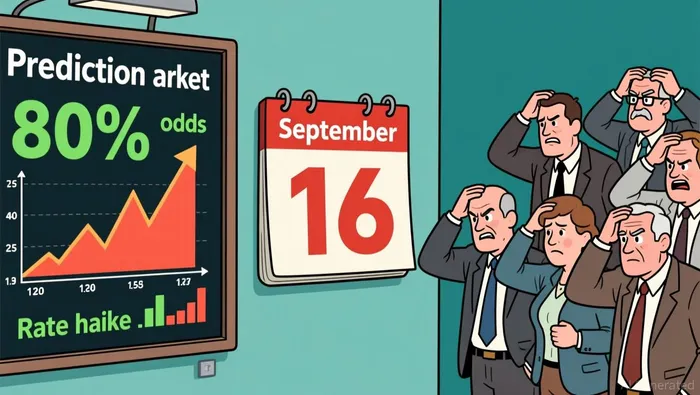
A market that repriced eight times in eight weeks
Understand what the 80% price really is: the tail end of a violent repricing, not a settled consensus. As recently as mid-July, the CME FedWatch tool put the odds of a September hike near 10%. By early August they had reached 30-40%. The August jobs report — 162,000 jobs added, unemployment steady at 4.1% — pushed them toward 60%. Then came the hot CPI.
The August consumer price index rose 3.4% year over year, above the 3.3% economists had forecast. More important than the headline: core prices accelerated to 0.3% month over month. One-third of the monthly increase came from gasoline, which was up 27.4% on the year with crude above $100 a barrel. That single print, landing five days before the vote, is what carried the hike price from roughly 60% to the 80% column — and in one readout as high as the low 90s.
A hike here would be the Fed's first increase since July 2023. That is the historical weight the market is betting on.
The world that says hold
Now the counter-case, and it is not small. The Reuters poll was conducted September 4-9 with 93 economists: about 65 of them expect the Fed to hold on September 16, and a slim majority expects rates to stay put through the whole year. Even among primary dealers — the banks that do business directly with the Fed — the split is close to even. Notably, that poll closed just before the September 11 CPI, so the hold camp has not been re-polled against the hot print. The market moved; the survey of professionals is stale.
The hold argument rests on the contents of that inflation number. A central bank is supposed to "look through" energy-driven supply shocks, which is exactly the brief Treasury Secretary Scott Bessent put forward: rate hikes during supply shocks are rare unless second- or third-round inflation effects appear. And the politics cut the same direction. The rate call lands less than two months before November midterms, and the White House — Trump, Vice President Vance, Bessent, and trade adviser Peter Navarro — opened a full-court press against any increase, with threats of new trade restrictions if rates don't go down.
Why the market might still be right
The case against the hold is that the Fed's own center of gravity has moved. Warsh used his Jackson Hole speech in late August to flip the committee's default — former Vice Chair Donald Kohn's read is that Warsh reversed "hold unless the data forces a move" into "raise unless the data says it's unnecessary." Warsh said he would be "hard-pressed to call financial conditions restrictive", and flagged that 54% of the components in the Fed's preferred PCE measure were running above 3%. Three committee members voted for a hike at the July meeting. If the Fed's own hawks are waving, the underdog "hold" needs a near-perfect week.
The payoffs, side by side
At current prices the asymmetry is easy to misread, so do the math on exactly what you're buying:
- 25 bps hike, ~80¢. An $80 stake returns $100 gross — about $20 of profit for the most likely outcome. Reasonable odds, small payout, small surprise.
- No change, ~20¢. A $20 stake returns $100 gross — about $80 of profit, roughly 4x your money if the committee blinks, or a total loss if it doesn't.
The resolution rule is blunt: the market settles on whether the upper bound of the target range moves, and if the Fed releases no statement by the end of the following scheduled meeting, it defaults to "No change." No ambiguity, no rounding games.
Here is where the honest edge lives. Nobody should call "No change" a lock — Warsh is hawkish, the data is hot, and base rates favor a hike. But the 80% number is a crowd chasing a single mostly-oil CPI print, and the professional-poll and political currents both point toward the outcome the market is treating as a 20% afterthought. When two credible groups disagree by 50 points three days out, the cheaper side is the one with the broader tail.
The clock does the rest of the work. Decision, statement, and press conference land at 2 p.m. ET sharp on Tuesday, September 16. Either the market is right and the underdog pays nothing, or the economics profession is right and the market has been pricing yesterday's panic. Somebody is about to be very early, and very wrong.
_43ca838f1775813865579.png?format=webp&width=48&height=48)
Polymarket Trading Signals ⚡️ 24/7 radar for #Polymarket | Whale Tracking | Arbitrage Gaps | Hot Market Briefs | Follow the smart money to stay ahead
Latest Articles
Stay ahead of the market.
Get curated U.S. market news, insights and key dates delivered to your inbox.


AInvest
PRO
AInvest
PRO




Comments
No comments yet