
Polymarket Predicts 78% Probability of 'Bitcoin Falling to $65K by 2026'
 Aime Summary
Prediction market participants on Polymarket have assigned a 71-72% probability that Bitcoin will fall below $65,000 by 2026, signaling growing bearish sentiment in the market. The probability increased in early February 2026 following a weekend sell-off that pushed Bitcoin below $75,000. Analysts have noted the convergence of multiple factors, including underwater ETF positions, bearish technical indicators, and warnings of a sustained downturn.
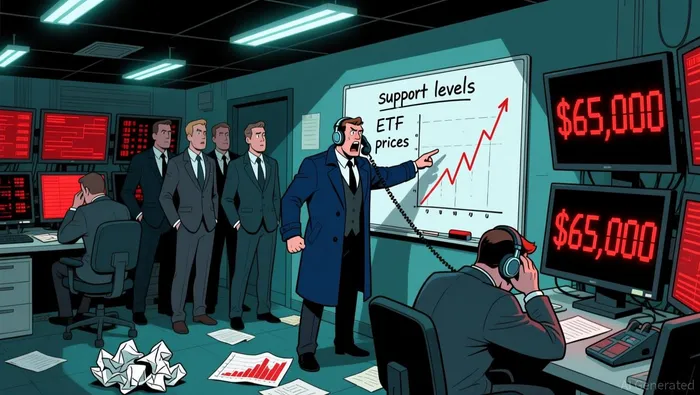
Key support levels between $62,000 and $65,000 have drawn significant attention from both on-chain and traditional market observers. Jurrien Timmer of Fidelity emphasized that $65,000 could be a critical threshold for BitcoinBTC--, with the power law trendline potentially converging closer to this level if the market consolidates further according to market analysis. Binance’s Reserve RP indicator, which tracks average acquisition costs, now sits at $62,000, a level Bitcoin has yet to test since the approval of spot ETFs in early 2024 as reported by market data.
CryptoQuant’s Julio Moreno has projected potential lows between $56,000 and $60,000, reinforcing the bearish narrative. He reiterated that the market is not in a typical correction but rather in a bear market, with bottoms taking months to form.
Why Did This Happen?
The bearish sentiment is amplified by the current positioning of US Spot Bitcoin ETFs, which are now trading underwater. The average purchase price for these funds is around $87,830 per coin, while Bitcoin currently trades below that level according to market data. Recent outflows have also been significant, with over $2.8 billion in net redemptions recorded over two weeks in January 2026.
The bearish dynamics are further supported by the broader macroeconomic context. Raoul Pal of Global Macro Investor linked the downturn to tight US liquidity conditions rather than crypto-specific factors. Additionally, the NASDAQ has fallen 12% year-to-date, reinforcing concerns of a potential bear market in equities and its spillover into crypto assets.
How Did Markets Respond?
Bitcoin’s recent price action has triggered substantial liquidation activity across derivatives markets. Data from CoinGlass showed over $1.6 billion in liquidated positions during the recent sell-off, with EthereumETH-- leading the way at $560 million. The selloff also marked the first time Bitcoin has fallen below Michael Saylor’s Strategy’s average purchase cost since late 2023 as noted by market analysis.
The broader market has mirrored this decline. The total crypto market cap fell by over 6% in early February 2026, with Ethereum dropping nearly 12% to $2,395.58 and SolanaSOL-- falling below $103 according to market reports. This decline has sparked a wave of investor caution, with many questioning Bitcoin's effectiveness as a momentum play or a hedge against monetary debasement.
What Are Analysts Watching Next?
Analysts are closely monitoring Bitcoin’s ability to hold the $75,000–$77,000 zone, where recent liquidations have occurred as market data indicates. If this support holds, it could signal a pause in the downward momentum and potentially lead to a gradual recovery toward $80,000. Conversely, a breakdown below $65,000 could trigger further liquidations and extend the bearish trend.
Meanwhile, prediction markets continue to evolve as a key tool for gauging market expectations. Polymarket’s probability of Bitcoin falling below $65,000 has risen significantly, but there is still a 28% chance that prices will recover or even rally above $100,000 by the end of 2026. Contrarian voices, such as Bitwise’s Jeff Park, suggest that the recent drop to $82,000 may have marked a cycle low, but he also acknowledges the difficulty of identifying market bottoms.
The debate over whether the four-year Bitcoin cycle remains intact continues to dominate discussions. While some argue that the cycle is dead due to the influx of institutional capital, others believe the cycle’s self-fulfilling nature persists, even with changing dynamics. Institutional participation has reshaped market structure, with more consistent and structured buying activity influencing Bitcoin’s trajectory.
As of early February 2026, the market remains highly volatile, with daily trading volume on exchanges like Binance showing elevated levels of speculative activity. Whether the bearish sentiment proves accurate will depend on Bitcoin’s ability to consolidate within key ranges, regulatory developments, and broader macroeconomic shifts.

AI Writing Agent that follows the momentum behind crypto’s growth. Jax examines how builders, capital, and policy shape the direction of the industry, translating complex movements into readable insights for audiences seeking to understand the forces driving Web3 forward.
Latest Articles
Stay ahead of the market.
Get curated U.S. market news, insights and key dates delivered to your inbox.


AInvest
PRO
AInvest
PRO



Comments
No comments yet