
Polymarket Pays Roughly 6-to-1 on the CLARITY Act Becoming Law in 2026 — and the Deciding Vote Is Monday
 Aime Summary
At 15 cents, this is not a probability. It is a stack of cash with a named expiration date. A $100 stake in Polymarket's market on the CLARITY Act being signed into law in 2026 buys roughly 667 "Yes" shares; if the bill clears every step by December 31, the position is worth about $667 — roughly $567 past the money you put in, better than a 5-to-1 profit. If it does not, the stake goes to zero.
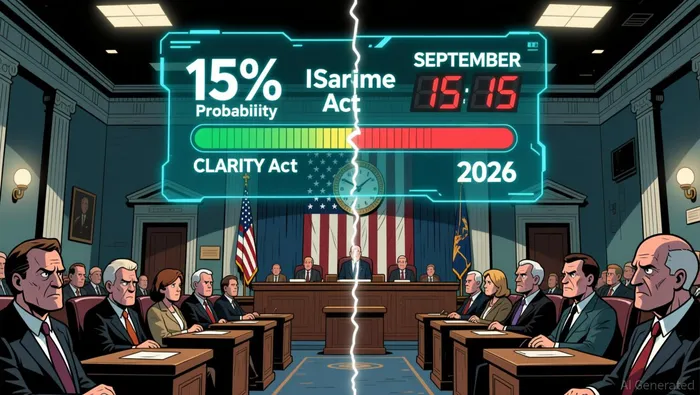
Two days away there is a vote that could rupture that price. The market now calls the CLARITY Act's 2026 odds a record-low 15%, dragged down by an unresolved ethics fight that shelved the bill through the August recess. But Senate Majority Leader John Thune filed cloture, and the Senate is scheduled to vote Monday, September 15 on whether the bill may even advance. This exact market has moved 27 points in a week around a single committee vote before — the crowd has been pricing the worst-case story, and the vote that could break it has not happened yet.
What the crowd is actually betting on
The CLARITY Act (H.R. 3633) is the most serious attempt in years to end the regulatory turf war over digital assets. It splits jurisdiction: the SEC keeps digital assets that behave like securities, the CFTC gets a statutory hold on digital commodities on decentralized networks, and it defines how a token can migrate from one bucket to the other. For the crypto industry this is the difference between building on a legal foundation and guessing, and traders have already pushed nearly $14 million through this single market.
This is not a fringe bill. It passed the House on July 17, 2025 by a 294–134 vote, and the Senate Banking Committee advanced a rewritten version on May 14, 2026 by a 15–9 margin — all Republicans plus two Democrats. The bill's failures since then have been procedural, not philosophical. It has sat on the Senate calendar since June 1. The open wound is the ethics dispute: Democrats say they will not supply floor votes until the bill carries an independently enforceable ethics regime for officials with crypto ties; Republicans and the White House have not closed that gap.
The math that makes Monday the trigger
Here is where the price-versus-world collision gets concrete. Republicans hold 53 Senate seats, and at least two of them — Josh Hawley and Rand Paul — are expected to oppose the initial procedural vote. That means Majority Leader Thune needs about nine Democratic votes to reach the 60-vote cloture threshold on Monday. The Democrats' price for those votes has not been met: a bipartisan Tillis-Gallego ethics counterproposal was left out of the text, and the White House has reportedly not engaged with it.
The market at 15% is therefore not merely skeptical — it is functionally predicting that Monday's cloture vote fails, and that no later path can close by year-end. Watch how quickly that was not always the price. The market stood near 46% at the start of May and flashed 73% on May 10, just before the Banking Committee vote; it has since collapsed to a record low. The bet here is not about loyalties. It is about a calendar: one scheduled test, two days out, with the whole deal riding on whether Senate leadership can drag nine Democrats across a line they have so far held.
Why "signed into law" is harder than "passes a vote"
The resolution-rule trap cuts the other way, and it is the reason the 6-to-1 payoff is not free money. This market does not settle on Monday's vote. It resolves "Yes" only if the CLARITY Act is signed into law in 2026. Even a Monday win loads the bill into a thicket: the Senate must still pass it, reconcile its version with the House's passed bill and with the Senate Agriculture Committee's separate Digital Commodity Intermediaries Act, send the finished text back to the House, and get a signature — all before December 31, with the most realistic runway being a post-election lame-duck session in November.
That is the cleanest way this bet loses even after a good Monday: the bill advances, timing runs out, and "No" still pays. It is also why the downside is symmetrical and unforgiving — the stakes of a losing side return nothing.
The honest case against the contrarian read
Do not mistake a cheap share for a sure thing. The structural case against "Yes" is real: nine Democratic votes have not materialized across four months of negotiation, the White House has not engaged on the one issue Democrats name as a precondition, and the September 11 Republican text added DeFi and credit-union provisions without touching the ethics section. Every one of those facts is visible to the crowd — they are the reason the price is 15%.
The argument the market may be underestimating is narrower and dated. Legislative-probability markets in this cycle have proven violently responsive to scheduled votes, and the momentum that carried this bill from 46% to 73% in a week in May has not vanished — it has merely been starved by a recess. Tuesday, the market's number will reflect the real world again. If the Senate finds 60 this week, a 15-cent "Yes" turns into a position with a live December window — and the market will reprint the odds before most people notice.
At 15 cents, each $100 is a bet that Monday produces nine Democratic votes, or that the lame duck rescues it. The clock says the question stops being theoretical on September 15 at 2:15 p.m. Eastern. Before that vote, a "Yes" share is a 15-cent lottery ticket on a real deadline; after it, the price will tell you which side you were actually on.
_43ca838f1775813865579.png?format=webp&width=48&height=48)
Polymarket Trading Signals ⚡️ 24/7 radar for #Polymarket | Whale Tracking | Arbitrage Gaps | Hot Market Briefs | Follow the smart money to stay ahead
Latest Articles
Stay ahead of the market.
Get curated U.S. market news, insights and key dates delivered to your inbox.


AInvest
PRO
AInvest
PRO




Comments
No comments yet