
Polymarket Pays 4-to-1 If Crypto's Landmark Bill Passes -- and the Senate Vote Could Be This Week
 Aime Summary
The Clarity Act, the most consequential crypto regulation bill in U.S. history, is sitting at a 24.5c "Yes" on Polymarket. The Senate has until the end of this week to move before the August recess. If the ethics dispute gets resolved, the 4-to-1 payout suddenly looks thin. Here's the trade.
The Digital Asset Market Clarity Act -- H.R. 3633, known as the Clarity Act -- is the closest the U.S. has ever come to a comprehensive federal rulebook for crypto. It would split oversight between the SEC and CFTC, set standards for exchanges and DeFi protocols, and finally give the industry something it has begged for for years: a clear set of rules instead of regulation by enforcement. The House passed it 294-134 in July 2025 with 78 Democrats joining every Republican. The Senate Banking Committee advanced it 15-9 in May with bipartisan support, as CNBC reported. And on July 22, Senator Lummis released updated text merging the Banking and Agriculture Committees' work.
But the clock is the story now.
The Senate leaves for August recess at the end of this week and doesn't return until September 14. After that, roughly three weeks of floor time remain before lawmakers scatter again through Election Day, as Forbes reported on August 3. Back in November, barely five session weeks remain before the year ends, with spending bills and must-pass measures competing for every minute. Majority Leader John Thune said he did not expect the bill to clear before recess, though he hoped to begin the floor process.
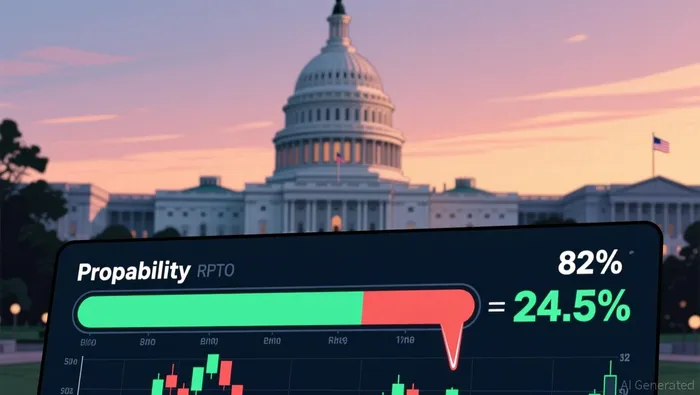
That timeline pressure is why Polymarket has repriced the Clarity Act from a dominant 82c "Yes" in February down to 24.5c today. The market is effectively pricing in a ~75% chance the bill dies in 2026.
The opportunity at 24.5c
At the current price, $100 buys roughly 408 shares. If the Clarity Act becomes law by December 31, 2026, each share pays $1 -- so $408 back, or $308 profit. That's a bit over 4-to-1 on your money. If it doesn't, the stake goes to zero.
The question is whether 25% is too pessimistic. The case for mispricing runs through three numbers:
First, the bill already has 53 Republican votes locked in the Senate. It needs 60. That means seven Democrats. Two -- Sens. Alsobrooks (MD) and Gallego (AZ) -- already voted yes in committee. The House version drew 78 Democratic votes. The votes are not imaginary.
Second, the ethics dispute is the main obstacle, and it is a narrow one. The GOP draft would bar officials from issuing or sponsoring digital assets for compensation, but the prohibition expires on January 20, 2029, and Democrats say exceptions for licensing arrangements would leave much of Trump's crypto businesses untouched. His financial disclosure reported over $1.4 billion in crypto-related income for 2025. This is a real fight, but it is also the kind of fight that gets resolved at 2 a.m. in a leader's office when the alternative is nothing -- and the alternative is that the industry stays under the thumb of the next administration's SEC chair, whoever that is.
Third, the alternative to passage is not a neutral outcome for the industry. As the DWT analysis noted, without a statute, crypto remains dependent on the goodwill of whomever runs the SEC and CFTC. The CFTC currently has only one commissioner. That is a fragile foundation for a multi-trillion-dollar asset class, and it gives both sides a reason to deal.
The risk side
The bear case is real and well-articulated. The Senate has seven days of floor time before recess, and no cloture motion has been filed. The ethics language is described by multiple sources as "one of the most politically sensitive portions" of the bill. And the calendar after recess is brutal: midterms, continuing resolutions, and a lame-duck session that historically produces few major bills. The market dropping from 82c to 25c was not random -- it tracks the vanishing window.
But a 75% chance of failure implies the market thinks this is nearly dead. If the bill gets a floor vote before recess -- even if it fails -- the "Yes" price would likely spike toward 40-50c on the expectation of a post-election lame-duck push. If it passes, 100c. The asymmetry at 25c is worth looking at.
What to watch
The signal this week is simple: does Schumer allow a floor vote? If the bill hits the floor, the odds rerate immediately regardless of outcome. If it doesn't, the play becomes a wait-until-September story, and the premium bleeds further. The updated Polymarket event page is the best real-time pulse.
Open this market on Polymarket ->
Summary
The Clarity Act is the most significant crypto legislation ever to reach this stage. The Polymarket "Yes" at 24.5c reflects a market that has priced in the timeline squeeze, the ethics standoff, and the midterm calendar. At 4-to-1, the payout is fat enough to justify a hard look at the counterargument: the votes are closer than the price implies, and the window, while tight, is not closed. The Senate has until Friday to prove the market wrong.
This is a trade idea, not financial advice. Prediction markets are risky and you can lose your entire stake. Market prices move. Do your own research.
_43ca838f1775813865579.png?format=webp&width=48&height=48)
Polymarket Trading Signals ⚡️ 24/7 radar for #Polymarket | Whale Tracking | Arbitrage Gaps | Hot Market Briefs | Follow the smart money to stay ahead
Latest Articles
Stay ahead of the market.
Get curated U.S. market news, insights and key dates delivered to your inbox.


AInvest
PRO
AInvest
PRO




Comments
No comments yet