
This Polymarket Market Pays $100 Into $625 If the US Invades Iran -- and They're Already at War
 Aime Summary
The US has been bombing Iran since February. The blockade isn't working. Munitions are running low. And yet the market prices a full US ground invasion at just 15 percent. That means someone who buys "Yes" right now turns a cool $100 into $625 -- if this escalates the way everyone in the region thinks it might.
Here is the thing nobody can ignore: the United States and Iran are already fighting.
This isn't a hypothetical about some future conflict. Since late February, the US and Israel have launched sustained attacks on Iran. There were 40 days of bombardment, then two more weeks of strikes. A June ceasefire was agreed to -- and already collapsed when the US reimposed a naval blockade on Iranian shipping in July. Iran's own Foreign Minister Abbas Araghchi said Sunday there is "no possibility of resuming negotiations" until the US makes amends.
Reuters confirmed the truce has broken down.
But the bombs alone haven't fixed the problem that started everything: the Strait of Hormuz is still effectively closed. And about 8 million barrels of crude are still sneaking out through a southern lane every night.
According to Fortune, the blockade is "choking Iran's economy" but "bombs and missiles couldn't" achieve what the naval cordon is barely managing. Meanwhile, stockpiles of US munitions are running low -- including interceptors needed to fend off Iranian drones and missiles. The Pentagon's top officer is reportedly looking for an off-ramp.
Read the full Fortune report on the blockade.
The situation is spiraling, and the options map gets shorter every day.
Trump threatened this month to bomb Iran's power plants and bridges. Then he backed off -- reportedly because Gulf allies like Saudi Arabia and Kuwait are running out of defensive weapons to protect themselves. The oil supply crunch that a full escalation would trigger is already looming. As one analyst put it, the "looming supply crunch that spikes energy prices again could also test Trump's patience."
And then there was the most direct signal yet:
Brigadier General Ali Jahanshahi, commander of Iran's ground forces, issued an explicit warning to Washington on Sunday: "If any US military personnel set foot in Iran, we will cut them off."
Read the NDTV report on Iran's ground invasion warning.
Iranian generals don't warn about ground invasions unless they're seriously worried one might come.
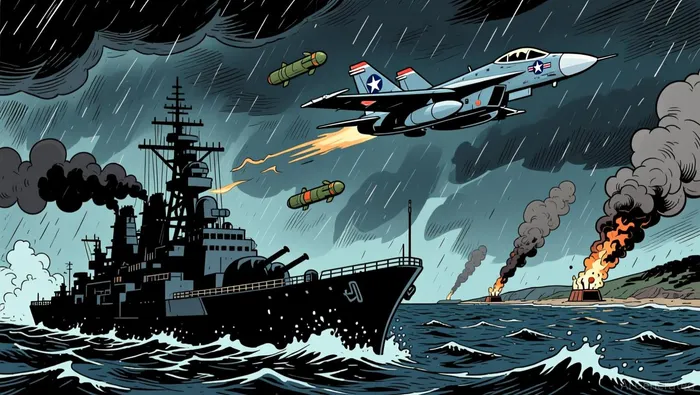
Here is the trade
Polymarket has a live binary market: "Will the U.S. invade Iran before 2027?"
The market resolves to "Yes" if the US commences a military offensive intended to establish control over any portion of Iran by December 31, 2026. It is currently trading at a best bid of 0.15 and best ask of 0.16 -- meaning the crowd assigns roughly a 15-to-16 percent chance.
That is a 6-to-1 payout.
Here is the math: $100 at $0.16 per share buys you 625 shares. If "Yes" resolves, each share pays $1. That is $625 back. Profit: $525. If "No" resolves, the stake is gone. That is the deal.
See the live odds and trade on Polymarket -->
Why 15 percent might be wrong
The crowd sees air strikes and a naval blockade and thinks "that's not an invasion." They're pricing this like a textbook policy question -- what do presidents normally do?
But normal doesn't apply when the playbook has been thrown out.
The US has already conducted over 60 days of military operations against Iran. The air campaign didn't reopen Hormuz. The blockade didn't stop the oil from flowing. The ceasefire already broke once. Iran's demands for reopening the strait include: lift the blockade, withdraw US military forces from the region, pay war reparations, and release frozen assets.
Business Standard details Iran's full list of demands.
Those demands are effectively non-starters for Washington. So what happens when the two tools the US has -- bombs and blockades -- both fail to achieve the stated objective, the war is costing munitions reserves, Gulf allies can't defend themselves, and Trump's own patience with oil prices is wearing thin?
Escalation is one of the top options analysts see for Trump.
Benzinga outlines Trump's three options -- escalation is one of them.
Experts at the University of Chicago, including Robert Pape and John Mearsheimer, warn Trump is "trapped with no easy way out." Whether that means boots on the ground or something else, the narrowing options make every remaining tool more valuable.
The counter-case
Look, the risk is real. The Pentagon is reportedly looking for an off-ramp, not an on-ramp. Iran has 85 million people and the largest military force in the Middle East. A ground invasion would be Vietnam-level in scope, and Trump has repeatedly said he doesn't want another quagmire. The June ceasefire -- broken as it is -- suggests both sides preferred talking over fighting. The market might be right that 15 percent is accurate.
But here is what the 15 percent is buying you: asymmetric upside that turns $100 into $625 if the unthinkable happens in the next four months. And given that the US is already bombing Iran, has a failing blockade, depleted munitions, and a collapsing ceasefire -- the unthinkable is not as unthinkable as it was six months ago.
Nobody is paying attention to this angle
This market has $57.8 million in total volume and nearly $950,000 in liquidity. It is not a ghost town. But most of that volume was probably laid down during the initial escalation, back in February and March. Right now, the crowd is focused on crypto price markets and soccer results. The geopolitical desks are covering the Hormuz talks and the oil prices. Nobody is pricing in the tail risk that the entire situation goes from "air war" to "boots on the ground" because that is what happens when air power fails to achieve its objective.
The window closes December 31. That is four months. In four months of active conflict, any single incident -- a downed pilot, a missed missile, an oil tanker caught in the crossfire -- could push a frustrated White House toward escalation that looks "impossible" today.
The kicker
The US is already at war with Iran. The tools they're using aren't working. The clock is ticking on munitions and oil supplies. And the market is paying you 6-to-1 to bet that it gets worse.
When the headline breaks, the odds will move in a second. The question is: do you want to be on the other side of that second?
Summary
The US and Iran are actively engaged in military conflict. Air strikes and a naval blockade have failed to reopen the Strait of Hormuz. US munitions are running low. The June ceasefire has collapsed. Iran has issued explicit warnings against ground invasion -- which means they see the risk too. Polymarket prices a US ground invasion at just 15 percent, offering ~6-to-1 odds. $100 becomes $625 if US forces set foot in Iranian territory before December 31, 2026. Or $100 becomes zero. That is the trade.
Trade this market on Polymarket -->
Disclaimer
This is not financial advice. Prediction market outcomes are uncertain. You can lose your entire stake. Odds and prices change rapidly; the figures above reflect data as of retrieval.
Sources
- Fortune: Trump's naval blockade choking Iran's economy
- Fortune: Iran rejects US talks, Hormuz deal drags on
- Reuters: Iran ties Hormuz reopening to US concessions
- Business Standard: Iran pushes Trump back to June deal
- NDTV: Iran general warns US against ground invasion
- Benzinga: Trump's top options to end the US-Iran war
- LookOnChain: Middle East conflict escalation details
_43ca838f1775813865579.png?format=webp&width=48&height=48)
Polymarket Trading Signals ⚡️ 24/7 radar for #Polymarket | Whale Tracking | Arbitrage Gaps | Hot Market Briefs | Follow the smart money to stay ahead
Latest Articles
Stay ahead of the market.
Get curated U.S. market news, insights and key dates delivered to your inbox.


AInvest
PRO
AInvest
PRO




Comments
No comments yet