
This Polymarket Bet Pays 4.6x if the Strait of Hormuz Reopens -- and the Clock Is Ticking
 Aime Summary
The Strait of Hormuz has been effectively shut for five months. The July 31 "back to normal" market just expired as a No. Now the Sept 30 deadline trades at 21 cents -- a 4.6-to-1 payout on a bet that still has a real path to winning. Here's the trade.
The world's most important oil chokepoint -- where roughly 20 million barrels of oil and 20% of the world's LNG normally transit daily -- has been in crisis since February 28, when U.S. and Israeli strikes on Iran under Operation Epic Fury triggered a near-total Iranian blockade. Pre-war, roughly 130 vessels crossed the strait per day. By early July, that number had collapsed to 5. By mid-July, Lloyd's List Intelligence reported zero vessels above 10,000 deadweight tons transiting the Southern Highway with AIS enabled. The strait is, for all practical purposes, closed.
But Polymarket has layered three deadline markets on top of the crisis, and the middle one is where the math gets interesting.
The September 30 market resolves to "Yes" if the IMF Portwatch 7-day moving average of transit calls hits 60 or more on any single day between now and September 30. That threshold is about half the pre-war normal -- the market doesn't need the crisis to fully end, just to ease enough that traffic can resume at a meaningful clip. The current price: 21.5 cents for Yes, meaning the crowd gives it about a 1-in-5 chance. Each winning share pays $1, so $100 at 21.5c buys about 465 shares. If it wins, that's $465 back -- a $365 profit, or roughly 4.6x.
The same question with a December 31 deadline trades at 57.5 cents, implying the market thinks the odds of a return to normal roughly triple if you give it an extra three months. The gap between the two -- 36 points of implied probability -- is the whole debate: does the crisis break by autumn, or does it drag on through year-end?
Why the September long shot could connect. The crisis is already five months old, and both sides have shown they can negotiate. The Islamabad Memorandum of June 17, signed by Trump and Iranian President Pezeshkian, briefly raised hopes of a resolution before it collapsed in July. The key threshold -- 60 transits as a 7-day moving average -- is deliberately modest. The pre-war normal was about 130, so this requires less than half the pre-crisis traffic. If a diplomatic window opens, or if the U.S. Navy's escort operations manage to restart meaningful transit, that number could be reached in days, not weeks.
Meanwhile, the costs of the blockade are compounding. War risk insurance has spiked to roughly 0.5% of vessel value -- four times pre-crisis levels. Emergency Conflict Surcharges run $2,000-$4,000 per container. Freight rates on Asia-Europe routes have surged 30-50%. An estimated 22,500 mariners were trapped on stranded vessels at the peak of the crisis. The economic pressure to find a resolution -- any resolution -- is immense.
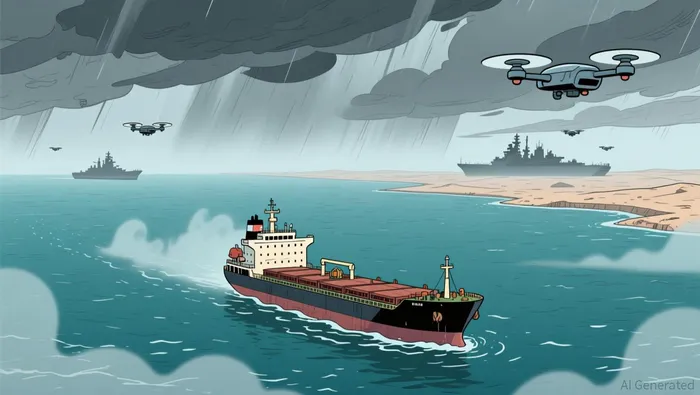
The other side of the trade. The counterargument is straightforward: this crisis has proven remarkably resilient to diplomatic solutions. The Islamabad Memorandum failed. A renewed ceasefire in late June collapsed within days when Iran's IRGC Navy redeclared the strait closed. Iran has been attacking commercial vessels consistently -- Wikipedia's timeline lists 58 ships attacked by Iran as of late July, with methods ranging from speed boats and missiles to naval mines and GNSS jamming. The IRGC has established a formal "Persian Gulf Strait Authority" to regulate maritime transit. This is not a crisis that is accidentally unresolved; it is being actively maintained.
The crowd's position. The Sept 30 market has seen $1.46 million in total volume and about $323,000 in 24-hour volume, with $298,000 in liquidity. The Dec 31 market trades at 57.5c with comparable liquidity. The spread between the two suggests the market sees a roughly 46% chance that if the crisis hasn't resolved by Sept 30, it resolves by year-end. That conditional probability feels thin given the current trajectory of resumed hostilities, but it's also not irrational -- these conflicts have a history of sudden diplomatic breakthroughs after long stalemates.
How to think about it. The Sept 30 "Yes" at 21.5c is a long shot with a defined catalyst and a concrete deadline. The payout is real: 4.6x on a move that could happen in days if a diplomatic or military breakthrough occurs. The Dec 31 "No" at 42.5c is the safer play -- it pays about 2.35x if the crisis drags through year-end, which the current trajectory makes look plausible. The honest read is that both sides have incentives to find a path forward, but the mechanisms for doing so have failed repeatedly. This is a trade idea, not a prediction -- the odds shift with every news cycle, and prediction markets are inherently risky.
Open this market on Polymarket ->
Summary
The Strait of Hormuz remains effectively closed after five months of crisis, with the July 31 normalization market having expired as No. The Sept 30 deadline trades at 21.5c for Yes -- a 4.6x payout on a bet that requires only 60 daily transits (half of pre-war normal) to win. With the economic toll compounding and diplomatic channels still open, the long shot has a real path, but the crisis has repeatedly resisted resolution.
This is a trade idea, not financial advice. Prediction markets carry risk. Odds and liquidity figures are as of August 2, 2026, and will have moved by the time you read this.
Sources
- Al Jazeera -- Strait of Hormuz traffic plunges as US, Iran resume fighting (July 10, 2026)
- Wikipedia -- 2026 Strait of Hormuz crisis
- Movargo -- Strait of Hormuz Shipping 2026: Crisis timeline and key facts
- Shipfinder -- Live Strait of Hormuz traffic tracker
- Polymarket -- Strait of Hormuz traffic returns to normal by September 30?
_43ca838f1775813865579.png?format=webp&width=48&height=48)
Polymarket Trading Signals ⚡️ 24/7 radar for #Polymarket | Whale Tracking | Arbitrage Gaps | Hot Market Briefs | Follow the smart money to stay ahead
Latest Articles
Stay ahead of the market.
Get curated U.S. market news, insights and key dates delivered to your inbox.


AInvest
PRO
AInvest
PRO




Comments
No comments yet