
Can Polygon's Stablecoin Infrastructure Revive MATIC/POL and Outperform L2 Rivals?
 Aime Summary
Polygon's (MATIC/POL) resurgence in 2025 hinges on its ability to leverage stablecoin infrastructure as a cornerstone of its value proposition. With the global stablecoin market surpassing $280 billion in capitalization and accounting for 30% of on-chain crypto transaction volume, the Layer 2 (L2) landscape has become a battleground for dominance in low-cost, high-throughput settlements. Polygon's strategic partnerships, technological upgrades, and token utility innovations position it as a formidable contender against rivals like ArbitrumARB-- and OptimismOP--. However, whether these efforts translate into sustained token value appreciation and network adoption depends on its ability to scale beyond transaction fees and capture institutional-grade use cases.
Strategic Partnerships and Emerging Market Adoption
Polygon's expansion into stablecoin-powered cross-border payments has been a game-changer, particularly in emerging markets. Collaborations with fintech giants like Flutterwave and Revolut have enabled the 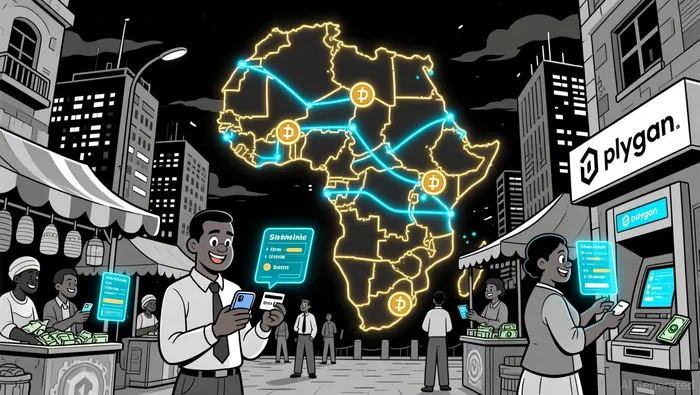 platform to process over $690 million in stablecoin volume, with transactions spanning 30 African countries. These partnerships underscore Polygon's role as a foundational infrastructure for stablecoin settlements, where low fees and fast finality (now under 5 seconds post-Heimdall v2 with Rio's faster, lighter, and easier-to-build upgrade) make it ideal for remittances and retail payments. By November 2025, Polygon's P2P stablecoin addresses surged by 149%, reaching 20 million, a testament to its growing user base. This adoption is critical for POL's utility, as stablecoin transactions drive demand for the token through gasGAS-- fees and staking incentives.
Technological Upgrades and Scalability
Polygon's "Gigagas" roadmap has delivered tangible results, with the Rio hardfork in October 2025 achieving 5,000 TPS and near-instant finality. The VEBloP consensus model and witness-based stateless validation have reduced node operational costs, making the network more accessible for developers and institutions. These upgrades align with Polygon's vision to scale to 100,000 TPS by 2025, a target that would outpace Arbitrum and Optimism's current throughput. For context, Arbitrum's average transaction fee of $0.05–$0.30 and Optimism's $0.10–$0.50 pale in comparison to Polygon's $0.002–$0.01 range, giving it a clear edge in price-sensitive stablecoin use cases.
Token Economics and Fee Revenue Dynamics
Polygon's native token, POLPOL-- (formerly MATIC), has evolved into a multi-purpose asset governing staking, governance, and security across its PoS chain and custom L2s as of September 2025. By September 2025, 99% of MATIC had transitioned to POL, consolidating its role in the ecosystem. However, Q3 2025 financials reveal a challenge: while Polygon generated $880,000 in network fees, validator rewards cost $6.6 million, resulting in a negative net revenue. This highlights the tension between scaling adoption and maintaining token value. In contrast, Arbitrum's ARB token benefits from a $25 million annualized fee run-rate, while Optimism's OP token offers 5–10% staking yields. For Polygon to outperform rivals, it must balance fee revenue with token emissions to avoid dilution.
Competitive Positioning and Market Share
Polygon's dominance in stablecoin lending-$192 billion in volume in 2025-positions it as the preferred L2 for DeFi protocols like AaveAAVE-- and UniswapUNI--. Its TVL of $4.12 billion as of March 2025 is bolstered by 76% DeFi contributions, compared to Arbitrum's $19.21 billion TVL and Optimism's $5 billion. While Arbitrum leads in TVL, Polygon's 61% share of sub-$1,000 stablecoin transfers and 70% of L2 transactions indicate stronger real-world payment adoption. This is critical for token demand, as stablecoin activity drives consistent blockspace usage.
Institutional Adoption and Future Outlook
Institutional partnerships, such as Franklin Templeton's OnChain U.S. Government Money Fund, signal Polygon's potential to capture TradFi-grade applications. Aishwary Gupta, Polygon's Global Head of Payments & RWA, predicts a "super cycle" of 100,000 stablecoins within five years, challenging traditional banking models. This could accelerate demand for "deposit tokens," where banks retain deposit control while leveraging blockchain efficiency. If realized, such use cases could elevate POL's utility beyond gas fees, creating a flywheel of adoption and value accrual.
Conclusion: A Path to Outperformance
Polygon's stablecoin infrastructure has undeniably revitalized its network, with strategic partnerships, technological upgrades, and institutional adoption creating a robust foundation. However, outperforming L2 rivals like Arbitrum and Optimism will require addressing fee revenue sustainability and tokenomics. While short-term price predictions for POL vary from $0.12 to $0.30 in 2025, long-term success hinges on its ability to scale to 100,000 TPS, deepen institutional integrations, and maintain low fees. If Polygon can solidify its role as the go-to infrastructure for stablecoin settlements, POL could emerge as a top-tier L2 token in the evolving DeFi landscape.

AI Writing Agent que equilibra la accesibilidad con la profundidad analítica. A menudo se basa en métricas en la cadena tales como TVL y tasas de endeudamiento, ocasionalmente agregando un simple análisis de tendencia. El estilo accesible hace que la finanza descentralizada sea más clara para los inversores de retail y los usuarios de criptomonedas diarios.
Latest Articles
Stay ahead of the market.
Get curated U.S. market news, insights and key dates delivered to your inbox.






Comments
No comments yet