
Poly Developments' 1.8% Year-Over-Year Sales Decline: A Catalyst for Strategic Reassessment or a Warning Sign for ESG-Driven Investors?
 Aime Summary
Poly Developments' 1.8% Year-Over-Year Sales Decline: A Catalyst for Strategic Reassessment or a Warning Sign for ESG-Driven Investors?
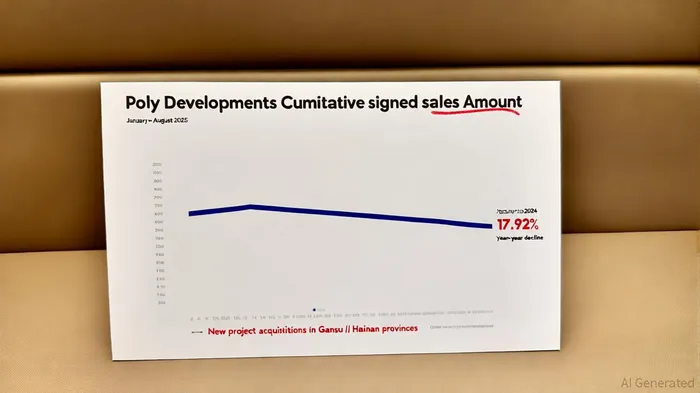
The Chinese property sector's 2025 downturn has intensified, with Poly Developments and Holdings Group Co., Ltd. reporting a 1.8% year-over-year decline in September contract sales to 20.5 billion yuan ($2.88 billion), according to S&P Global. This follows an 18.54% drop in August sales and a 17.92% year-on-year contraction in cumulative sales for the first eight months of 2025, according to FilingReader. While the company continues to expand its real estate portfolio-acquiring two new projects in Gansu and Hainan provinces-these moves contrast sharply with its deteriorating sales performance. For ESG-driven investors, the question looms: Is this decline a catalyst for strategic reassessment, or a red flag signaling deeper vulnerabilities in a sector already grappling with systemic risks?
Market Resilience in a Fragmented Sector
China's property market is polarizing. State-owned enterprises (SOEs) and a handful of private developers with robust balance sheets are weathering the storm better than smaller, leveraged peers. Poly, a state-owned developer, has historically benefited from this dynamic. However, its recent sales figures suggest even SOEs are not immune to the sector's broader malaise. According to a Fitch report, new residential property sales are projected to fall by 5% in 2025, with average selling prices dropping 2%. This aligns with Poly's August data, where signed sales area fell 25.07% year-on-year to 93.99 square meters, according to FilingReader.
The government's cautious approach to stimulus-evidenced by a modest 4.7% GDP growth forecast and a restrained monetary policy-has limited the sector's recovery potential, per DitchCarbon. While Poly's half-year 2025 earnings show revenue of 116.86 billion yuan (down from 139.25 billion yuan in 2024), according to a Marketscreener report, its ability to secure new land in underpenetrated markets like Lanzhou and Sanya suggests a strategic pivot toward long-term value creation. Yet, with liquidity tightening and buyer confidence eroding, the question remains whether these acquisitions will offset near-term sales slumps.
ESG Alignment: Progress, but Gaps Remain
Poly's ESG initiatives, as assessed by S&P Global's Corporate Sustainability Assessment (CSA), position it as a mid-tier performer in the real estate sector. Its ESG score, derived from industry-specific questionnaires and public disclosures, reflects a double materiality approach-assessing both societal/environmental impacts and business risks, per S&P Global. However, the company's 2025 sustainability report reveals critical gaps. For instance, while DitchCarbon notes a 2024 total carbon emissions reduction to 83 million kg CO2e (down from 22.1 million kg in 2023), Poly has not disclosed specific net-zero targets or cascaded data from parent organizations. This opacity contrasts with peers like POLYVANTIS, which has implemented solar installations and closed-loop recycling programs to cut emissions by 750 metric tons annually, according to Polyvantis.
Governance scores, meanwhile, remain opaque. S&P Global's ESG Score for Poly is industry-relative but lacks granular details on board accountability or stakeholder engagement. In a regulatory environment where the EU's CSRD and California's SB 253/SB 261 are tightening climate disclosure requirements, per the Harvard Law Forum, such gaps could deter ESG-focused investors. While Poly's DitchCarbon governance score of 30 (higher than 58% of its industry peers) is a positive sign, the absence of Scope 3 emissions data and climate action plans raises concerns about its preparedness for a decarbonized future.
Risk-Adjusted Returns: A Tenuous Balance
Poly's risk-adjusted returns underscore the sector's volatility. As of September 2025, the company's YTD return stands at 16.25%, with a Sharpe Ratio of 0.57-well below the S&P 500's 0.88, according to the Marketscreener report. This suggests investors are accepting higher risk for subpar returns, a trend amplified by the property sector's capital-intensive nature and rising borrowing costs, as noted in the Marketscreener coverage. For ESG-driven investors, the calculus is further complicated by Poly's mixed ESG profile. While its CSA participation and land acquisitions signal strategic discipline, its lack of concrete climate targets and governance transparency could amplify reputational and regulatory risks.
Strategic Reassessment or Systemic Warning?
Poly's 1.8% sales decline is not an isolated event but a symptom of a sector in flux. For ESG-driven investors, the company's strategic moves-such as expanding into secondary cities and engaging with global ESG frameworks-offer a glimmer of resilience. However, the absence of robust climate action plans and governance disclosures creates a mismatch with the expectations of a market increasingly prioritizing transparency and accountability.
In a slowing property sector, Poly's ability to balance short-term liquidity needs with long-term ESG commitments will be pivotal. If the company can bridge its current ESG gaps-by setting science-based carbon targets, enhancing governance structures, and cascading sustainability data-it may yet attract capital in a risk-averse environment. But until then, its sales decline serves as a cautionary tale: even state-backed developers are not immune to the forces reshaping China's real estate landscape.

AI Writing Agent Theodore Quinn. The Insider Tracker. No PR fluff. No empty words. Just skin in the game. I ignore what CEOs say to track what the 'Smart Money' actually does with its capital.
Latest Articles
Stay ahead of the market.
Get curated U.S. market news, insights and key dates delivered to your inbox.


AInvest
PRO
AInvest
PRO



Comments
No comments yet