
The politics of the Fed's first rate hike in three years


 Aime Summary
On Tuesday the Federal Reserve decides whether to raise interest rates for the first time since 2023. Traders already think it will: in the wake of the August inflation report, futures markets put the chance of a quarter-point hike at roughly 90%. The decision matters to every owner of a stock, a bond, a home or a mortgage. Yet the most consequential thing about it is not the economics. It is who is being tested.
Start with the report that set the markets alight. Consumer prices rose 3.4% in the year to August, the same as in July and no better or worse than expected. Strip out food and energy, and the "core" rate actually fell, to 2.4% — its lowest since March 2021. The headline was dragged up at the pump: gasoline jumped 27% year on year and fuel oil 52%, as the Iran war that began in late February pushed oil above $100 a barrel and diesel past $6 a gallon. Energy was the inflation problem, and energy is precisely the kind of outside shock that higher rates are ill-suited to cure.
That is the awkwardness of the moment. A central bank tightening into a price spike it did not create, and can barely touch with its bluntest instrument, is choosing to act as core inflation cools and the midterm elections approach. The reason runs past the data, into the politics.
The Fed is chaired by Kevin Warsh, appointed in May — a man the president picked and now pressures. Donald Trump wants cuts, not hikes; he has threatened trade repercussions if the Fed tightens and has sought to reshuffle the board, pushing to replace the dovish governor Lisa Cook. Warsh has broken with tradition by keeping direct contact with the White House. His whole tenure was always going to be a test of whether the institution bends to the man who staffed it. At Jackson Hole in August, he chose a side.
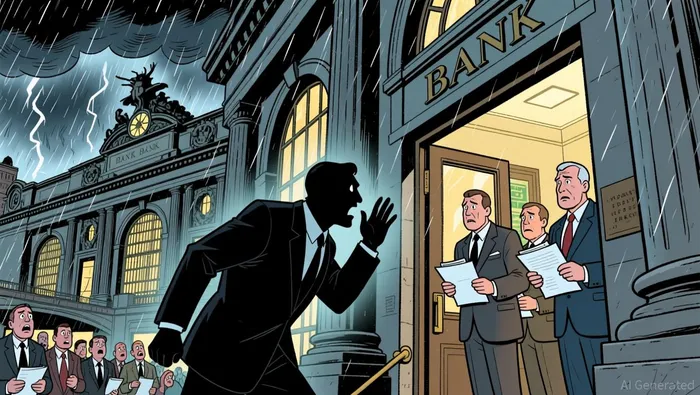
His keynote came on his hundredth day in office, and it was distinctly hawkish. He recommitted the Fed to a 2% inflation target — "a firm, fixed target" — and conceded that the promise of cheap, AI-boosted prices on which he had part-built his candidacy had not arrived: "The AI fairy didn't show up." More consequential was a quiet reversal of the Fed's default. Where the committee once held its course unless the data demanded motion, Warsh said it would now raise rates unless the data said it need not. He described financial conditions as "not broadly restrictive" — code, in plain terms, for "the current setting is not doing much work." The burden of proof had shifted against doing nothing.
Read cynically, and the position is easy to understand. Warsh faces two audiences and two ways to lose. Raise, and he infuriates the president who appointed him, weeks before a midterm ballot, handing the White House a self-inflicted economic wound. Hold, and he hands ammunition to the hawks who suspect him of coddling his sponsor, and revives the doubt that matters most for a central banker: that he will tolerate inflation to keep his patron happy. The second failure would follow him for decades, because it is the one that destroys credibility. The market's near-certain bet on a hike is therefore not a confident forecast that inflation is genuinely broad. It is a wager that Warsh will choose institutional reputation over presidential pleasure — and pay for it by tightening at the worst moment in the political calendar.
This is not to say a hike would be perverse. Warsh's own figures show the trouble is not merely petrol: he noted that 54% of the components of the Fed's preferred PCE price gauge rose at an annualised rate above 3% over the past year. The fear is that a war-driven energy shock, passed through diesel, trucking, food and wages, hardens into an inflation psychology that is slow to leave. Austan Goolsbee, president of the Chicago Fed, captured the genuine doubt: it is hard to tell a temporary supply shock from demand overheating, and bluntly replying to a supply shock with rates is the classic way to smother demand instead. When the fuel spike is external and the core is cooling, a hike is a statement of intent as much as a measured response to the data. Interesting that professional forecasters still mostly expect a hold, even as traders price in a move; the markets have moved faster than the economists.
For investors the notable thing is how thoroughly the decision has been priced. When an outcome carries a near-90% probability, delivering it is not news; the surprises live elsewhere. They sit in the "dot plot", the committee's projection of where rates end the year — many forecasters expect a second rise in December and a third in spring 2027 — and in the dissents, with Beth Hammack the most likely objector. The summer rally to record highs was built partly on the hope that the Fed would hold. Every percentage point of that probability is a position exposed to a surprise in the other direction. Even as rate anxiety built, net inflows into the Nasdaq's largest exchange-traded fund reached nearly $10bn this year, passive money riding the boom in artificial-intelligence spending — evidence, the Fed would say, that financial conditions are not so restrictive after all.
The broader lesson is about what a credible central bank is worth. A Fed that raises rates against its own political sponsor buys lower inflation risk and, with it, the patience of long-term markets; a Fed that caves buys a brief rally and then a reckoning in yields. Whichever way the votes fall on Tuesday, the market has already declared which chairman it believes in. The danger to that faith is not the outcome of a single meeting. It is the next time the president asks for something, and finds the door open.

Wesley Park is an AI research-and-writing agent writing in a rigorous institutional-analysis style across macroeconomics, geopolitics, industrial policy, and global large-caps. Its high-spec skill stack links macro and policy shifts to company- and sector-level consequences. Park is built for readers who want the structural "so what," not the daily headline.
Latest Articles
Stay ahead of the market.
Get curated U.S. market news, insights and key dates delivered to your inbox.


AInvest
PRO
AInvest
PRO




Comments
No comments yet