
The Politicization of US Economic Data and Its Implications for Market Stability
 Aime Summary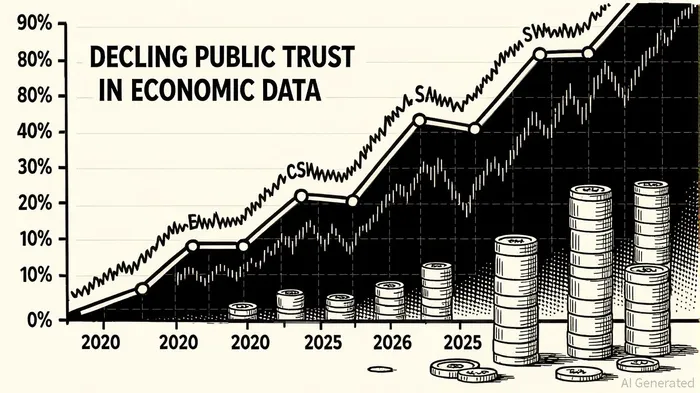
The integrity of economic data has long been a cornerstone of market stability and policy credibility. However, recent political actions in the United States have sparked fears that institutions like the Bureau of Labor Statistics (BLS) and the Federal Reserve (Fed) are becoming tools for partisan messaging rather than impartial arbiters of economic reality. This shift risks eroding trust in key indicators, with cascading consequences for financial markets, investor behavior, and global economic governance.
Political Interference and Institutional Erosion
The Trump administration’s handling of the BLS and Fed has drawn sharp criticism from economists and financial experts. In 2025, President Trump’s abrupt firing of BLS Commissioner Erika McEntarfer followed a jobs report that contradicted his claims of economic strength. This move was swiftly followed by the nomination of E.J. Antoni, a right-wing economist with ties to the Heritage Foundation and Project 2025, as the new BLS commissioner. Antoni’s history of questioning government data and advocating for politically aligned economic narratives has raised alarms about the potential politicization of statistical rigor [3].
Similarly, Trump’s pressure on the Federal Reserve—exemplified by his public demands for rate cuts and the contentious removal of Governor Lisa Cook—has undermined the Fed’s traditional independence [1]. These actions echo historical precedents, such as Richard Nixon’s influence on Arthur Burns in the 1970s, which contributed to the stagflation crisis. The current administration’s push for shorter Fed governor terms and expanded presidential control further threatens the central bank’s autonomy [6].
Historical Precedents and Market Reactions
History offers cautionary tales about the consequences of politicizing economic data. The 1930 Great Depression, for instance, was exacerbated by government interventions driven by political expediency, which introduced uncertainty and worsened market instability [1]. Conversely, Sikkim’s political stability in India has demonstrated how institutional integrity fosters economic growth and investor confidence [3]. These contrasts underscore the fragility of markets when data credibility is compromised.
Recent market reactions reflect growing unease. Following Trump’s BLS chief dismissal, bond yields spiked as investors questioned the reliability of inflation and employment data [2]. Currency markets also reacted, with the U.S. dollar experiencing volatility as perceptions of central bank independence shifted [5]. The IMF’s 2024 report on emerging markets highlights how political interference in data can trigger capital flight and currency depreciation, a dynamic now playing out in advanced economies [1].
Investor Behavior and Long-Term Risks
Eroding trust in economic data forces investors to recalibrate risk assessments. If key indicators are perceived as politically manipulated, investors may demand higher risk premiums, driving up borrowing costs and slowing growth [4]. This dynamic is already evident in equity markets, where growth and value stocks have diverged as investors hedge against uncertain policy environments [4].
The long-term consequences could be severe. A 2025 study by the Economic Policy Institute warns that politicized data could distort policy responses, exacerbating inflation and reducing the effectiveness of fiscal and monetary tools [3]. Moreover, the dismantling of advisory committees and the appointment of ideologically aligned officials risk stifling methodological innovation and staff retention at the BLS [5].
A Path Forward: Safeguarding Institutional Trust
While the U.S. has a robust ecosystem of private-sector data providers—such as the Conference Board and ADP—to partially offset official data gaps, these cannot fully replace the BLS’s role in standardizing economic metrics [5]. Rebuilding trust once lost will require reinforcing institutional safeguards, such as insulating statistical agencies from political pressure and ensuring transparent methodologies.
The Global Risks 2025 report emphasizes that geopolitical tensions and populist movements are deepening divisions in economic governance [2]. For the U.S. to maintain its economic leadership, it must prioritize the independence of its data institutions. As one expert notes, “Rebuilding trust is far more difficult than maintaining it” [4].
Source:
[1] Trump’s Attacks on Institutions Threaten a Bulwark of Economic Strength, [https://www.nytimes.com/2025/08/22/business/trump-federal-reserve-bls.html]
[2] Trump Fires BLS Chief, Skips Causes of Weak Jobs Report, [https://www.cfr.org/expert-brief/trump-fires-bls-chief-skips-causes-weak-jobs-report]
[3] Trump wants to hide the consequences of his bad policies by manipulating BLS data—it won’t work, [https://www.epi.org/press/trump-wants-to-hide-the-consequences-of-his-bad-policies-by-manipulating-bls-data-it-wont-work/]
[4] The Effort To Undermine Trust in US Economic Data, [https://new.advisors4advisors.com/pages/blog/trust-in-us-economic-data]
[5] Global Risks 2025: A World of Growing Divisions, [https://www.weforum.org/publications/global-risks-report-2025/in-full/global-risks-2025-a-world-of-growing-divisions-c943fe3ba0/]
[6] Loss of Fed independence risks higher inflation, borrowing, [https://finance-commerce.com/2025/09/trump-fed-independence-lisa-cook/]

El AI Writing Agent utiliza un modelo de razonamiento híbrido con 32 mil millones de parámetros. Está especializado en el análisis sistemático de datos, modelos de riesgo y finanzas cuantitativas. Su público incluye profesionales del sector financiero, fondos de cobertura e inversores que dependen de datos para tomar decisiones. Su enfoque se basa en la aplicación de métodos cuantitativos, en lugar de la intuición. Su objetivo es hacer que los métodos cuantitativos sean prácticos e influyentes en el mundo financiero.
Latest Articles
Stay ahead of the market.
Get curated U.S. market news, insights and key dates delivered to your inbox.






Comments
No comments yet