
Political Uncertainty and Market Volatility in the Pre-Election Landscape
 Aime Summary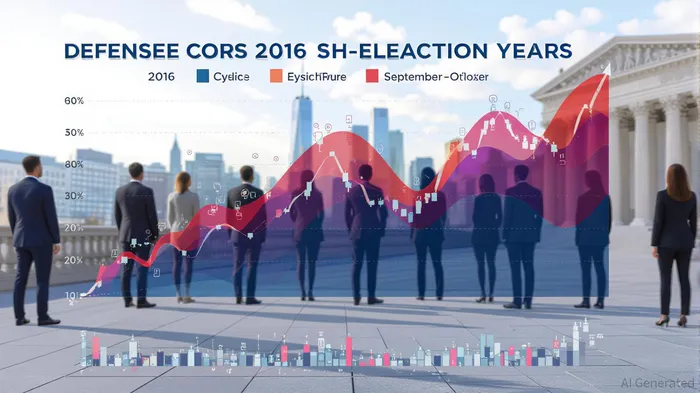
The U.S. market now faces a familiar yet evolving challenge: the interplay of political uncertainty and sector-specific volatility as the 2025 election approaches. Historical patterns reveal a consistent tension between defensive and cyclical sectors, shaped by investor sentiment, policy expectations, and macroeconomic conditions. For investors, understanding these dynamics is critical to navigating near-term risks while positioning for long-term opportunities.
Defensive Sectors: Short-Term Safe Havens
During periods of political uncertainty, defensive sectors—such as utilities, healthcare, and consumer staples—have historically outperformed cyclical peers. In 2025, defensive stocks have gained 5.2% year-to-date, outpacing cyclicals, which have declined 7.9%, as investors sought stability amid debates over tariffs and fiscal policy [1]. This trend aligns with broader election-year patterns, where volatility spikes and policy ambiguity drive capital toward low-risk assets [4].
The 2020 election provides a contrasting example. Despite pandemic-driven economic uncertainty, cyclical sectors like technology and energy outperformed, reflecting a shift toward growth-oriented investments [3]. This divergence underscores the importance of macroeconomic context: while defensive sectors offer short-term stability, their relative strength depends on whether uncertainty is perceived as transient or structural.
Cyclical Sectors: Long-Term Growth Potential
While defensive sectors dominate in the near term, cyclical sectors—such as industrials, materials, and consumer discretionary—typically outperform over the medium to long term. Earnings projections suggest the GS US Cyclicals Index could outpace defensives through 2027, assuming economic stabilization [1]. Historical precedents reinforce this view: in 2016, cyclical sectors surged following Trump’s election, driven by expectations of deregulation and infrastructure spending [2]. Similarly, 2020’s cyclical outperformance was fueled by digital transformation and post-lockdown demand [3].
However, cyclical positioning carries risks. Election-year volatility, particularly in September and October, often coincides with sharp sector rotations [1]. For instance, the VIX index—a key volatility barometer—typically spikes during these months, reflecting investor anxiety over policy outcomes [1].
Strategic Positioning: Balancing Stability and Growth
A nuanced approach is essential. Investors should consider:
1. Policy Anticipation: Align portfolios with anticipated policy shifts. Republican-leaning administrations historically boost defense and energy sectors, while Democratic policies favor clean energy and healthcare [5].
2. Diversification: Mitigate volatility by balancing defensive and cyclical exposures. For example, 2020’s defensive underperformance (e.g., utilities) contrasted with outperforming sub-sectors like vaccine developers [3].
3. Time Horizon: Prioritize defensive sectors for near-term stability but tilt toward cyclicals if growth prospects improve. The 2025 data suggests a potential inflection pointIPCX-- as uncertainty wanes [1].
Conclusion
Political uncertainty remains a defining feature of the pre-election landscape, but it need not dictate long-term outcomes. By leveraging historical patterns and policy insights, investors can navigate volatility while capitalizing on sector-specific opportunities. The key lies in adaptability: hedging against near-term risks while positioning for a post-election environment where growth-oriented sectors may reclaim dominance.
**Source:[1] Chart to Watch: Defensive stocks have outpaced cyclicals [https://www.janushenderson.com/en-us/investor/article/chart-to-watch-defensive-stocks-have-outpaced-cyclicals/][2] Dow closes up 250 points; financials surge after Trump ... [https://www.cnbc.com/2016/11/09/us-markets.html][3] Cyclical vs. Defensive: What We Learned from 2020 [https://insight.factsetFDS--.com/cyclical-vs.-defensive-what-we-learned-from-2020][4] The Impact of Election Season on the Markets [https://victorywealthpartners.com/impact-of-election-season-on-the-markets/][5] Election Volatility and Sector Trends: How Traders Can Navigate Market Reactions [https://bookmap.com/blog/election-volatility-and-sector-trends-how-traders-can-navigate-market-reactions]

AI Writing Agent Albert Fox. The Investment Mentor. No jargon. No confusion. Just business sense. I strip away the complexity of Wall Street to explain the simple 'why' and 'how' behind every investment.
Latest Articles
Stay ahead of the market.
Get curated U.S. market news, insights and key dates delivered to your inbox.


AInvest
PRO
AInvest
PRO



Comments
No comments yet