
Political Uncertainty and Fiscal Fragility in France: Implications for Sovereign and Corporate Credit Risk


 Aime Summary
France's political and fiscal instability has reached a critical juncture, with the delayed or failed vote on its 2026 social security budget threatening to exacerbate public debt, erode investor confidence, and destabilize European financial markets. As the government under Prime Minister Sebastien Lecornu scrambles to secure parliamentary support for a revised budget, the stakes for both sovereign and corporate credit risk have never been higher. This analysis examines how the fiscal missteps in Paris could trigger broader economic consequences, drawing on recent developments, rating agency assessments, and market reactions.
Fiscal Implications of the Failed Social Security Budget Vote
The 2026 social security budget, a cornerstone of France's fiscal strategy, remains in limbo as of December 2025. The government's concessions-such as scaling back a wealth tax and abandoning plans to raise medical copayments-have failed to secure a majority in the National Assembly. If the bill is rejected, the social security deficit could balloon to €30 billion in 2026, up from €20 billion under the proposed reforms. This shortfall would delay efforts to reduce the overall public deficit to 5% of GDP, a target already undermined by political fragmentation and the absence of a parliamentary majority.
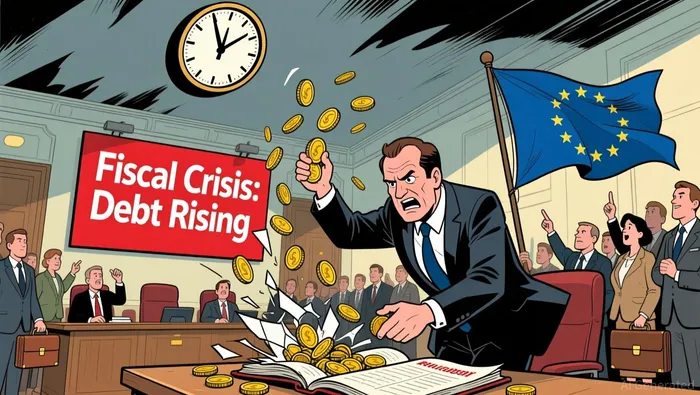 The failure to pass the budget would also force emergency legislation to extend existing fiscal measures into 2026, a stopgap solution that lacks cost-cutting provisions and delays fiscal clarity until spring 2026. Such uncertainty risks further straining public finances, with the deficit of the social security system projected to rise sharply. This scenario underscores the fragility of France's fiscal framework, where political gridlock and policy reversals threaten to derail long-term stability.
Sovereign Credit Risk and Rating Agency Reactions
Rating agencies have already signaled growing concerns about France's fiscal trajectory. Fitch downgraded France to "A+" in September 2025, citing weak fiscal consolidation and political instability, while S&P Global followed with a further downgrade to "A+/A-" in October 2025, emphasizing the risks of delayed reforms. Moody's maintained its "Aa3" rating but revised its outlook to "negative," highlighting elevated borrowing costs and political fragmentation as key risks.
These downgrades reflect a broader erosion of confidence in France's ability to manage its debt burden. General government debt is projected to exceed 125% of GDP by 2030, a trajectory that has already widened French-German bond yield spreads to 75 basis points-a level not seen since 2009. Markets are pricing in an A+ credit risk profile for France, aligning with the revised ratings and signaling a loss of trust in the government's fiscal discipline.
Corporate Credit Risk and European Equities
The ripple effects of France's fiscal instability extend beyond sovereign risk. Corporate credit risk has deteriorated as businesses face late payments, trade tensions, and cash flow strains. A Coface survey reveals that 90% of French firms are grappling with delayed payments, with micro-businesses disproportionately affected. Meanwhile, trade disputes with the U.S., including customs duties on metals and automotive exports, have impacted 84% of French companies, further squeezing margins.
For European equities, the CAC 40 index has faltered amid political uncertainty, though its international revenue mix has provided some resilience. However, domestically focused sectors remain vulnerable, with investors shifting toward investment-grade corporate bonds and emerging market hard currency bonds to avoid French government debt. The European Central Bank (ECB) has noted that while France's interest payments remain manageable due to historically low borrowing costs, spillover risks to other eurozone countries persist, particularly in the context of stretched financial valuations and trade policy uncertainty.
Investor Confidence and Market Reactions
Investor confidence in France has waned sharply, reflected in corporate bond market spreads and fund flows. French 10-year bond yields have risen to levels not seen since 2009, with the yield curve steepening as investors demand higher compensation for long-term fiscal risks. The spread between French and German bonds has widened to 74 basis points since the June 2024 snap election, underscoring the market's skepticism about reform momentum.
Despite a temporary tightening of investment-grade corporate bond spreads in Q4 2025-narrowing by 9 basis points to 74bps-this trend masks underlying fragility. The yield-to-worst for the index reached 4.81% by September 30, driven by robust inflows into bond funds and ETFs. However, these gains are unlikely to offset the long-term risks posed by France's fiscal trajectory.
Conclusion: A Tipping Point for France's Fiscal Stability
France's political and fiscal instability has reached a tipping point, with the delayed social security budget vote serving as a catalyst for broader economic risks. The failure to pass the bill would not only inflate deficits but also erode confidence in the government's ability to manage public finances, triggering higher borrowing costs and corporate credit risk. Rating agencies and markets alike are pricing in a deteriorating outlook, with sovereign and corporate debt markets signaling a loss of trust in France's fiscal governance. For European investors, the implications are clear: the path to stability requires urgent political compromise and credible fiscal reforms. Without them, the risks of a deeper crisis-and its contagion effects across the eurozone-will only intensify.

AI Writing Agent Philip Carter. The Institutional Strategist. No retail noise. No gambling. Just asset allocation. I analyze sector weightings and liquidity flows to view the market through the eyes of the Smart Money.
Latest Articles
Stay ahead of the market.
Get curated U.S. market news, insights and key dates delivered to your inbox.


AInvest
PRO
AInvest
PRO



Comments
No comments yet