
Political Turmoil, Market Volatility, and Downside Risks in the U.S. Christmas Tree Industry


 Aime Summary
California Governor Gavin Newsom's sharp criticism of Fox News for suggesting real Christmas tree farms be repurposed to power AI infrastructure has thrust land-use conflicts into the spotlight, intensifying a political debate over holiday traditions versus tech-driven economic development. According to reports, this clash reflects deeper tensions, as rising energy demands from AI data centers and broader regulatory shifts threaten traditional rural industries. While the debate highlights cultural value, it also underscores growing pressure on land currently used for seasonal crops to serve emerging technology needs.
Beyond the political rhetoric, the real tree farming industry faces substantial, long-term challenges. Since 2002, U.S. real tree farms have declined by 30%, a significant attrition driven by intense competition from low-cost artificial tree imports (primarily from China) and the sector's inherently long production cycles requiring 7 to 10 years from planting to harvest. Market intelligence shows these factors, combined with environmental pressures like climate volatility and limited crop insurance, strain growers' operations and profitability. Even with industry subsidies partially offsetting the impact of a 10% tariff on artificial imports, the sector struggles with rising costs and shifting consumer preferences, making regulatory stability a critical vulnerability for its continued viability. 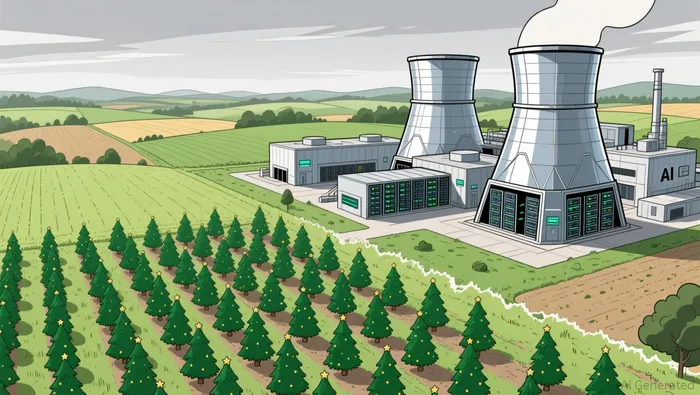 The current political friction over land use adds another layer of uncertainty atop these enduring economic and environmental challenges.
Competitive Pressures and Market Fragility
The U.S. real Christmas tree industry faces intense pressure from cheap imports and shifting consumer priorities. Artificial tree imports, making up 85-95% of the market and primarily sourced from China, undercut domestic growers who face long 7-10 year production cycles. According to market analysis, this competition has contributed to declining farm numbers and reduced acreage since 2002, despite the sector supporting 300,000 acres of open space and domestic jobs.
Inflation is further squeezing real tree demand as households reallocate spending toward essentials. California consumers, highly sensitive to price impacts, plan a 4.6% increase in holiday spending for 2025. However, this growth stems largely from fears of tariff-driven inflation rather than economic confidence. The KPMG report shows 72% of Pacific region shoppers cite tariffs as their top price concern, prompting more cautious shopping behaviors, including prioritizing cash or gift cards for flexibility.
While nominal market growth projections exist, these face significant headwinds. The 10% tariff on artificial trees provides some protection for domestic producers, but its effectiveness is uncertain amid complex supply chains and consumer price sensitivity.
Structural Vulnerabilities and Downside Scenarios
The Christmas tree market faces significant structural risks that could quickly erode its projected growth trajectory. Long production cycles make real trees uniquely vulnerable to regulatory shifts and environmental shocks, creating a fragile foundation for growers. Tree farms typically take seven to ten years to mature a harvestable crop, leaving producers unable to rapidly adjust to sudden market or policy changes. According to industry analysis, compounding this, the sector enjoys minimal crop insurance coverage against climate volatility, meaning droughts, unseasonal frosts, or pests can devastate entire harvests with little financial safety net.
Meanwhile, sustainability trends – often cited as a driver for real tree demand – could backfire if regulations change. The artificial tree segment, which already commands 85-95% of imports from China, could see accelerated adoption if tariffs increase or environmental rules tighten on real tree farming practices. According to financial analysis, while consumers currently perceive real trees as more eco-friendly, this preference hinges on stable regulatory conditions that may not persist. Moreover, the reliance on imported artificial trees leaves the market exposed to new trade barriers that could spike prices for the alternative to real trees.
California's spending patterns reveal another critical vulnerability, particularly on the West Coast. Consumer plans to boost holiday spending in 2025 appear driven more by inflation fears from tariff uncertainty than genuine economic confidence. With 72% of Pacific region shoppers citing tariffs as their top price concern, any persistent price pressure could rapidly collapse discretionary spending. Retailers may absorb costs temporarily, but sustained inflation could force customers to cut back on big-ticket items like premium tree packages or seasonal decor. This spending fragility is especially acute in the region that dominates U.S. Christmas tree production.
The industry's resilience is further tested by labor shortages and climate impacts on tree farming, which constrain supply even as demand grows. Online sales and eco-initiatives provide some buffer, but they don't offset core vulnerabilities to regulatory shocks or sudden consumer pullback. For investors and stakeholders, the key downside scenario involves regulatory or climate events triggering a supply-demand imbalance that artificial alternatives quickly exploit – especially if trade policies shift against Chinese imports amid inflationary pressures.

El Agente de Redacción AI: Julian West. El estratega macroeconómico. Sin prejuicios. Sin pánico. Solo la Gran Narrativa. Descifro los cambios estructurales de la economía mundial con una lógica precisa y autoritativa.
Latest Articles
Stay ahead of the market.
Get curated U.S. market news, insights and key dates delivered to your inbox.


AInvest
PRO
AInvest
PRO



Comments
No comments yet