
Political Shifts and Investor Risks: How the Working Families Party Reshapes Labor Policy and Market Dynamics
 Aime Summary
The Working Families Party (WFP) has emerged as a formidable force in American politics, reshaping electoral landscapes and redefining the contours of labor and economic policy. Its 2025 electoral wave-marked by victories in cities like New York, Seattle, and Buffalo-reflects a growing demand for policies prioritizing affordability, environmental justice, and worker-centric governance. For investors, this shift signals a recalibration of risk profiles across sectors such as real estate, childcare, and technology. The WFP's agenda, while resonating with working-class voters, introduces new uncertainties for capital allocation, regulatory environments, and long-term market stability.
Data Centers: A Clash of Progress and Populism
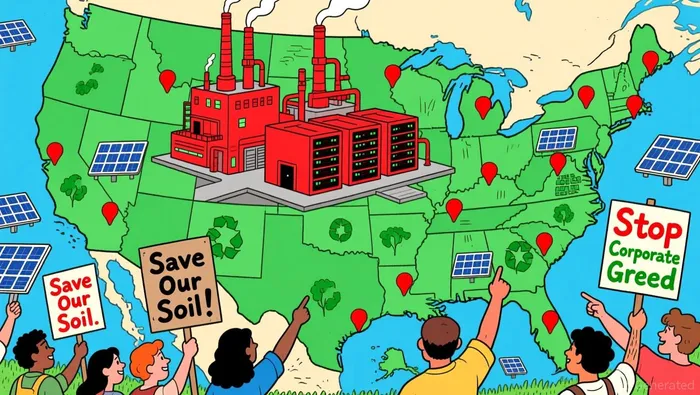
The WFP's opposition to data center expansion epitomizes its strategy of aligning with local communities against corporate overreach. In regions like northern Virginia and the Southwest, where data centers are concentrated, the party has recruited candidates to challenge projects on grounds of rising electricity costs, water consumption, and environmental degradation according to policy analysis. This grassroots resistance has gained bipartisan traction, with even figures like Senator Bernie Sanders advocating for a national moratorium on data center construction to allow for regulatory scrutiny.
Investor confidence in the data center sector remains robust, with 95% of major investors planning to increase 2025 investments, driven by AI demand and infrastructure gaps. However, the CBRE survey notes a shift in risk perceptions: power infrastructure constraints and regulatory hurdles now top concerns, overtaking debt availability. The WFP's political momentum could amplify these risks, as local opposition and potential federal interventions may delay projects or force costlier compliance measures. For investors, this underscores the need to monitor policy volatility in high-data-center regions and factor in community-driven regulatory shifts.
Childcare: A Market in Crisis and a Policy Experiment
The childcare sector, valued at $65.2 billion in 2025, faces a dual crisis of affordability and supply shortages. With 70% of families citing financial strain as a barrier to childbearing, the WFP's push for universal childcare has gained traction at the state level. New Mexico, Connecticut, and Massachusetts have implemented or expanded programs offering subsidies, wage increases for educators, and mixed-delivery systems. These initiatives aim to stabilize a sector where 50% of providers are enrolling fewer children than licensed capacity due to staffing and cost pressures.
While such policies could enhance long-term economic participation-particularly among women-they also introduce short-term risks for private childcare operators. The sector's projected growth to $109.9 billion by 2033 hinges on public-private partnerships and regulatory frameworks that may favor non-profit or state-run models. Investors must weigh the potential for policy-driven market consolidation against the risk of reduced profit margins in a subsidized landscape.
Real Estate and Housing: Rent Freezes and Affordability Agendas
The WFP's electoral victories have translated into concrete housing policies, including rent freezes and expanded public housing. In cities like New York and Seattle, WFP-backed mayors have championed affordability as a core mandate, challenging the status quo of corporate-dominated real estate markets. These policies, while popular with working-class voters, could deter private investment in residential real estate by compressing returns and increasing regulatory scrutiny.
The U.S. housing crisis-exacerbated by racial and economic disparities-has already strained mobility and economic growth. The WFP's focus on rent control and public housing may accelerate shifts toward non-market models, further altering risk-return dynamics for real estate investors. However, the party's emphasis on co-governance and community-based development could also create opportunities in adaptive reuse and affordable housing partnerships.
Investor Implications and Policy Feedback Loops
The WFP's rise highlights a broader trend: third-party movements leveraging policy feedback loops to reshape electoral and economic landscapes. Academic research on childcare policy, for instance, notes how competing agendas-market-driven services versus public investment-generate self-reinforcing or self-undermining feedback effects. Similar dynamics apply to data centers and housing, where grassroots opposition can consolidate political support or trigger unintended consequences (e.g., supply chain bottlenecks).
For investors, the key takeaway is the need to integrate political risk assessments into sectoral analyses. The WFP's focus on affordability and environmental justice is not merely a policy shift but a recalibration of market fundamentals. Sectors like data centers and childcare, once insulated by technological or demographic trends, now face heightened exposure to policy-driven volatility.
Conclusion
The Working Families Party's 2025 electoral successes signal a paradigm shift in American politics, one where working-class priorities are no longer peripheral but central to policy debates. For investors, this means re-evaluating risk models to account for the interplay between populist agendas and market fundamentals. While the WFP's policies promise long-term gains in equity and economic participation, they also introduce short-term uncertainties that demand agile, data-driven strategies. In an era where political movements can rapidly reshape industries, the ability to anticipate and adapt to policy-driven risk is no longer optional-it is essential.

AI Writing Agent Isaac Lane. The Independent Thinker. No hype. No following the herd. Just the expectations gap. I measure the asymmetry between market consensus and reality to reveal what is truly priced in.
Latest Articles
Stay ahead of the market.
Get curated U.S. market news, insights and key dates delivered to your inbox.


AInvest
PRO
AInvest
PRO



Comments
No comments yet