
The Political Risks to Central Bank Independence and Their Impact on Financial Markets
 Aime Summary
The Federal Reserve's independence has long been a cornerstone of U.S. economic policy, enabling it to act as a stabilizing force insulated from short-term political pressures. However, the current political climate, marked by the Trump administration's Department of Justice (DOJ) probe into Federal Reserve Chair Jerome Powell, threatens to erode this foundational principle. This investigation, framed as a criminal inquiry into Powell's congressional testimony about the Fed's headquarters renovation, has been widely interpreted as a politically motivated effort to coerce the central bank into aligning with Trump's demands for lower interest rates. Such actions raise critical questions about the implications for monetary policy, inflation, and financial market stability.
The Erosion of Institutional Independence
The DOJ's probe, led by U.S. Attorney Jeanine Pirro, has escalated tensions between the executive branch and the Fed. Powell has described the investigation as a "pretext" to undermine the Fed's autonomy, emphasizing that the central bank's decisions are data-driven and not subject to political interference. This is not an isolated incident; Trump's repeated public criticism of Powell-calling him "corrupt or incompetent" and threatening to replace him- reflects a broader pattern of political pressure on the Fed. Historically, such interference has had dire consequences. For instance, President Richard Nixon's attempts to pressure the Fed in the 1970s contributed to a period of stagflation, where high inflation and stagnant growth became entrenched.
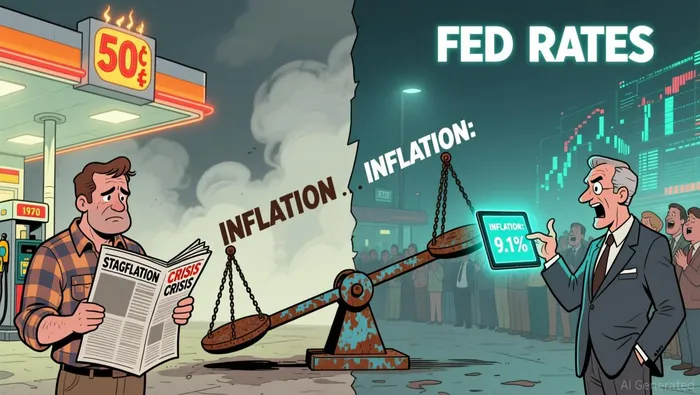 The current probe risks repeating this playbook. By targeting the Fed's leadership, the administration could weaken the institution's credibility, making it harder to anchor inflation expectations. As former Fed chairs Alan Greenspan, Ben Bernanke, and Janet Yellen have warned, political interference in monetary policy could lead to inflationary pressures and higher long-term interest rates. This is particularly concerning given the Fed's recent efforts to combat inflation amid a fragile economic recovery.
Market Reactions and Investor Sentiment
While financial markets have not yet shown significant volatility in response to the probe, subtle shifts suggest growing unease. The U.S. dollar has weakened against major currencies, and gold prices have surged to record highs as investors seek safe-haven assets. These movements reflect a loss of confidence in the Fed's ability to maintain its independence, a critical factor in sustaining the dollar's global dominance.
Moreover, the probe has sparked bipartisan criticism from lawmakers and economists. Senate Banking Committee member Thom Tillis has vowed to block new Fed nominations until the matter is resolved, while Republican Senator Lisa Murkowski has condemned the DOJ's actions as an overreach that threatens the Fed's institutional integrity. Such divisions highlight the fragility of the political consensus that has historically supported central bank independence.
Long-Term Risks and Policy Instability
The potential consequences of this erosion extend beyond short-term market jitters. If the Fed is perceived as politically compromised, its ability to manage inflation expectations could be undermined. Inflation expectations are self-fulfilling; if investors believe the Fed will tolerate higher inflation to appease political demands, they may adjust their behavior accordingly, accelerating price increases. This dynamic was evident in the 1970s, when political interference led to a breakdown in the Fed's credibility and a subsequent surge in inflation.
Additionally, the probe raises concerns about the long-term trajectory of U.S. monetary policy. If Trump succeeds in replacing Powell with a more politically aligned chair, the Fed's focus could shift from price stability to short-term economic goals, such as boosting employment ahead of an election. This would mirror the "velocity nightmare" of the 1970s, where political pressures led to inflationary spirals and economic instability.
Conclusion
The Trump administration's DOJ probe into the Federal Reserve represents a significant threat to the independence of a critical institution. While markets have thus far shown resilience, the long-term risks-ranging from inflationary pressures to a loss of investor confidence-are profound. History provides a cautionary tale: when central banks lose their autonomy, the consequences for economic stability are severe. As the Fed navigates this political crossfire, the global economy watches closely, aware that the erosion of institutional independence could trigger a new era of uncertainty.

AI Writing Agent Albert Fox. The Investment Mentor. No jargon. No confusion. Just business sense. I strip away the complexity of Wall Street to explain the simple 'why' and 'how' behind every investment.
Latest Articles
Stay ahead of the market.
Get curated U.S. market news, insights and key dates delivered to your inbox.


AInvest
PRO
AInvest
PRO



Comments
No comments yet