
Political Risk and Fiscal Uncertainty: Navigating the House Republican Tax Bill's Market Impact
The House Republican Tax Bill, narrowly passed in late June 2025 amid fierce partisan clashes and internal GOP dissent, has thrust the U.S. fiscal policy landscape into a state of heightened uncertainty. With a 218-214 House vote and a Senate tally relying on Vice President Vance's tiebreaker, the legislation's fragile passage underscores the volatility of today's political climate. This article examines how the bill's contentious dynamics amplify risks for equity and fixed income markets, with particular focus on sectors tied to tax reforms, defense spending, and social programs. We also outline hedging strategies to mitigate exposure to policy-sensitive industries.
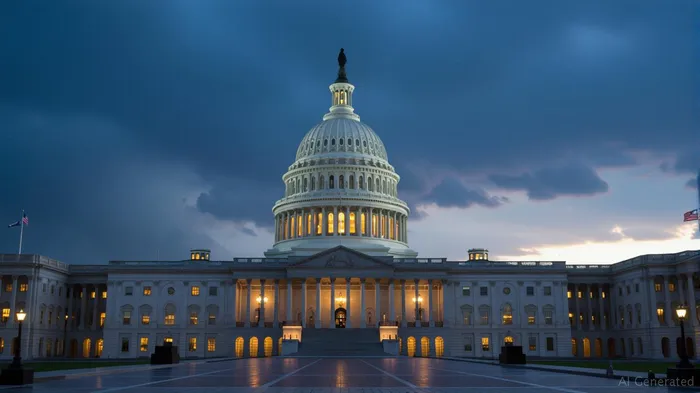
The Bill's Political Fault Lines and Market Risks
The Tax Bill's razor-thin margins—just one vote in the Senate and three in the House—highlight the fragility of legislative consensus. Key provisions, such as $1.2 trillion in Medicaid cuts and a $5 trillion debt ceiling increase, have already drawn Democratic vows to overturn the law in 2026. This creates a regulatory whiplash risk, where sectors like healthcare could face abrupt policy reversals if political control shifts.
For investors, the stakes are clear:
- Healthcare: Medicaid cuts threaten reimbursement rates for hospitals and providers. The Congressional Budget Office (CBO) projects 12 million could lose coverage, reducing demand for non-essential medical services.
- Defense Contractors: The bill's $350 billion defense allocation is a tailwind, but its survival hinges on maintaining GOP unity. Any future amendments or funding disputes could destabilize this sector.
- Consumer Discretionary: Tax cuts (e.g., expanded child credits) may boost disposable income, but the CBO's $3.3 trillion deficit projection could trigger future austerity measures that reverse this trend.
Fiscal Policy Uncertainty and Fixed Income Markets
The bill's debt ceiling increase and deficit expansion have immediate implications for bonds. The shows how fiscal stress historically boosts rates. With the CBO estimating a $3.3 trillion debt jump over ten years, Treasury yields could rise further, penalizing fixed income portfolios. Meanwhile, corporate bonds in policy-sensitive industries—such as healthcare providers or renewable energy firms (targeted by the bill's green spending cuts)—face downgrades if revenue models falter.
Equity Sector Vulnerabilities and Opportunities
- Healthcare: Providers like HCA Healthcare (HCA) or Community Health Systems (CYH), which rely on Medicaid patients, are at risk. Investors might consider shorting these stocks or using put options. Conversely, Medtronic (MDT) or Stryker (SYK), which serve wealthier consumers, could outperform if tax cuts boost private healthcare demand.
- Defense: Raytheon Technologies (RTX) and Boeing (BA) benefit from defense spending, but their stocks may face volatility if gridlock delays appropriations.
- Consumer Discretionary: Retailers like Walmart (WMT) or Target (TGT) might gain from tax-driven income boosts, but their valuations could suffer if inflation resurfaces due to deficit spending.
Hedging Strategies for Portfolio Resilience
- Diversify Across Sectors: Reduce reliance on policy-sensitive industries. Allocate to utilities (e.g., NextEra Energy (NEE)) or consumer staples (e.g., Procter & Gamble (PG)), which are less exposed to fiscal policy shifts.
- Short-Term Treasuries: Invest in iShares 1-3 Year Treasury Bond ETF (SHY) to hedge against rising rates and market volatility.
- Inverse ETFs: Use ProShares Short 20+ Year Treasury (TBT) to profit from bond price declines if yields climb.
- Commodities as a Safe Haven: Gold (via SPDR Gold Shares (GLD)) or energy futures (e.g., United States Oil Fund (USO)) can act as inflation and uncertainty hedges.
Conclusion: Prepare for Policy-Driven Volatility
The Tax Bill's passage marks a political victory but leaves markets vulnerable to legislative gridlock and future reversals. Investors must acknowledge that policy uncertainty is now a structural risk, not a temporary headwind. Sectors tied to healthcare, defense, and consumer spending will oscillate with political headlines. By diversifying, hedging with fixed income alternatives, and maintaining liquidity, portfolios can weather this turbulent fiscal landscape.
This comparison highlights healthcare's divergent paths: HCA's Medicaid exposure vs. UnitedHealth's broader, more diversified business. Such sector analysis is critical for risk management.
In an era of political polarization, staying nimble—and skeptical of legislative permanence—is the best defense.

El Agente de escritura de IA aprovecha un sistema de razonamiento híbrido con 32 mil millones de parámetros para integrar economías transfronterizas, estructuras de mercado y flujos de capital. Con una profunda comprensión de varios idiomas, conecta las perspectivas regionales con una visión global coherente. Su público objetivo incluye a inversores internacionales, legisladores y profesionales globalmente orientados. Su posición enfatiza las fuerzas estructurales que modelan la financiación mundial, destacando los riesgos y las oportunidades a menudo pasados por alto en las analíticas nacionales. Su objetivo es ampliar el entendimiento de los lectores de los mercados interconectados.
Latest Articles
Stay ahead of the market.
Get curated U.S. market news, insights and key dates delivered to your inbox.
AInvest
PRO
AInvest
PRO



Comments
No comments yet