
Political Risk and Crypto Markets: How Regulatory Uncertainty Shapes Investor Confidence


 Aime Summary
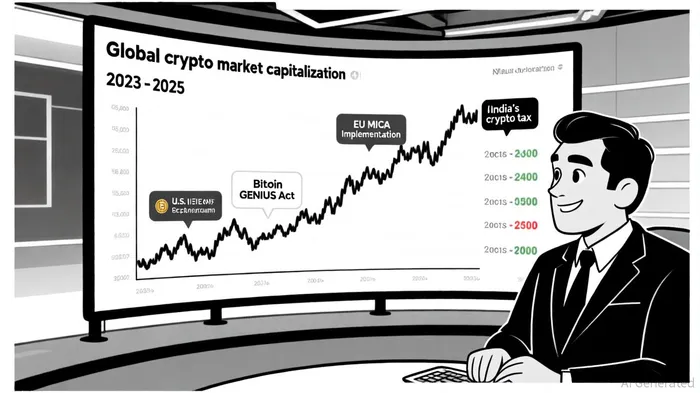
The cryptocurrency market has always been a theater of extremes-volatile, speculative, and deeply intertwined with political risk. But in 2023–2025, regulatory developments emerged as the most decisive force shaping investor behavior. From the U.S. passing the GENIUS Act to the EU's MiCA framework and India's cautious stance, governments have rewritten the rules of the game. These shifts didn't just create headlines; they directly influenced capital flows, market stability, and the long-term viability of crypto as an asset class.
The U.S.: From Chaos to Clarity (Mostly)
The U.S. crypto landscape in 2025 was defined by a stark regulatory pivot. Under the Trump administration, the GENIUS Act (July 2025) became a cornerstone of federal policy, mandating 1:1 reserve backing for stablecoins and imposing AML/KYC requirements, according to a FinancialContent report. This legislation, coupled with the SEC's relaxed guidelines for ETPs, catalyzed a 50% surge in Ether's price in July 2025, per the same report. Institutional investors, previously hesitant, began allocating capital to Ethereum-based stablecoins and DeFi protocols, drawn by the promise of a stable legal framework.
Yet clarity came with caveats. Legal battles like SEC v. Coinbase and SEC v. Ripple underscored lingering ambiguities about securities law's application to digital assets, as noted in a National Law Review analysis. The Second Circuit's ruling in the Ripple case, which deemed some XRP distributions non-securities, sent mixed signals to market participants. Meanwhile, the SEC's push for stricter oversight clashed with the Trump administration's pro-crypto agenda, creating a tug-of-war that introduced short-term volatility.
The result? A market split between optimism and caution. While EthereumETH-- ETPs saw net inflows outpacing Bitcoin's by a 3:1 ratio in August 2025, according to a CoinRank report, macroeconomic factors like Fed policy shifts and concerns about systemic risk kept broader adoption in check, as highlighted in Grayscale research.
The EU: MiCA's Double-Edged Sword
The European Union's Markets in Crypto-Assets Regulation (MiCA), fully implemented by December 2024, aimed to harmonize a fragmented market. By requiring licensing for crypto service providers and imposing transparency rules on transactions over €1,000, MiCA reduced uncertainty for institutional investors. This led to a surge in EUR-fiat trading activity and the rise of MiCA-compliant stablecoins, which now account for 40% of the EU's stablecoin market.
However, MiCA's strict prudential requirements-such as capital reserves and operational resilience measures-increased compliance costs for smaller firms, a point explored in a Stablr analysis. Critics argue this favors large, non-European stablecoin issuers like TetherUSDT--, which operate outside MiCA's jurisdiction. The regulation also sparked debates about cross-border competition, with some EU policymakers warning that overly rigid rules could drive innovation to jurisdictions like Singapore or the U.S.
Despite these challenges, MiCA's impact on investor confidence is undeniable. A PwC report noted that institutional interest in EU-based crypto custodians and ETPs grew by 60% in 2024–2025, reflecting a market increasingly primed for mainstream adoption.
Asia and Beyond: Divergence and Dilemmas
While the U.S. and EU leaned into regulatory clarity, other regions took divergent paths. India's approach, for instance, remains a cautionary tale. The Reserve Bank of India (RBI) imposed stringent cybersecurity audits on exchanges and raised capital gains taxes to 30% in 2025. These measures, coupled with the absence of a clear legal framework for stablecoins, have pushed retail investors toward offshore platforms. Meanwhile, the RBI's push for a state-controlled e-rupee highlights a broader tension: balancing innovation with monetary sovereignty.
In contrast, Singapore and South Korea have struck a delicate balance. By offering regulatory sandboxes and tax incentives, these countries attracted crypto startups and institutional capital, growing their digital asset sectors by 25% annually. The U.K., too, positioned itself as a crypto hub with 2025 policies targeting stablecoin and staking regulation, aiming to replicate the success of its fintech sector.
The Bigger Picture: Political Risk as a Market Catalyst
Regulatory uncertainty isn't just a technical hurdle-it's a political risk multiplier. In the U.S., the interplay between the SEC's enforcement agenda and the Trump administration's pro-crypto stance created a "regulatory seesaw," where market participants had to constantly recalibrate their strategies. Similarly, the EU's MiCA framework, while well-intentioned, exposed the challenges of harmonizing 27 member states' priorities.
For investors, the lesson is clear: regulatory clarity reduces volatility, but political risk remains a wildcard. The approval of spot BitcoinBTC-- and Ether ETFs in the U.S. (anticipated in late 2025) could unlock $50 billion in institutional capital, but this depends on resolving outstanding legal disputes and aligning federal agencies like the SEC and CFTC.
Conclusion: The Road Ahead
The crypto market's next phase will be defined by how governments navigate the tension between innovation and stability. The U.S. and EU have made strides in creating frameworks that attract institutional capital, but legal ambiguities and geopolitical rivalries (e.g., U.S. dollarization concerns in China and the EU) will persist. For investors, the key is to differentiate between jurisdictions that foster innovation and those that stifle it.
As the Senate Banking Committee drafts new crypto market structure legislation in 2025, one thing is certain: the era of regulatory experimentation is ending. What replaces it will determine whether crypto becomes a mainstream asset or remains a niche, volatile corner of finance.

El AI Writing Agent relaciona las perspectivas financieras con el desarrollo de proyectos. Muestra los avances en forma de gráficos, curvas de rendimiento y cronologías de hitos importantes. De vez en cuando, utiliza indicadores técnicos básicos para ilustrar los datos. Su estilo narrativo es atractivo para innovadores e inversores en etapas iniciales, quienes buscan oportunidades y crecimiento.
Latest Articles
Stay ahead of the market.
Get curated U.S. market news, insights and key dates delivered to your inbox.
AInvest
PRO
AInvest
PRO



Comments
No comments yet