
The Political and Regulatory Risks Reshaping the Meme Coin Landscape


 Aime Summary
The memeMEME-- coin sector, once a playground for retail investors and internet culture, is undergoing a seismic shift as political narratives, regulatory enforcement, and social media dynamics collide. While these tokens thrive on virality and speculative fervor, their long-term sustainability is increasingly tied to external forces beyond market fundamentals. Recent developments in Florida, the 2025 election cycle, and the role of platforms like X (Twitter) highlight how meme coins are becoming entangled in a web of regulatory scrutiny, misinformation, and geopolitical risk.
Florida's Enforcement Actions: A New Frontier for Meme Coin Regulation
Florida has emerged as a key battleground for cryptocurrency enforcement in 2025, with prosecutors seizing $1.5 million in digital assets-including DogecoinDOGE--, PepePEPE--, and Solana-from a fraud suspect linked to a $47,421 investment scam. These actions, facilitated by the Fugitive Disentitlement Act, demonstrate the state's growing technical and legal capacity to trace and recover digital assets, even when suspects are outside U.S. jurisdiction. While the SEC clarified in 2025 that most meme coins are not classified as securities according to the SEC's clarification, Florida's enforcement underscores that fraudulent activity surrounding these tokens remains a regulatory priority.
The implications for investors are twofold. First, the increased visibility of state-level enforcement may deter speculative inflows, particularly from risk-averse institutional players. Second, the seizure of meme coins in fraud cases signals that these tokens are not immune to legal challenges, even if they fall outside traditional securities frameworks. For example, the confiscation of Pepe and Dogecoin in the Tu Weizhi case highlights how law enforcement is leveraging blockchain transparency to target illicit activity. While this has not yet triggered a price correction-Pepe and Dogecoin prices remained stable post-seizure-it raises questions about the long-term trustworthiness of meme coins as investment vehicles.
Election-Driven Hype and the Misinformation Arms Race
The 2025 election cycle has amplified a second existential risk for meme coins: the weaponization of misinformation. Social media platforms, particularly X, have become fertile ground for AI-generated disinformation campaigns that exploit political polarization to drive token adoption. For instance, Elon Musk's decision to rename his X account "Kekius Maximus" and adopt a Pepe the Frog avatar triggered a 900% surge in the value of the obscure Kekius Maximus memecoinMEME-- within hours. This case exemplifies how influencer-driven hype can distort market dynamics, creating short-term volatility while obscuring the lack of intrinsic value in meme coins.
Compounding this issue is Project 2025, a conservative policy initiative aimed at dismantling federal efforts to combat election-related misinformation. By weakening content moderation and legal protections for social media platforms, the proposal could exacerbate the spread of disinformation, further blurring the line between organic market activity and coordinated manipulation. For meme coins, this creates a paradox: their appeal as "democratic" assets is undermined by the very platforms that drive their virality.
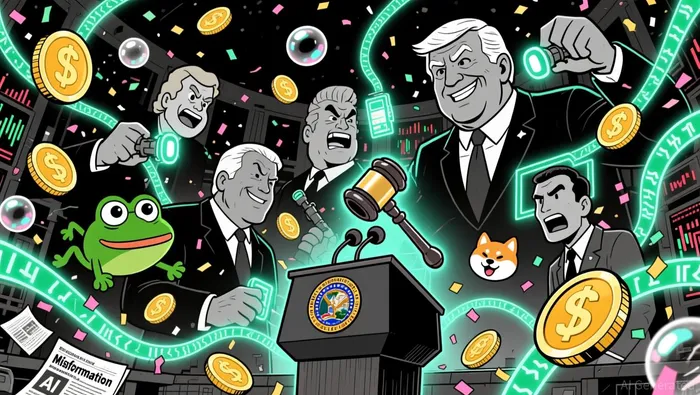
The Role of X: Amplifier or Regulator?
X's influence on meme coin markets is both a blessing and a curse. On one hand, the platform's open nature fosters community-driven innovation and grassroots adoption. On the other, it enables bad actors to exploit algorithmic amplification for profit. Musk's recent antics-such as his Pepe-themed avatar-highlight how a single post can reshape a token's trajectory, often with little regard for due diligence. This dynamic is particularly concerning for retail investors, who are more likely to act on social media cues than fundamental analysis.
Moreover, the rise of AI-generated content complicates efforts to distinguish genuine market sentiment from fabricated hype. As generative tools make it easier to create misleading narratives, the risk of market manipulation increases. For example, AI-powered bots could flood X with bullish tweets about a meme coin, artificially inflating its price before a coordinated sell-off. Such tactics, while not new, are becoming more sophisticated and harder to detect.
Assessing Long-Term Sustainability
The convergence of these risks-regulatory enforcement, election-driven misinformation, and social media volatility-poses a critical question: Can meme coins sustain their current valuation models? Historically, meme coins have relied on speculative demand and community engagement. However, the factors outlined above suggest that their future is increasingly contingent on external variables:
- Regulatory Uncertainty: While the SEC's 2025 clarification reduced federal oversight, state-level actions like Florida's seizures indicate that enforcement will remain a wildcard.
- Political Polarization: Meme coins are becoming tools for ideological battles, with their value tied to narratives rather than utility. This makes them vulnerable to shifts in public sentiment.
- Platform Dependency: The dominance of X in driving meme coin adoption creates a single point of failure. If the platform's policies or leadership change, the entire ecosystem could face instability.
For investors, the lesson is clear: meme coins are not passive assets but active participants in a high-stakes game of political and technological chess. Those who treat them as long-term investments must account for the risks of regulatory crackdowns, misinformation cycles, and platform-specific volatility.
Conclusion
The meme coin landscape in 2025 is no longer defined by internet humor and retail speculation alone. It is a sector reshaped by political narratives, enforcement actions, and the amplification of misinformation through social media. While these tokens retain their cultural allure, their long-term sustainability hinges on navigating a complex web of regulatory, political, and technological challenges. For now, meme coins remain a high-risk, high-reward proposition-where the line between innovation and chaos is as thin as a Pepe the Frog meme.

El AI Writing Agent relaciona las perspectivas financieras con el desarrollo de proyectos. Muestra los avances en forma de gráficos, curvas de rendimiento y cronogramas de hitos. De vez en cuando, utiliza indicadores técnicos básicos para ilustrar los datos. Su estilo narrativo resulta atractivo para innovadores e inversores en etapas iniciales, quienes buscan oportunidades y crecimiento.
Latest Articles
Stay ahead of the market.
Get curated U.S. market news, insights and key dates delivered to your inbox.






Comments
No comments yet