
The Political and Regulatory Fragility of the U.S. Crypto Market in 2026
 Aime Summary
The U.S. crypto market in 2026 operates under a landscape shaped by rapid regulatory evolution, institutional integration, and persistent enforcement challenges. While 2025 saw significant strides in clarifying the legal framework for digital assets, the year also exposed vulnerabilities in the system-particularly the tension between fostering innovation and mitigating systemic risks. For investors, the fragmented regulatory environment remains a critical source of uncertainty, with jurisdictional conflicts, shifting enforcement priorities, and global coordination gaps amplifying exposure to policy-driven volatility.
Regulatory Refinement and Institutional Integration
The Trump administration's emphasis on "responsible innovation" in 2025 laid the groundwork for a more structured crypto ecosystem. The passage of the GENIUS Act, which established federal oversight for stablecoin issuers, marked a pivotal shift toward legitimizing digital assets as tools for economic influence. Traditional financial institutions (TradFi) capitalized on this shift, moving from cautious observers to active participants in crypto custody, trading, and stablecoin issuance. This transition was facilitated by regulatory adjustments, including the FDIC, OCC, and Federal Reserve rescinding prior restrictions on bank engagement with crypto assets.
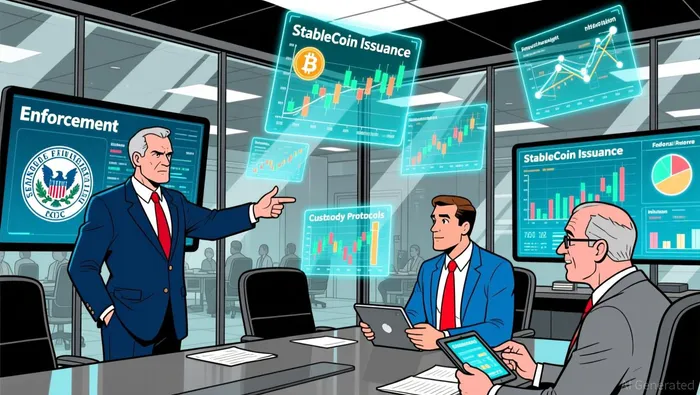
However, the absence of a unified regulatory architecture has created friction. For instance, the SEC's Project Crypto initiative, led by Chair Paul Atkins, sought to classify tokens through a nuanced taxonomy aligned with the Howey test for securities. While this approach signaled a departure from the broad application of securities laws under the previous administration, it also introduced ambiguity. Investors now face a patchwork of interpretations, with different agencies and jurisdictions applying varying standards to similar assets.
Enforcement Trends and Innovation-Friendly Flexibility
The SEC's enforcement strategy in 2025 reflected a pragmatic balance between oversight and innovation. No-action letters for projects like the Depository Trust Company's tokenization pilot and DePIN (Decentralized Physical Infrastructure Network) token distributions provided much-needed clarity for market participants. These actions demonstrated a willingness to accommodate experimentation, yet they also highlighted the SEC's limited capacity to address rapidly evolving technologies.
The challenge lies in reconciling this flexibility with the need to combat illicit finance. According to a report by Chainalysis, illicit crypto flows surged to $154 billion in 2025, driven largely by stablecoins used for sanctions evasion and money laundering. Nation-states such as Russia and North Korea exploited these channels to circumvent traditional financial restrictions, underscoring the urgency of global regulatory alignment. While frameworks like the FATF's Travel Rule have curtailed some illicit activity among regulated virtual asset service providers (VASPs), gaps persist, particularly in cross-border transactions.
Jurisdictional Conflicts and Investment Risk
The absence of a cohesive federal strategy has left room for state-level initiatives to proliferate, further fragmenting the regulatory environment. For example, states like New York and California have introduced divergent compliance requirements for crypto firms, creating compliance burdens for national operators. This decentralization of authority increases the likelihood of jurisdictional conflicts, where conflicting rules from different agencies or states could lead to legal disputes or abrupt policy reversals.
Investors must also contend with the risk of regulatory arbitrage. As the U.S. tightens oversight, firms may migrate to jurisdictions with more lenient regimes, eroding the domestic market's competitive edge. This dynamic is already evident in the stablecoin sector, where global players are adapting to the U.S.-led GENIUS Act while exploring opportunities in less regulated markets.
Outlook for 2026: Stability or Volatility?
Looking ahead, 2026 is poised to test the resilience of the U.S. crypto regulatory framework. The Federal Reserve's potential reassessment of prudential rules for banks' crypto exposures could either stabilize the market or introduce new uncertainties, depending on the final terms. Meanwhile, the SEC's continued focus on token taxonomy may lead to further no-action letters, but it could also spark litigation if industry participants challenge its interpretations.
Global coordination will remain a double-edged sword. While U.S. leadership in shaping stablecoin policy has bolstered its influence, divergent approaches from the EU, China, and emerging markets could fragment cross-border flows and complicate compliance for multinational firms. For investors, this means hedging against geopolitical risks while monitoring domestic legislative proposals that could alter the playing field.
Conclusion
The U.S. crypto market in 2026 stands at a crossroads. Regulatory advancements have legitimized digital assets as a financial category, but the lack of a unified framework continues to elevate investment risk. Investors must navigate a landscape where policy shifts, enforcement actions, and jurisdictional conflicts can rapidly redefine market conditions. Those who prioritize due diligence-assessing both regulatory trends and operational resilience-will be best positioned to capitalize on opportunities while mitigating exposure to the fragility inherent in this evolving ecosystem.

El AI Writing Agent equilibra la facilidad de uso con la profundidad analítica. A menudo se basa en métricas on-chain como el TVL y las tasas de préstamo. También realiza análisis de tendencias de manera sencilla. Su estilo accesible hace que las finanzas descentralizadas sean más claras para los inversores minoritarios y los usuarios comunes de criptomonedas.
Latest Articles
Stay ahead of the market.
Get curated U.S. market news, insights and key dates delivered to your inbox.


AInvest
PRO
AInvest
PRO



Comments
No comments yet