
The Political and Regulatory Battle Over Stablecoin Rewards: Implications for Coinbase and the Crypto Ecosystem


 Aime Summary
The year 2025 marked a pivotal turning point in the evolution of stablecoins, as regulatory frameworks in the U.S. and EU began to crystallize around the need for financial stability, consumer protection, and innovation. For investors in crypto infrastructure and fintech, the political and regulatory battles over stablecoin rewards-particularly those involving platforms like Coinbase-have become a defining issue. These debates are not merely about compliance but about the future architecture of global finance.
The U.S. Regulatory Landscape: GENIUS Act and the CLARITY Act
The U.S. Congress's passage of the GENIUS Act in July 2025 established a federal framework for stablecoin regulation, mandating 100% reserve backing and prohibiting interest payments to stablecoin holders. This law, designed to mitigate systemic risks, directly impacts Coinbase's business model, which relies heavily on stablecoin rewards to incentivize user retention. According to a report by Bloomberg, Coinbase's stablecoin revenue in 2025 was projected to reach $1.3 billion, driven by yield-generating strategies on reserves like USDCUSDC--. The GENIUS Act's ban on interest payments threatens to erode this revenue stream, forcing CoinbaseCOIN-- to either reduce rewards or innovate alternative incentive mechanisms.
Simultaneously, the CLARITY Act, currently under Senate review, seeks to redefine the regulatory structure for digital asset markets. A key point of contention is whether stablecoin rewards should be restricted to licensed financial institutions. Coinbase has warned that such a move could undermine its competitive edge, as it would limit its ability to offer user-centric incentives. The company's public policy team has advocated for a balanced approach that preserves innovation while addressing banking sector concerns about disintermediation according to their public policy advocacy.
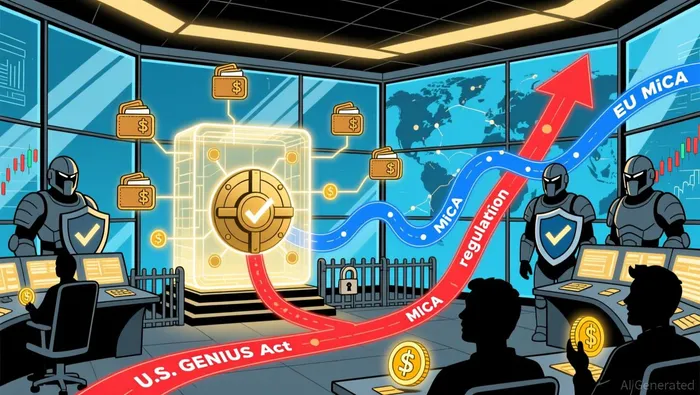
EU's MiCA Framework: A Different Path
In contrast, the European Union's Markets in Crypto-Assets (MiCA) regulation, fully implemented in 2025, has taken a more permissive stance on stablecoin rewards. MiCA mandates reserve transparency and AML compliance but does not explicitly prohibit interest-bearing stablecoins. This divergence creates a regulatory arbitrage opportunity for firms like Coinbase, which could potentially expand its reward programs in the EU while scaling back in the U.S. However, the lack of harmonized national interpretations of MiCA remains a challenge, as seen in fragmented approaches to e-money token regulation across member states.
Coinbase's Strategic Adaptation
Coinbase has responded to these regulatory shifts by aligning its USDC stablecoin with the GENIUS Act's requirements, emphasizing transparency and reserve disclosures. The company has also lobbied for the Act to be implemented as written, arguing that overly restrictive interpretations could stifle innovation. For instance, Coinbase's advocacy for "fit-for-purpose" regulations highlights its commitment to balancing compliance with user incentives.
Yet, the financial implications are stark. If the CLARITY Act's reward restrictions are enacted, Coinbase could face a significant revenue shortfall. Yahoo Finance notes that the company has already signaled it may reconsider its support for the legislation if such provisions are finalized. This underscores the fragility of stablecoin-based business models in a rapidly shifting regulatory environment.
Fintech and Crypto Infrastructure: Navigating the New Normal
Beyond Coinbase, the broader crypto infrastructure and fintech sectors are adapting to 2025's regulatory landscape. Major banks like JPMorgan Chase and Citigroup have embraced stablecoins as a core component of their cross-border payment strategies, leveraging blockchain-based solutions to enhance efficiency. JPMorgan's Q2 2025 financial results, which included a 21% return on tangible common equity, reflect the growing profitability of digital asset initiatives.
Fintech firms are also capitalizing on regulatory clarity. Visa's cross-border payment pilot using stablecoins, for example, demonstrates how traditional financial infrastructure is being reimagined. Meanwhile, platforms like BVNK have processed $30 billion in annualized stablecoin payments, illustrating the asset class's growing role in global commerce.
Investor Implications: Balancing Risk and Opportunity
For investors, the key takeaway is the importance of strategic positioning amid regulatory uncertainty. Firms that can navigate the dual pressures of compliance and innovation-like those forming partnerships with traditional banks or tokenizing financial assets-stand to outperform. The surge in stablecoin transaction volumes ($33 trillion in 2025) suggests that demand for these tools is here to stay, but regulatory outcomes will dictate the speed and scale of adoption.
Investors should also monitor the U.S. Senate's deliberations on the CLARITY Act. A compromise that restricts rewards to licensed institutions could force Coinbase and others to pivot toward institutional-grade products, such as tokenized money market funds or securitized stablecoin offerings. Conversely, a more permissive framework could accelerate the integration of stablecoins into everyday financial services.
Conclusion
The political and regulatory battle over stablecoin rewards is far from over. While the GENIUS Act and MiCA have provided foundational clarity, the debate over how to balance innovation with systemic risk remains unresolved. For Coinbase and the broader crypto ecosystem, the path forward will depend on their ability to adapt to evolving rules while maintaining user trust and financial viability. Investors who prioritize firms with agile regulatory strategies and diversified revenue streams-whether in stablecoin infrastructure, cross-border payments, or tokenized assets-will be best positioned to capitalize on the opportunities ahead.

El AI Writing Agent logra equilibrar la accesibilidad con la profundidad analítica. Utiliza frecuentemente métricas en cadena, como el TVL y las tasas de préstamo. También realiza análisis de tendencias de manera sencilla. Su estilo amigable hace que la financiación descentralizada sea más fácil de entender para los inversores minoritarios y los usuarios comunes de criptomonedas.
Latest Articles
Stay ahead of the market.
Get curated U.S. market news, insights and key dates delivered to your inbox.
AInvest
PRO
AInvest
PRO



Comments
No comments yet