
Political Prediction ETFs Just Filed. And They're Weird.
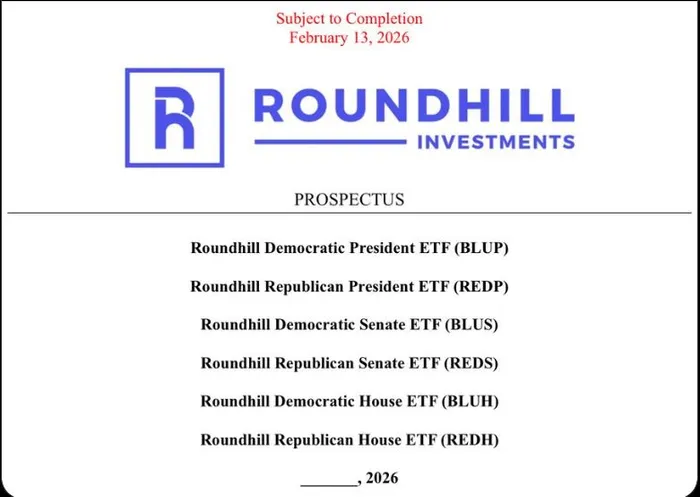
Roundhill dropped 6 new ETF filings Friday. GraniteShares and Bitwise are already sprinting to catch up. The race is on but someone should probably ask if we're even running the right race.
Here's what Roundhill wants to do: wrap prediction market contracts and swaps into an ETF. Democrats win the White House. Republicans take the Senate. Six funds. Simple concept on the surface. Underneath? Lets look into that.
Are we ready for binary-outcome ETFs?
ETFs are built to efficiently hold baskets of liquid securities like stocks, bonds, futures things with continuous pricing, lots of market makers, and a creation/redemption plumbing system that's been stress-tested for decades.
A long-dated event contract is the opposite. It's a fully funded binary bet: settles at $1 or $0 (or close to it), and the "price path" is basically an evolving probability. There's no diversified basket here. There's one question.
Roundhill doesn't hide that. In fact, the filings put the core risk in neon:
"The Roundhill Democratic President ETF's investment objective is to provide capital appreciation if the Democratic Party wins the 2028 U.S. Presidential Election… and if not, the Fund will lose substantially all of its value."
This is normal for an option. It is not normal for an ETF in the mind of most ETF buyers.
Sure, there are product cousins with ugly tails leveraged ETFs, inverse ETFs, volatility ETNs (RIP XIV). But culturally, "ETF" still reads as: up a bit, down a bit, broadly diversified, liquid, resilient. Even thematic ETFs usually fail slowly, not instantly.
The pre-election pitch is easy. The post-election mechanics are the trap.
Before the election, these funds should trade like a probability meter: tick up and down with the market-implied odds plus a small interest component (depending on how the contracts and collateral are structured). On paper, you can tell a simple story:
"Want exposure to election odds without opening a prediction market account? Here you go."
But after the election is where this gets strange because Roundhill's concept is not "single-event, then liquidate." It's "perpetual political exposure that rolls forward."
The funds do not terminate after the 2028 election. They roll into 2032.
And the way they handle the winner vs. the loser is where you can almost hear the ETF plumbing creak.
The roll problem is where this gets ugly.
Say both the Democrat and Republican President ETFs go into the 2028 election with $10M each. Democrats sweep. Republican ETF goes to near zero and reverse splits, then rolls into the 2032 contract. Democrat ETF doubles to $20M and immediately needs to roll into 2032 Democratic winner contracts too. That's a $20M market order into a contract that's four years out, with basically no one on the other side. Whoever takes that trade has capital locked up for potentially four years. They're going to price that in. Hard. Investors eat serious slippage before 2032 even gets started. You're paying for the win before you've won anything.
The ETF wrapper may amplify the weakest parts of prediction markets
The ETF ecosystem is mature. Prediction markets are improving fast, but they are not mature in the ways ETFs require:
Liquidity: continuous depth across maturities, especially long-dated contracts.
Authorized participant (AP) mechanics: efficient creation/redemption depends on the ability to source/hedge underlying exposure and arb away ETF premiums/discounts.
Operational clarity: what happens under halts, disputes, venue outages, rule changes, or contract interpretation fights.
Investor comprehension: most ETF buyers do not model "my fund can go to (near) zero."
The ETF wrapper doesn't remove prediction market friction. It can just repackage it into a vehicle people trust more than they should.
A cleaner version of this idea exists
If you have to bring prediction markets into ETFs, the product design should acknowledge what investors actually want.
Most investors don't want a perpetual rolling binary that silently bleeds in the four-year off-season due to forced rolls. They want:
Single-election, single-life ETFs exposure to an event when it matters, and/or
Overlay model (1–5% in event contracts) inside a thematic basket a small, meaningful overlay that complements a broader portfolio thesis.
These are products investors can actually use.
Should these be in a 401k? Absolutely not. Will the SEC approve them? Unclear. Is the market ready? No.
Good concept. Wrong structure. Build the overlay or single event.

Senior strategist with 20+ years experience delivering data-driven research, ETF and stock analysis, and practical investment ideas.
Latest Articles
Stay ahead of the market.
Get curated U.S. market news, insights and key dates delivered to your inbox.


AInvest
PRO
AInvest
PRO



Comments
No comments yet