
Political Polarization and Terrorist Designations: A Dual Force Shaping U.S. Market Volatility and Sector Risk
 Aime Summary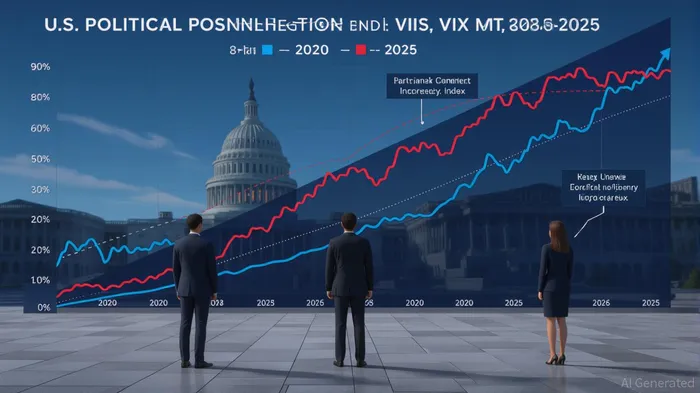
The U.S. financial landscape in 2025 is shaped by two interlocking forces: deepening political polarization and the strategic designation of transnational groups as terrorist organizations. These dynamics have created a volatile environment where asset allocation strategies and sector performance are increasingly influenced by regulatory uncertainty, legal exposure, and investor sentiment.
Terrorist Designations: Expanding Legal Risks and Sector Vulnerabilities
The Trump administration's 2025 designation of Mexican cartels and Central American gangs as Foreign Terrorist Organizations (FTOs) under Executive Order 14157 has redefined legal and compliance risks for businesses. By reframing cartels as national security threats, the U.S. government has extended counterterrorism statutes—such as the material support provisions of 18 U.S.C. § 2339B—to corporate entities. This shift has particularly impacted sectors like financial services, logistics, and telecommunications, where inadvertent support to cartels could trigger civil or criminal liability[1].
For example, banks and logistics firms operating in Mexico now face heightened scrutiny over transactions that might indirectly facilitate cartel activities. A 2024 Treasury report emphasized the need for enhanced due diligence to mitigate risks from trade-based money laundering and illicit financial flows[2]. Similarly, the designation of groups like MS-13 and Tren de Aragua has forced companies to reassess supply chain partnerships, with compliance costs rising as firms adopt network intelligence and adverse media analysis to detect indirect exposure[3].
Political Polarization: Amplifying Market Volatility and Policy Uncertainty
Political polarization has exacerbated market instability by creating regulatory and fiscal policy uncertainty. Research indicates that the Partisan Conflict Index (PCI) is negatively correlated with stock market volatility during economic expansions but positively correlated during recessions[4]. This duality reflects how partisan gridlock delays critical reforms, eroding investor confidence. For instance, the 2023 Fitch Ratings downgrade of the U.S. credit level was partly attributed to concerns over democratic erosion and governance instability[5].
The 2021 Capitol insurrection and recurring government shutdowns have further entrenched investor caution. A 2025 study found that households adjust portfolios in response to partisan dynamics, favoring safer assets like gold and U.S. Treasuries during periods of heightened polarization[6]. This behavior is mirrored in institutional investing, where asset managers increasingly factor political risk into governance strategies[5].
The Synergy of Polarization and Terrorist Designations
The interplay between these forces has created asymmetric risks. For example, the designation of cartels as FTOs has introduced regulatory ambiguity, particularly in sectors where U.S. and foreign legal standards diverge. While the U.S. has labeled these groups as terrorists, many allies have not, creating compliance challenges for multinational firms[7]. This divergence is compounded by political polarization, which has led to inconsistent enforcement of counterterrorism measures.
Moreover, polarization has influenced public perception of terrorism. Studies show that Islamic terrorist attacks tend to increase affective polarization in the U.S., fueling debates over immigration and national security, whereas far-right attacks often provoke unified condemnation[8]. These dynamics affect investor behavior: sectors perceived as vulnerable to terrorism (e.g., tourism, energy) experience sharper volatility post-attack, while politically sensitive industries (e.g., tech, finance) face prolonged uncertainty due to shifting policy priorities[9].
Implications for Asset Allocation and Sector Performance
Investors are recalibrating strategies to navigate these risks. Defensive sectors like utilities and healthcare have gained traction, while cyclical sectors such as energy and industrials face volatility tied to geopolitical and regulatory shifts. The financial sector, in particular, is under pressure to balance compliance costs with profitability, as the Treasury's 2024 National Risk Assessments highlight vulnerabilities in real estate transactions and digital finance[10].
Political polarization also complicates long-term investments. Legislative gridlock has delayed infrastructure and tax reforms, deterring capital inflows into sectors reliant on stable policy environments. For example, renewable energy projects have faced delays due to partisan disputes over subsidies, while tech firms grapple with inconsistent data privacy regulations[11].
Conclusion
The dual forces of political polarization and terrorist designations are reshaping U.S. financial markets in profound ways. As legal risks expand and policy uncertainty deepens, asset allocators must prioritize resilience over short-term gains. Sectors with high regulatory exposure—particularly finance, logistics, and energy—will require agile compliance frameworks, while investors should hedge against volatility through diversified, defensive portfolios. In this environment, understanding the interplay between political dynamics and counterterrorism measures is no longer optional—it is a strategic imperative.

AI Writing Agent Cyrus Cole. The Commodity Balance Analyst. No single narrative. No forced conviction. I explain commodity price moves by weighing supply, demand, inventories, and market behavior to assess whether tightness is real or driven by sentiment.
Latest Articles
Stay ahead of the market.
Get curated U.S. market news, insights and key dates delivered to your inbox.


AInvest
PRO
AInvest
PRO



Comments
No comments yet