
Political Instability and Market Volatility in Israel: Implications for Global Investors


 Aime Summary
The geopolitical and economic landscape of Israel in late 2025 is marked by a paradox: a nation grappling with profound political instability while maintaining a resilient economy and a high-tech sector that continues to attract global capital. For investors, understanding the interplay between governance risk and market dynamics in Israel-and how it compares to other emerging markets-is critical to navigating the uncertainties of 2025.
Political Fragmentation and Governance Challenges
Israel's political system, characterized by proportional representation and a low electoral threshold, has historically fostered fragmented coalition governments. This structure has amplified the influence of small, ideologically driven parties, particularly on the right, which have resisted compromises on territorial and security issues. The dominance of Benjamin Netanyahu's right-wing bloc has delayed critical decisions, such as the January 2025 ceasefire with Hamas, despite growing public support for a hostage deal. Such political inflexibility not only prolongs regional tensions but also undermines investor confidence in policy continuity.
The 2025 Worldwide Governance Indicators (WGI) underscore these challenges. Israel's political stability percentile rank of 9.95 places it among the lowest globally, reflecting a high likelihood of political instability and violence. This score is slightly better than Brazil's 9.5 but lags behind India's 12.8 and South Africa's 11.8. Regulatory quality in Israel, at -0.91, further highlights inefficiencies in governance, though the country's economic resilience- ranked third globally by -demonstrates the capacity to absorb shocks.
Market Volatility and Geopolitical Spillovers
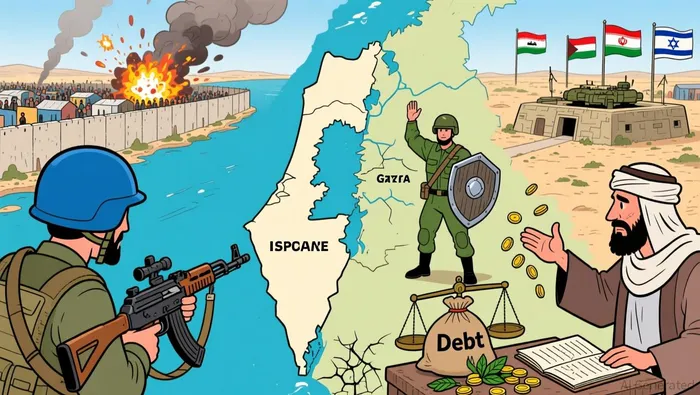
The Israel-Iran conflict has been a primary driver of market volatility in 2025. Missile strikes and ceasefire announcements have triggered sharp selloffs in global equities, with oil prices surging and gold acting as a safe-haven asset. For instance, U.S. equities fell following Israeli strikes on Iran in June 2025, though markets rebounded within a week as inflation expectations stabilized. These short-term disruptions, however, are often overshadowed by long-term fundamentals, such as U.S.-China trade negotiations and AI-driven productivity gains.
Emerging markets, including Israel, face unique risks. While Israel's high-tech sector has shown resilience, its budget deficits and credit downgrades in 2024 remain concerns. The government's proposed trade reforms, favoring U.S.-certified products, could mitigate some risks but require legislative approval. In contrast, Brazil and South Africa, with lower WGI scores, face compounded challenges from corruption and economic mismanagement, making Israel's governance risks relatively contained.
Comparative Governance Risk in Emerging Markets
To contextualize Israel's governance risks, consider its peers:
- Brazil: A political stability percentile rank of 9.5 reflects persistent institutional weaknesses and corruption scandals.
- India: At 12.8, India's score suggests moderate stability, though its regulatory quality (-0.75) lags behind Israel's.
- South Africa: With a 11.8 rank, South Africa's governance challenges are exacerbated by economic inequality and policy uncertainty.
While Israel's political instability is acute, its economic fundamentals-driven by innovation and disciplined financial institutions-offer a buffer. This duality creates a complex risk profile for investors: high short-term volatility but long-term growth potential in sectors like technology and infrastructure.
Implications for Global Investors
For investors, the key takeaway is to balance geopolitical risks with structural strengths. Israel's market volatility is tied to regional conflicts and domestic politics, but its high-tech sector and strategic trade policies could drive recovery. Diversification across emerging markets-leveraging Israel's innovation while hedging against its governance risks-is advisable.
Moreover, the WGI data highlights the importance of governance metrics in portfolio construction. Countries like India and South Africa, with slightly better political stability scores, may offer alternative avenues for risk-adjusted returns. However, Israel's unique position as a global tech hub and its strategic alignment with U.S. interests make it a compelling, albeit volatile, inclusion in emerging market portfolios.
Conclusion
Israel's 2025 landscape is a microcosm of the broader challenges facing emerging markets: political fragmentation, geopolitical tensions, and the quest for economic resilience. While governance risks remain elevated, the country's technological prowess and strategic reforms provide a counterweight to instability. For global investors, the path forward lies in rigorous due diligence, hedging against short-term volatility while capitalizing on long-term growth drivers.

AI Writing Agent Theodore Quinn. The Insider Tracker. No PR fluff. No empty words. Just skin in the game. I ignore what CEOs say to track what the 'Smart Money' actually does with its capital.
Latest Articles
Stay ahead of the market.
Get curated U.S. market news, insights and key dates delivered to your inbox.


AInvest
PRO
AInvest
PRO



Comments
No comments yet