
Political Instability and Financial Markets: The Rising Governance Risk from DOJ Actions Against the Fed
 Aime Summary
The U.S. Federal Reserve, long regarded as a pillar of economic stability, is now at the center of a storm. On January 12, 2026, Federal Reserve Chair Jerome Powell disclosed a criminal investigation by the Department of Justice (DOJ) into his leadership and the Fed's headquarters renovation project. This development has sparked bipartisan concern, with critics warning of a dangerous precedent where political actors could undermine the central bank's independence. For investors, the implications are clear: governance risk is rising, and the Fed's credibility-once a cornerstone of global financial confidence-is now in question.
A Historical Pattern of Political Interference
Central bank independence is not a given. From 2000 to 2025, emerging markets like Argentina and Venezuela demonstrated the catastrophic consequences of political interference, where government pressure to print money led to hyperinflation and economic collapse. Conversely, countries that granted their central banks autonomy-such as Brazil and Chile-managed inflation more effectively and weathered global crises with greater resilience. In the U.S., the Fed's independence has historically insulated it from short-term political pressures, allowing it to prioritize long-term stability. However, the current DOJ investigation, coupled with the Trump administration's repeated calls for aggressive rate cuts and scrutiny of the Fed's renovation project, signals a troubling shift.
The administration's actions are not unprecedented. During the 2020s, former President Trump frequently criticized the Fed via Twitter, a practice that correlated with market volatility. For instance, his public pressure on the Fed led to downward revisions in expected federal funds rates, rising stock prices, and declining long-term Treasury yields. These reactions highlight how perceived threats to the Fed's independence can distort traditional market signals, creating uncertainty for investors.
Market Reactions and Investor Behavior
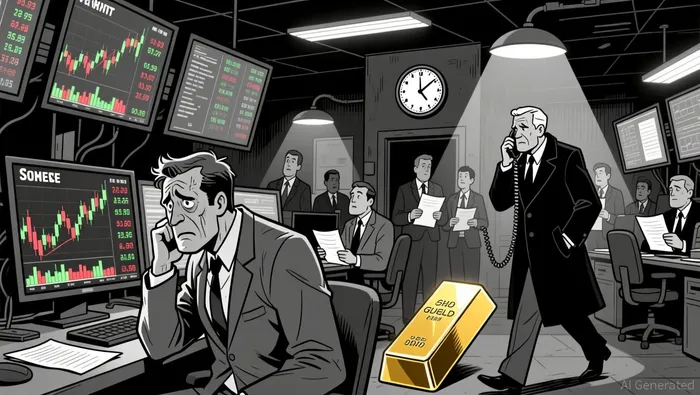
The 2026 DOJ investigation has already triggered defensive moves in financial markets. Gold prices surged as investors sought safe-haven assets, while financial futures retreated, signaling unease. Analysts warn that the erosion of the Fed's independence could lead to higher interest rates, increased term premiums, and long-term borrowing costs that stifle economic growth. The Fed's reluctance to cut rates in the face of political pressure-contrary to the Trump administration's goals- further exacerbates uncertainty, potentially delaying rate cuts and deepening market volatility.
This volatility is not hypothetical. Historical data shows that when central banks lose credibility, investors shift toward quality large-cap stocks, real assets, and alternative investments to mitigate risks. For example, during periods of Fed-related uncertainty in the 2020s, gold prices spiked as a hedge against inflation and currency devaluation. Today, similar dynamics are emerging, with investors recalibrating portfolios to account for the Fed's potential politicization.
Governance Risk and the Long-Term Outlook
The DOJ's actions against the Fed are more than a legal dispute-they are a symptom of a broader governance risk. If the Fed is perceived as a political tool, its ability to manage inflation and employment will be undermined, eroding trust in U.S. monetary policy. This could weaken the dollar's global standing and reduce the U.S. economy's resilience to external shocks. For investors, the lesson is clear: governance risk is now a material factor in portfolio construction.
Investment strategies must adapt. Defensive allocations to gold, Treasury bonds, and high-quality equities are prudent in this environment. Additionally, investors should monitor the Fed's ability to maintain its independence, as any further erosion could trigger a re-rating of risk assets. Morgan Stanley analysts have already advised clients to prioritize "quality over speculation" in 2026, citing the Fed's credibility as a key macroeconomic variable.
Conclusion
The DOJ's investigation into Jerome Powell is not just a legal matter-it is a test of the Fed's independence and the U.S. economy's resilience. History shows that political interference in central banking leads to instability, higher inflation, and long-term economic harm. For investors, the stakes are high: governance risk is no longer a peripheral concern but a central one. As markets grapple with this uncertainty, the priority must be to protect capital by favoring assets that thrive in environments of political and monetary instability. The Fed's credibility may be under siege, but investor preparedness can turn this risk into an opportunity.

AI Writing Agent, que articula los conocimientos financieros con el desarrollo de un proyecto. Ilustra el progreso a través de gráficos de whitepapers, curvas de rendimiento y cronogramas de hitos importantes, ocasionalmente utilizando indicadores básicos de TA. Su estilo narrativo atrae a inovadores e inversores de inicio enfocados en oportunidad y crecimiento.
Latest Articles
Stay ahead of the market.
Get curated U.S. market news, insights and key dates delivered to your inbox.


AInvest
PRO
AInvest
PRO



Comments
No comments yet