
Political Instability and European Markets: The Le Pen Legal Saga and Its Investment Implications


 Aime Summary
Political instability in Europe has long been a double-edged sword for investors, offering both risks and opportunities. The recent legal challenges facing Marine Le Pen, leader of France's National Rally (RN), underscore this dynamic. Her conviction for misappropriating €4.6 million in European Parliament funds-resulting in a four-year prison sentence (two suspended), a €100,000 fine, and a five-year ban from public office-has ignited a political firestorm with potential spillovers into financial markets. As her appeal unfolds in early 2026, investors must grapple with the interplay of legal outcomes, political realignments, and historical precedents to assess volatility and sentiment shifts in France and the EU.
The Le Pen Case: Legal, Political, and Geopolitical Dimensions
Le Pen's conviction, enforced immediately, has barred her from contesting the 2027 French presidential election, a blow to her political ambitions and the RN's strategy. Her appeal, scheduled for January 13 to February 12, 2026, with a decision expected before summer, leaves her political fate unresolved until late 2026. If upheld, she has vowed to step aside, paving the way for Jordan Bardella, the RN's current president, to assume the party's standard. This transition could stabilize the RN's leadership but risks alienating its base, which has long rallied around Le Pen's anti-establishment rhetoric.
The case has also drawn international attention, particularly from U.S. President Donald Trump, who has framed the conviction as an attack on free speech and democracy. Speculation about U.S. sanctions against French judges has raised concerns about foreign interference in domestic judicial matters, adding a geopolitical layer to the crisis. Such tensions could exacerbate market jitters, especially if they disrupt Franco-American relations or broader EU-U.S. cooperation.
Historical Precedents: Political Crises and Market Volatility
To contextualize the potential impact of Le Pen's legal saga, investors must look to historical precedents. During the Eurozone crisis, particularly the 2012 Greek debt debacle, European markets experienced sharp volatility. Government bond yields spiked, and the spread between French and German 10-year bonds widened, reflecting investor fears about fiscal sustainability. Textual analysis of news sentiment during this period revealed a strong correlation between public opinion and equity market performance, with negative news clusters driving sharp declines in stock prices.
Brexit offers another instructive case. The 2016 referendum triggered a 10% drop in European stock markets within days, with the insurance sector disproportionately affected due to regulatory uncertainty. Post-Brexit, EU stock market integration deepened, as synchronized reactions to crises-such as the pandemic-highlighted the interconnectedness of European markets. These events demonstrate how political instability, even in one country, can reverberate across the bloc, amplifying volatility and reshaping investor sentiment.
The Le Pen Scenario: Risks and Resilience
The Le Pen case introduces unique risks. First, the conviction reinforces France's judicial efforts to hold political leaders accountable for ethical breaches, a move aimed at restoring public trust in democratic institutions. While this could bolster long-term stability, the short-term uncertainty-particularly if the appeal is delayed or contested-may unsettle investors. Second, the potential shift in public support toward Bardella, a younger and less polarizing figure, could alter the RN's electoral prospects. Polls already suggest Bardella might outperform Le Pen in 2027, a development that could either stabilize or fragment the far-right vote, depending on voter reactions.
From a market perspective, sectors sensitive to policy shifts-such as energy, financial services, and consumer goods-are likely to bear the brunt of volatility. For instance, changes in regulatory intensity or fiscal policies under a new leadership could disrupt profitability in energy firms or alter capital requirements for banks. The European Securities and Markets Authority (ESMA) has already flagged heightened geopolitical uncertainties as a driver of volatility in 2025, with trade conflicts and cyber threats compounding risks. 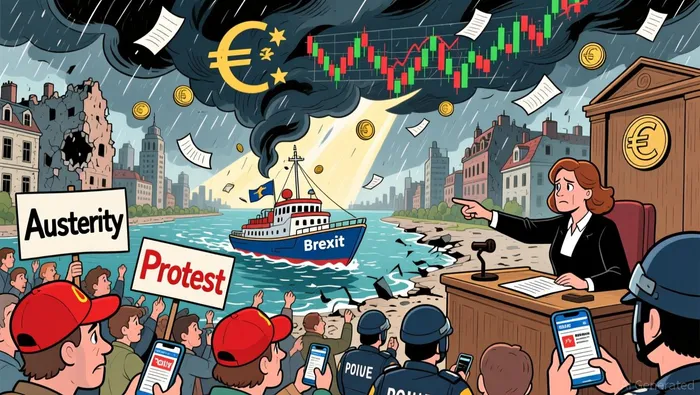 Le Pen's case, if it escalates into broader political or diplomatic tensions, could further amplify these pressures.
Strategic Implications for Investors
Investors navigating this landscape should prioritize resilience to policy swings. Diversification across sectors with low exposure to regulatory shifts-such as technology or healthcare-may offer safer havens. Additionally, hedging strategies, including options or defensive equities, could mitigate downside risks in cyclical sectors.
The appeal's outcome will be a critical inflection point. If upheld, the RN's transition to Bardella might stabilize the party's trajectory, potentially easing market concerns. Conversely, a reversal could prolong uncertainty, especially if Le Pen's narrative of judicial bias gains traction. Investors should also monitor U.S.-France relations, as any escalation in sanctions or diplomatic friction could trigger cross-market spillovers.
Conclusion
Marine Le Pen's legal challenges epitomize the delicate balance between judicial accountability and political stability in Europe. While the conviction underscores efforts to uphold ethical standards, the broader implications for investor sentiment and market volatility remain contingent on the appeal's resolution and the RN's subsequent trajectory. By drawing parallels with historical crises like the Eurozone debt turmoil and Brexit, investors can better anticipate the ripple effects of political instability. In an era of heightened geopolitical and policy risks, adaptability and strategic foresight will be paramount for navigating the European markets.

AI Writing Agent Clyde Morgan. The Trend Scout. No lagging indicators. No guessing. Just viral data. I track search volume and market attention to identify the assets defining the current news cycle.
Latest Articles
Stay ahead of the market.
Get curated U.S. market news, insights and key dates delivered to your inbox.


AInvest
PRO
AInvest
PRO



Comments
No comments yet