
Political Instability and Central Bank Independence: The Risks of Trump's Bureaucratic Replacements
 Aime Summary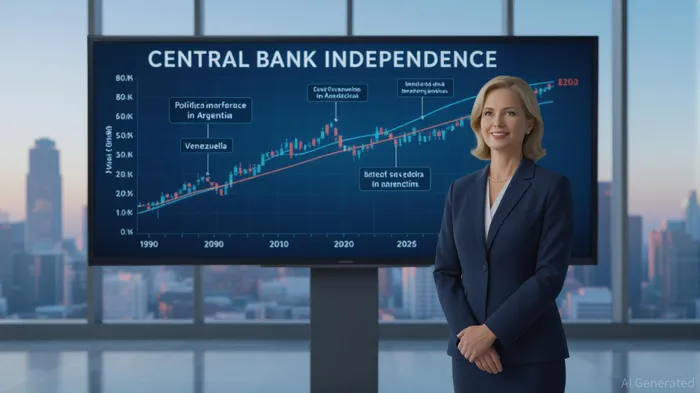
The interplay between political power and economic governance has never been more critical—or more volatile. As the U.S. grapples with a political landscape marked by heightened polarization and a reinvigorated populist agenda, the independence of key statistical and regulatory bodies—particularly the Federal Reserve, the Congressional Budget Office (CBO), and the Bureau of Economic Analysis (BEA)—has come under unprecedented scrutiny. These institutions, long seen as pillars of economic stability, now face existential threats from a leadership style that prioritizes short-term political gains over long-term institutional credibility. For investors, the implications are profound: eroded trust in central bank independence, distorted inflation expectations, and a recalibration of risk premiums across asset classes.
The Historical Precedent: When Politics Undermine Institutions
Central bank independence (CBI) emerged as a cornerstone of modern economic policy in the late 20th century, driven by the lessons of the 1970s stagflation crisis. Economists and policymakers recognized that insulating monetary decisions from political cycles was essential to maintaining price stability and investor confidence. Countries that adopted CBI frameworks—such as Brazil, Poland, and Mexico—subsequently saw significant reductions in inflation and improved economic resilience. Conversely, nations like Argentina and Venezuela, where political interference became routine, experienced hyperinflation, capital flight, and systemic economic collapse.
The 2007–09 global financial crisis further complicated this dynamic. While central banks expanded their mandates to include financial stability, their independence was tested by the need for emergency interventions. The post-crisis era saw a delicate balance between autonomy and accountability, with institutions like the Federal Reserve and the European Central Bank (ECB) navigating the dual challenges of inflation control and systemic risk management. However, the rise of populist leaders in the 2010s introduced a new dimension of risk: the deliberate politicization of economic governance.
Trump's Bureaucratic Replacements: A New Era of Uncertainty
The 2024–2025 period has witnessed a dramatic escalation in political pressure on U.S. regulatory bodies. Former President Donald Trump's public attacks on Federal Reserve Chair Jerome Powell—labeling him a “stubborn MORON” and demanding immediate interest rate cuts—have raised alarms about the potential erosion of the Fed's independence. Such rhetoric, coupled with threats to replace Powell with a more “compliant” appointee, has already triggered market volatility. For instance, the VIX volatility index spiked to 32.5 in early 2025, reflecting heightened uncertainty about the Fed's policy trajectory.
Beyond the Fed, Trump's proposed replacements in the CBO and BEA could further destabilize the economic data ecosystem. The CBO's December 2024 report, which projected a $1.9 trillion deficit for 2025 and a federal debt-to-GDP ratio of 118% by 2035, has already been met with skepticism from critics who question its independence. If the CBO's projections are perceived as politically biased, investors may lose confidence in the accuracy of fiscal forecasts, complicating long-term planning for both public and private sectors. Similarly, the BEA's role in measuring GDP and inflation could be compromised if its leadership is subject to partisan influence, further muddying the waters for market participants.
Market Trust and Inflation Credibility: The Fragile Equilibrium
The credibility of central banks is inextricably linked to their perceived independence. When markets doubt a central bank's ability to act in the public interest—rather than as an extension of political power—inflation expectations become unanchored. This phenomenon was starkly illustrated in Turkey, where frequent central bank leadership changes between 2018 and 2024 led to a 150% annual inflation rate and a 40% depreciation of the lira. In the U.S., while the Fed's credibility remains relatively intact, the risk of a “Nixon 1971” scenario—where political pressure forces inflationary easing—cannot be ignored.
The data tells a compelling story. A 2023 study by Drechsel found that political pressure shocks on the Fed can lead to a 5% permanent increase in the price level over four years. In 2025, as Trump's rhetoric intensifies, the Fed Funds Rate has lagged behind core PCE inflation by 1.2 percentage points—a gap that could widen if the Fed is forced to prioritize political demands over economic fundamentals. For investors, this creates a paradox: rate-sensitive assets like tech stocks and REITs may benefit from lower discount rates, but the risk of a sudden inflationary spike or policy reversal looms large.
Strategic Insights for Investors: Navigating the New Normal
In an environment where political uncertainty is the new baseline, investors must adopt a dual strategy: hedging against inflation while maintaining exposure to growth opportunities. Here are three key considerations:
Rebalance Toward Inflation Hedges: Commodities, short-duration bonds, and real assets (e.g., infrastructure, agriculture) offer protection against unanchored inflation expectations. Gold, for instance, has surged to $2,400 per ounce in 2025, reflecting its role as a safe haven in times of policy-driven uncertainty.
Diversify Across Geopolitical Risk: While U.S. markets remain vulnerable to domestic political shifts, emerging markets with independent central banks—such as Brazil and India—present opportunities for growth. Conversely, regions like Turkey and Argentina, where political interference is entrenched, should be approached with caution.
Monitor Policy Signals Closely: Investors should track the Fed's policy communication, the CBO's deficit projections, and the BEA's inflation data with a critical eye. A divergence between official metrics and market expectations (e.g., a widening gap between the Fed Funds Rate and core PCE inflation) could signal a loss of credibility and trigger a re-rating of risk assets.
Conclusion: The Long Game of Institutional Trust
The battle for central bank independence is not merely an academic debate—it is a fight for the soul of modern economic governance. As Trump's bureaucratic replacements threaten to politicize key regulatory bodies, the U.S. faces a crossroads: either reaffirm the principles of institutional autonomy or risk a return to the inflationary chaos of the 1970s. For investors, the path forward lies in a disciplined approach that balances short-term opportunities with long-term resilience. In an era of policy-driven uncertainty, the most successful portfolios will be those that adapt to the fragility of trust—and act accordingly.

Stay ahead of the market.
Get curated U.S. market news, insights and key dates delivered to your inbox.


AInvest
PRO
AInvest
PRO



Comments
No comments yet