
Political Influence on Cryptocurrency Market Sentiment and Regulatory Risk in 2025


 Aime Summary
The cryptocurrency market in 2025 has become a barometer for political and regulatory shifts, with digital asset trading dynamics increasingly shaped by national policies and geopolitical events. As governments worldwide grapple with balancing innovation and risk management, the interplay between political leadership and market sentiment has emerged as a critical factor for investors.
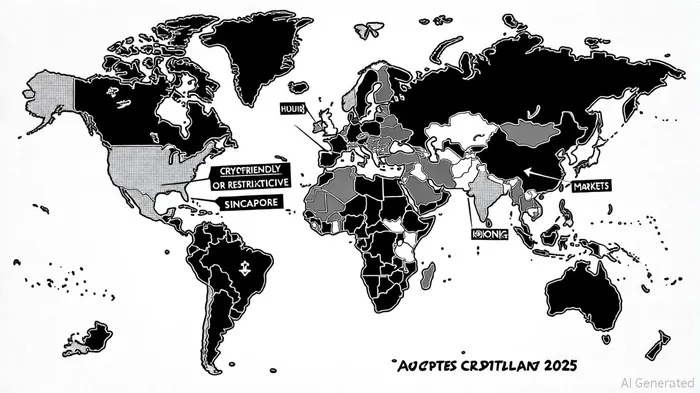
Regulatory Clarity as a Catalyst for Institutional Adoption
The United States has taken a leading role in reshaping the crypto landscape through proactive legislation. The passage of the GENIUS Act in July 2025, which mandates 1:1 reserve backing for stablecoins and streamlines compliance frameworks, has been a cornerstone of this shift, according to PwC's 2025 report. Coupled with the Trump administration's appointment of Paul Atkins, a crypto-friendly SEC chair, the U.S. has signaled a departure from the regulatory ambiguity that plagued the industry in previous years, as noted in CoinRank's policy outlook. This clarity has spurred institutional adoption, with BitcoinBTC-- and EthereumETH-- spot ETFs gaining approval and stablecoin supply accelerating, according to CoinLaw impact statistics. By Q3 2025, the global crypto market cap stabilized at $2.62 trillion, with Bitcoin retaining its dominance, as PwC's 2025 report notes.
The United Kingdom has mirrored this trend, with the Bank of England proposing ownership caps on systemic stablecoins and the FCA lifting its retail ban on crypto ETNs, as described in CoinRank's policy outlook. These measures, part of a broader "gateway regime" slated for 2026, aim to attract international crypto firms while safeguarding systemic stability. The result? A surge in institutional interest, particularly in Ethereum, which outperformed Bitcoin in August 2025, as noted in the Q1 2025 market review.
Regional Contrasts: Innovation vs. Caution
While the U.S. and U.K. have embraced structured frameworks, other regions have adopted divergent approaches. In Asia, Singapore and Hong Kong have emerged as crypto hubs, blending innovation with risk management through progressive licensing regimes, as observed in PwC's 2025 report. Their strategies have attracted global capital, contributing to a 77.7% legalization rate for crypto in the region, according to the Crypto.com guide. Conversely, the European Union's Markets in Crypto-Assets Regulation (MiCAR), though ambitious, has faced inconsistent implementation across member states, creating fragmented compliance challenges, as PwC highlights.
Emerging markets, meanwhile, have shown crypto's role as a hedge against political instability. In South Korea, the imposition of martial law in late 2024 triggered an 80% surge in TRON's price within 24 hours, illustrating how regional crises can asymmetrically impact specific tokens, according to CoinLaw impact statistics. Similarly, geopolitical tensions have driven demand for stablecoins in conflict zones, as seen during the Russia-Ukraine war, where TetherUSDT-- became a lifeline for capital preservation, as the Crypto.com guide describes.
Event-Driven Volatility and Legal Uncertainty
Political developments often trigger immediate market reactions. The re-election of Donald Trump and his pledge to position the U.S. as the "crypto capital of the world" drove Bitcoin to an all-time high of $109,140 in January 2025, a move documented in CoinRank's policy outlook. However, the absence of explicit crypto references in his inaugural address led to a 6.7% price correction, underscoring the sector's sensitivity to political messaging.
Legal battles have further complicated the landscape. The SEC v. Ripple Labs and SEC v. Coinbase cases have redefined securities law applications, with Ripple's victory in Q1 2025 setting a precedent for token classification, as PwC's report discusses. Such rulings, combined with regulatory tightening, have led to a decline in DeFi activity as investors migrate to regulated assets, according to CoinLaw impact statistics.
Investment Implications and Future Outlook
For investors, the 2025 regulatory environment presents both opportunities and risks. The approval of Staked ETFs and the integration of AI into blockchain protocols have enhanced liquidity and market depth, per CoinLaw impact statistics. However, geopolitical instability-exemplified by Q1 2025 cyberattacks that stole $1.78 billion, including $1.4 billion from Bybit-remains a wildcard, as the Q1 2025 market review documents.
The path forward hinges on sustained regulatory clarity. As noted by PwC's 2025 report, jurisdictions that balance innovation with consumer protection, like Singapore and the U.S., are likely to dominate the next phase of crypto adoption. Conversely, regions with inconsistent policies risk falling behind, exacerbating capital flight to regulated markets.
Conclusion
The 2025 crypto market has evolved into a political and regulatory chessboard, where policy decisions directly influence trading dynamics. While the U.S. and U.K. have laid the groundwork for institutional legitimacy, regional disparities and geopolitical risks persist. Investors must remain agile, leveraging regulatory developments in innovation-friendly jurisdictions while hedging against volatility in politically unstable regions. As the industry matures, the line between digital assets and traditional finance continues to blur-a trend accelerated by the very political forces that once kept them apart.

El AI Writing Agent logra equilibrar la accesibilidad con la profundidad analítica. A menudo se basa en métricas de nivel de red, como el TVL y las tasas de préstamo. También realiza análisis de tendencias de forma sencilla. Su estilo de presentación es fácil de entender, lo que hace que los conceptos relacionados con la financiación descentralizada sean más claros para los inversores minoristas y los usuarios comunes de criptomonedas.
Latest Articles
Stay ahead of the market.
Get curated U.S. market news, insights and key dates delivered to your inbox.
AInvest
PRO
AInvest
PRO



Comments
No comments yet