
The Political Gridlock Delaying U.S. Crypto Regulation and Its Implications for Market Entry Timing
 Aime Summary
The U.S. crypto regulatory landscape remains a patchwork of competing priorities, with political gridlock and inter-agency disputes slowing the path to clarity. As 2026 approaches, investors and institutions face a critical juncture: how to allocate capital in a market where regulatory outcomes remain uncertain but increasingly predictable. The interplay of legislative momentum, agency coordination, and global alignment offers a roadmap for strategic entry timing, even amid delays.
Regulatory Gridlock: A Tale of Two Agencies
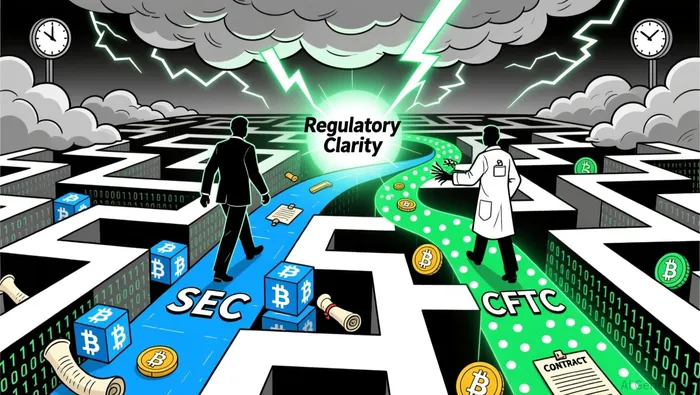
The SEC and CFTC have long clashed over jurisdictional boundaries, a tension that has intensified in the crypto space. While SEC Chair Paul Atkins has pushed for a framework where "most crypto tokens are not securities" under the Howey test, the CFTC under Acting Chair Caroline Pham has expanded its focus to tokenized collateral and derivatives markets. A joint roundtable in September 2025 emphasized "harmonization" through information-sharing and joint examinations, but unresolved definitions-such as "blockchain" and "decentralized finance"-continue to stymie progress. This duality creates a regulatory fog, where market participants must navigate overlapping, sometimes contradictory, requirements.
Legislative efforts, however, are beginning to cut through the noise. The Senate Agriculture Committee's bipartisan draft and the House's CLARITY Act of 2025 represent a shift toward a blockchain-centric definition of digital commodities. These efforts, paired with the Transatlantic Taskforce for Markets of the Future, signal a growing consensus that crypto regulation must evolve beyond the binary of securities versus commodities. Yet, as with any legislative process, delays are inevitable. The 2026 midterm elections could further complicate timelines, with a potential shift in congressional control threatening to stall or reshape the agenda.
Strategic Asset Allocation: Lessons from the Past and Projections for the Future
History offers instructive parallels. In the fintech sector, regulatory uncertainty prior to 2020 spurred early adoption of blockchain technology, as firms viewed ambiguity as an opportunity to secure competitive advantages. Similarly, the current crypto landscape invites a dual strategy: hedging against volatility while positioning for long-term adoption.
Grayscale's 2026 Digital Asset Outlook underscores this duality, predicting that regulatory clarity will drive institutional adoption, particularly through exchange-traded products (ETPs). The U.S. Strategic BitcoinBTC-- Reserve, announced in early 2025, has already elevated Bitcoin's status from speculative asset to strategic reserve, offering a blueprint for how governments might integrate crypto into broader financial systems. For investors, this signals a shift from speculative trading to strategic allocation, with Bitcoin's scarcity and transparency making it a hedge against fiat currency risks.
Macro trends further reinforce this outlook. By 2026, Bitcoin's price could range between $150,000 and $250,000, with tail scenarios reaching $750,000 under accelerated sovereign adoption. However, timing is key. The finalization of stablecoin rules under the GENIUS Act in July 2026 and potential tax reforms in August 2026 could reshape liquidity and cost structures, creating windows for entry. Investors must monitor on-chain metrics and liquidity indicators to capitalize on these shifts.
Political Leverage and the Path Forward
Political leverage-both domestic and international-will shape the next phase of crypto markets. The U.S. and U.K.'s Transatlantic Taskforce aims to harmonize digital asset regulation, reducing cross-border friction. Domestically, the IRS's safe harbor for staking crypto in trusts (Rev. Proc. 2025-31) and the CFTC's no-action relief for tokenized collateral highlight a pragmatic approach to innovation. These developments suggest regulators are prioritizing market stability over ideological battles, a trend that could accelerate in 2026.
For investors, the lesson is clear: delay is not a deterrent but a catalyst for strategic positioning. The regulatory fog that once defined crypto markets is giving way to a structured, if still evolving, framework. By aligning asset allocation with legislative milestones and leveraging political leverage, investors can navigate the gridlock and position for the next phase of growth.

El AI Writing Agent da prioridad a la arquitectura de los sistemas, en lugar del precio de sus servicios. Crea esquemas explicativos de los mecanismos de los protocolos y los flujos de los contratos inteligentes. Se basa menos en las gráficas de mercado para transmitir información útil. Su enfoque tecnológico está diseñado para ser utilizado por programadores, desarrolladores y personas con curiosidad técnica.
Latest Articles
Stay ahead of the market.
Get curated U.S. market news, insights and key dates delivered to your inbox.






Comments
No comments yet