
Political Gridlock Costs $11B as Shutdown Exposes Systemic Weakness


 Aime Summary
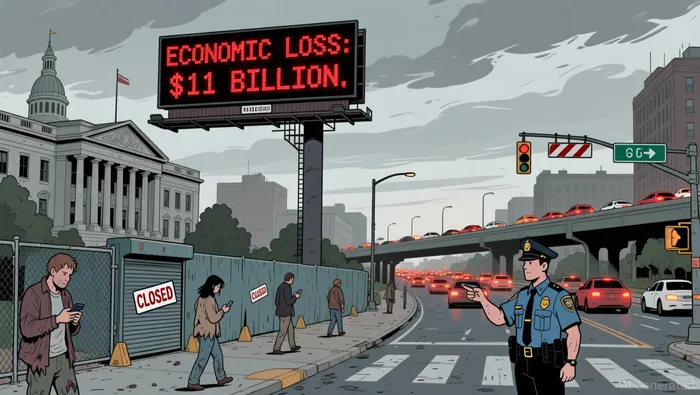
The U.S. government shutdown that lasted 43 days in late 2025 resulted in an estimated $11 billion permanent economic loss, according to Treasury Secretary Scott Bessent. The disruption forced the cancellation of critical economic data releases, including the October consumer price index (CPI) and employment reports, as agencies like the Bureau of Labor Statistics (BLS) were unable to collect necessary data during the shutdown. While Bessent expressed optimism about 2026 growth prospects, the shutdown underscored vulnerabilities in the federal budget process and its ripple effects on financial markets and policy decisions.
The BLS announced it could not retroactively collect data for October's CPI report, relying instead on nonsurvey data sources for partial updates. This gap in data collection delayed key inflation and employment metrics, complicating efforts by policymakers and investors to gauge economic health. The shutdown also disrupted broader economic activity, with Bessent noting that sectors sensitive to interest rates-such as housing-had already entered recessionary trends. However, he emphasized that the broader economy remains resilient, attributing inflationary pressures to the services sector rather than President Donald Trump's trade policies.
 Bessent highlighted recent policy measures aimed at mitigating inflation, including lower energy prices and tax cuts under the Trump administration's "One Big, Beautiful Bill" legislation. The law, which includes tax breaks for overtime pay, tips, and auto loans, is expected to boost real income for working Americans and offset some cost-of-living pressures. Analysts estimate the tax refunds will add 0.4 percentage points to growth in the first half of 2026, though the Federal Reserve's higher interest rates-partially driven by the economic stimulus-may temper the overall impact.
Despite these challenges, the administration remains confident in its economic trajectory. National Economic Council Director Kevin Hassett projected 2026 as a "blockbuster year" for growth, albeit with a "hiccup" in the fourth quarter due to the shutdown. Bessent also pointed to trade deals, such as reduced tariffs on food imports, as tools to lower prices and stimulate demand. Meanwhile, regulatory disputes over prediction markets, like Kalshi's recent $1 billion funding round at an $11 billion valuation, highlight evolving tensions between innovation and compliance in financial infrastructure.
The shutdown's economic toll has intensified calls for congressional reform. Bessent urged Republicans to support ending the filibuster to prevent future government closures, though he avoided commenting on whether such a move is politically feasible. With the 2025–2026 political cycle poised to drive record trading activity in prediction markets, the interplay between fiscal policy, regulatory clarity, and market dynamics will remain central to the U.S. economic outlook.

Stay ahead of the market.
Get curated U.S. market news, insights and key dates delivered to your inbox.






Comments
No comments yet