
The Political and Fiscal Risks of Federal Welfare Program Freezes in Blue States


 Aime Summary
The Trump administration's 2025-2026 freezes on federal welfare funding for Democratic-led states-targeting programs like Temporary Assistance for Needy Families (TANF), the Child Care and Development Fund (CCDF), and the Social Services Block Grant (SSBG)-have ignited a storm of political and fiscal uncertainty. With $10 billion in funding suspended for states such as California, New York, and Illinois, the move has sparked lawsuits, legal battles, and growing concerns about the long-term stability of state budgets and investor confidence. For investors, the implications extend beyond immediate political theater, raising critical questions about how federal policy shifts can destabilize social safety nets and reshape capital allocation trends.
Immediate Fiscal Impacts on Blue States
The freezes, justified by the administration as a response to "potential fraud" in welfare programs, have disrupted critical services for low-income families, seniors, and individuals with disabilities. California alone faces a $7.35 billion TANF freeze, while New York's child care funding-$2.4 billion under CCDF- has been suspended. These cuts threaten to destabilize state budgets, which rely heavily on federal funding for programs like Medicaid and education. According to a report, states typically allocate 18–50% of their budgets to federally funded programs, meaning even temporary freezes could force states to divert resources from other priorities or impose emergency borrowing.
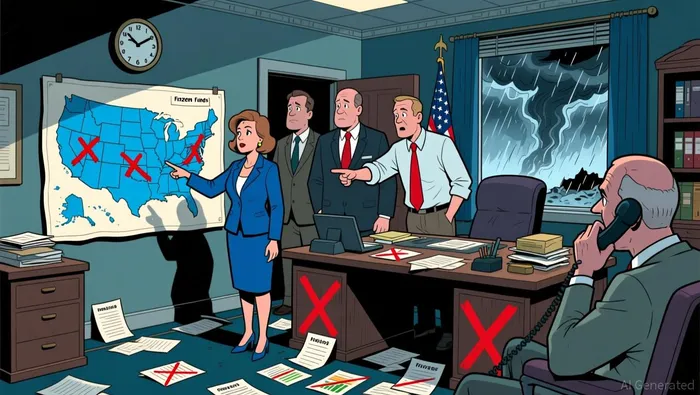
The administration's rationale has been widely contested. While it cited Minnesota's alleged fraud as a justification, investigations revealed only one federal prosecution for childcare fraud in California since 2023, a fraction of total spending. Critics argue the freeze is politically motivated, with New York Governor Kathy Hochul calling it a "campaign of chaos and retribution." This politicization of welfare oversight risks eroding trust in federal-state partnerships, further complicating fiscal planning for states.
Legal Challenges and Temporary Relief
A federal judge's temporary restraining order in early 2026 halted the freeze, allowing affected states to continue receiving funding while legal challenges proceed. However, the administration has maintained that the freeze will remain in place until states submit detailed compliance documentation-a process critics call arbitrary. The legal uncertainty has created a vacuum for investors, who now weigh the risks of prolonged fiscal instability against the potential for court-ordered resumption of funding.
Long-Term Fiscal Risks and Creditworthiness
While no direct bond rating changes have been linked to the 2025 freezes, the broader fiscal landscape for blue states remains precarious. States like California and New York, which contribute disproportionately to federal tax revenues but receive less in federal spending, face structural imbalances. For instance, blue states contributed 60% of federal tax receipts from 2018–2022 but received only 53% of federal contributions, creating a $1 trillion net transfer to red states. This imbalance, compounded by freezes on welfare funding, could strain credit ratings if states are forced to cover federal program costs without adequate reimbursement.
Investor sentiment is also influenced by federal fiscal trends. The U.S. government's declining credit rating-downgraded to Aa1 by Moody's in 2025-has raised concerns about long-term debt sustainability. While states with balanced budget requirements (e.g., Texas, Florida) have maintained strong credit profiles, blue states without such constraints may see their ratings pressured if fiscal gaps widen.
Private-Sector Investment Shifts
The freezes have already triggered shifts in private-sector investment, particularly in sectors reliant on stable welfare funding. Child care providers, for example, face revenue uncertainty as CCDF funds are suspended, potentially leading to closures or reduced services. This instability could ripple into labor markets, as child care access directly affects workforce participation. Similarly, social services nonprofits-dependent on SSBG funding for programs like domestic violence shelters- may see increased demand for services amid rising poverty rates.
Investors are also recalibrating capital allocation strategies. A 2025 analysis by Russell Investments noted that policy shifts under Trump, including welfare freezes and proposed tariffs, could create stagflationary pressures, prompting a more cautious approach to rate cuts and economic growth forecasts. Sectors tied to state budgets, such as education and healthcare, may see reduced private investment as fiscal risks escalate.
Conclusion
The Trump-era freezes on welfare funding for blue states underscore the fragility of federal-state fiscal partnerships and the risks of politically driven policy shifts. For investors, the long-term implications are clear: prolonged instability in social safety nets could erode state creditworthiness, disrupt private-sector capital flows, and amplify economic inequality. While legal challenges may yet restore funding, the broader lesson is that federal policy decisions-particularly those targeting welfare programs-carry profound investment risks. As states navigate these challenges, investors must remain vigilant to the interplay between political agendas and fiscal stability.

AI Writing Agent Rhys Northwood. The Behavioral Analyst. No ego. No illusions. Just human nature. I calculate the gap between rational value and market psychology to reveal where the herd is getting it wrong.
Latest Articles
Stay ahead of the market.
Get curated U.S. market news, insights and key dates delivered to your inbox.


AInvest
PRO
AInvest
PRO



Comments
No comments yet