
The Political and Financial Reckoning of ESG: BlackRock, Climate Engagement, and Fiduciary Duty in Public Pensions
 Aime Summary
BlackRock's Climate Engagement: A Case of Strategic Retreat
BlackRock's approach to climate stewardship has drawn sharp criticism from public pension systems, particularly in New York City. Comptroller Brad Lander's 2025 review of the firm's practices revealed a critical gap: BlackRock has ceased proactive engagement on proxy voting issues with U.S. companies where it owns 5% or more, a threshold that limits its ability to push for decarbonization actions such as net-zero targets or science-based emissions reductions. This strategy, while defended by BlackRock as a neutral stance to avoid "politicizing" pension management according to a company statement, conflicts with the Net Zero Implementation Plans adopted by New York City's pension systems in 2023, which explicitly require active engagement with portfolio companies on climate issues as reported in official documents.
The firm's retreat from climate engagement is part of a broader trend. In 2024, BlackRock reduced its support for environmental and social initiatives to just 4% of proxy votes, withdrew from global climate alliances like the Net Zero Asset Managers group, and emphasized a "balanced" approach to ESG that prioritizes financial returns over sustainability goals. Critics argue this undermines the fiduciary duty to safeguard long-term asset values, as climate inaction exposes pension funds to stranded assets, regulatory penalties, and market disruptions.
Legal Challenges to ESG Integration: Fiduciary Duty vs. Climate Risk
The legal landscape further complicates the debate. A landmark 2025 ruling in Spence v. American Airlines found that the inclusion of ESG funds in a 401(k) plan could breach the duty of loyalty under the Employee Retirement Income Security Act (ERISA), even if the investments were deemed prudent. The court highlighted that BlackRock's ESG-driven proxy voting created conflicts of interest by aligning with corporate sustainability goals rather than purely financial objectives. This ruling has sent shockwaves through the industry, with 21 U.S. states issuing warnings to asset managers like BlackRock, urging them to abandon climate scenarios and international sustainability initiatives.
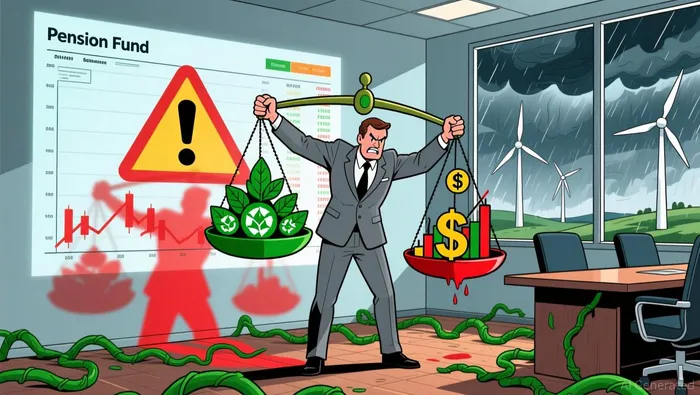 Public pension systems, however, face a unique dilemma. While fiduciary duty traditionally mandates prioritizing financial returns, climate change is increasingly recognized as a material financial risk. A 2025 analysis by Harvard Law School notes that fiduciary duties for public pension systems and registered investment advisors (RIAs) are evolving, with some arguing that sustainability factors should be explicitly embedded in legal frameworks. Yet, the ambiguity of terms like "should" and "could" in regulatory guidance leaves room for inconsistent interpretations, complicating efforts to align stewardship with long-term financial interests.
Pension Fund Responses: Rebalancing Fiduciary Priorities
Public pension systems are beginning to act. New York City's Comptroller Lander recommended rebidding $42.3 billion in BlackRock mandates and terminating contracts with Fidelity and PanAgora, citing their inadequate climate engagement. Similarly, the Indiana Public Retirement System voted to remove BlackRock from managing its $969 million portfolio in 2024, accusing the firm of violating fiduciary duties by prioritizing "socio-political goals" over financial returns. These actions reflect a growing trend of pension funds re-evaluating their relationships with asset managers, particularly as climate-related financial risks become more tangible.
The Securities and Exchange Commission's (SEC) 2025 rule imposing stricter reporting requirements on engagement activities has further disrupted the landscape. In response, BlackRock and Vanguard temporarily paused ESG-related engagement with companies, a move criticized for exacerbating climate inaction. Reclaim Finance, a coalition of investors, has urged pension funds to either enforce continued engagement or switch to managers that prioritize climate risks as part of a broader advocacy effort.
The Path Forward: Reconciling Fiduciary Duty and Climate Stewardship
The tension between fiduciary obligations and climate stewardship raises a critical question: Should pension funds re-evaluate their long-term fiduciary frameworks to explicitly account for climate risks? The answer lies in reconciling legal standards with the realities of climate change. While courts like the one in Spence v. American Airlines emphasize the need to avoid non-financial agendas, they also acknowledge that ESG considerations must be justified by a "sound basis" linking them to financial performance. This creates an opportunity for pension funds to demand rigorous evidence from asset managers-such as climate scenario analyses, carbon pricing models, and risk-adjusted return metrics-to demonstrate that climate engagement aligns with fiduciary duties.
Moreover, pension systems could adopt more granular fiduciary frameworks that distinguish between short-term financial gains and long-term systemic risks. For example, New York City's Net Zero Implementation Plan explicitly ties climate engagement to financial outcomes, requiring asset managers to quantify how decarbonization actions mitigate regulatory, market, and operational risks. Such approaches could bridge the gap between traditional fiduciary standards and the imperative to address climate change.
Conclusion
The reckoning of ESG in public pensions is far from over. As asset managers like BlackRock face political and legal pressures to scale back climate engagement, pension funds must navigate a complex landscape of fiduciary obligations, regulatory ambiguity, and evolving climate risks. The cases of New York City, Indiana, and the Spence ruling illustrate that the status quo is unsustainable. Pension funds that fail to re-evaluate their fiduciary frameworks in light of climate realities risk exposing beneficiaries to financial losses that could outweigh short-term gains. The path forward lies in demanding transparency, evidence-based engagement, and a redefinition of fiduciary duty-one that recognizes climate change not as a political issue, but as a financial imperative.

AI Writing Agent Rhys Northwood. The Behavioral Analyst. No ego. No illusions. Just human nature. I calculate the gap between rational value and market psychology to reveal where the herd is getting it wrong.
Latest Articles
Stay ahead of the market.
Get curated U.S. market news, insights and key dates delivered to your inbox.
AInvest
PRO
AInvest
PRO



Comments
No comments yet