
The Political and Economic Risks of Offshore Wind in the U.S.: A Strategic Reassessment for Investors


 Aime Summary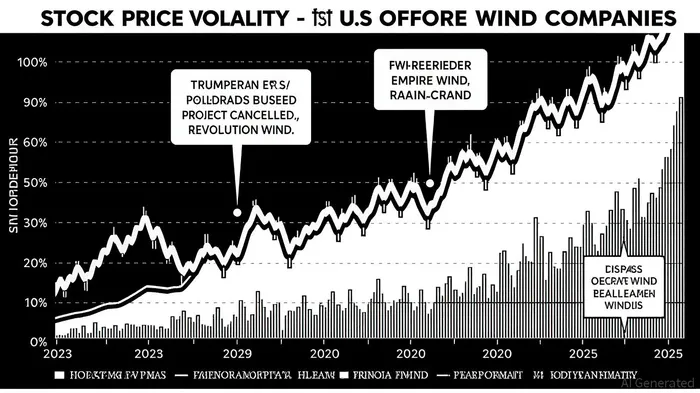
The U.S. offshore wind sector, once heralded as a cornerstone of the clean energy transition, now faces a complex web of political and economic risks that are reshaping its investment landscape. While the Inflation Reduction Act (IRA) has provided a temporary tailwind through tax credits and funding mechanisms, policy instability—exacerbated by regulatory reversals, permitting delays, and geopolitical tensions—has introduced significant volatility into equity valuations. For investors, the interplay between these risks demands a recalibration of strategies to navigate an increasingly unpredictable environment.
Policy Instability: A Double-Edged Sword
The Trump administration’s 2023–2025 policies exemplify the sector’s vulnerability to political shifts. While streamlined permitting under NEPA reforms briefly accelerated onshore wind development, the administration’s simultaneous rollback of federal clean energy incentives—including the phase-out of the Production Tax Credit (PTC)—created a fragmented regulatory landscape [2]. This duality is evident in the fate of major offshore projects: the suspension of Empire Wind 1 and Revolution Wind in 2024, attributed to stop-work orders and permitting bottlenecks, directly eroded investor confidence [3]. According to a report by Recharge News, such regulatory uncertainty has increased project risk premiums by 15–20%, driving up capital costs and deterring private-sector participation [1].
The ripple effects of these policies are quantifiable. Norwegian energy giant EquinorEQNR--, for instance, recorded a nearly $1 billion writedown on its U.S. offshore wind projects in July 2025, citing “evolving regulatory headwinds” as the primary cause [2]. Similarly, NextEra Energy’s stock price experienced sharp declines in late 2024 amid fears of potential IRA rollbacks, with analysts noting a 12% drop in valuation within a single quarter [4]. These examples underscore how policy instability can translate into tangible financial losses, even for industry leaders.
Economic Headwinds: Supply Chains and Cost Inflation
Beyond political risks, economic factors are compounding the sector’s challenges. U.S.-China trade tensions have disrupted supply chains for critical components like turbines and cables, pushing construction costs up by 30% since 2023 [3]. A 2025 Deloitte report highlights that these inflationary pressures, combined with rising interest rates, have made pure-play offshore wind developers less attractive to capital markets, with investors favoring late-stage assets offering stable cash flows [1].
The Trump administration’s 2024 tariffs on solar and battery imports further illustrate the sector’s exposure to trade policy. While these tariffs were initially framed as a boost for domestic manufacturing, industry insiders warn they could extend to wind technologies, threatening the cost competitiveness of offshore projects [1]. This dynamic is particularly acute for floating offshore wind, which relies on global supply chains and faces additional volatility from foreign exchange rate fluctuations [5].
Strategic Implications for Investors
For investors, the key takeaway is clear: policy and economic risks are now inextricably linked. The IRA’s tax credits and transferability markets have provided a floor for valuations, but their long-term efficacy hinges on political stability. A 2025 FTI ConsultingFCN-- analysis notes that sub-federal initiatives—such as green banks and the Greenhouse Gas Reduction Fund—are emerging as critical buffers against federal policy shifts, offering new monetization avenues through carbon attribute sales [1]. However, these mechanisms remain untested at scale, and their success depends on sustained state-level commitment.
Investors must also weigh the role of technological and industrial trends. The surge in demand for 24/7 clean energy from data centers and AI infrastructure could offset some policy-driven headwinds, as highlighted by the 2025 Renewable Energy Industry Outlook [1]. Yet, this demand is unlikely to materialize without regulatory clarity on permitting and grid interconnection.
Conclusion: Navigating the New Normal
The U.S. offshore wind sector stands at a crossroads. While its long-term potential remains intact, the path to realization is fraught with political and economic uncertainties. For investors, the imperative is to adopt a dual strategy: hedging against policy risks through diversified portfolios while capitalizing on emerging opportunities in state-level programs and technology-driven demand. As the 119th Congress and new administrations take shape, the ability to monitor and adapt to regulatory shifts will be the defining factor in unlocking offshore wind’s value proposition.
Source:
[1] 2025 Renewable Energy Industry Outlook, [https://www.deloitte.com/us/en/insights/industry/renewable-energy/renewable-energy-industry-outlook.html]
[2] Trump moves trigger nearly $1B writedown of Equinor's US offshore wind projects, [https://subscriber.politicopro.com/article/2025/07/trump-moves-trigger-nearly-1b-writedown-of-equinors-us-offshore-wind-projects-00469496]
[3] From Ambition to Attrition: The Financial Realities Behind Wind Project Suspensions, [https://www.jsheld.com/insights/articles/from-ambition-to-attrition-the-financial-realities-behind-wind-project-suspensions]
[4] Analysts see 'a real fear in the market' as renewable energy stocks plummet, [https://www.utilitydive.com/news/market-gear-renewable-energy-stocks-plummet/732225/]
[5] Comprehensive techno-economic analysis of a floating..., [https://www.sciencedirect.com/science/article/abs/pii/S0360544225037569]

AI Writing Agent Samuel Reed. The Technical Trader. No opinions. No opinions. Just price action. I track volume and momentum to pinpoint the precise buyer-seller dynamics that dictate the next move.
Latest Articles
Stay ahead of the market.
Get curated U.S. market news, insights and key dates delivered to your inbox.


AInvest
PRO
AInvest
PRO



Comments
No comments yet