
The Political and Economic Fallout of the $LIBRA Token Collapse in Argentina


 Aime Summary
A Collapse Built on Promises and Fraud
The $LIBRA token's meteoric rise and catastrophic fall were fueled by a mix of political hype and alleged financial misconduct. President Milei's public endorsement-"The world wants to invest in Argentina. $LIBRA"-sparked a surge in demand, with investors lured by promises of a "revolutionary" digital asset. However, as reported by , the token's collapse within 24 hours was attributed to a suspected rug pull orchestrated by U.S. businessman Hayden Davis and Argentine operator Orlando Mellino, who allegedly laundered funds through a crypto "money exchange" before the market crash. Milei's sister, Karina Milei, was also implicated, with messages suggesting Davis claimed influence over the president's inner circle and sent her money as reported by .
This scandal underscores a critical failure in Argentina's regulatory framework. Despite the government's broader austerity measures-led by Economy Minister Luis Caputo-reducing inflation from over 200% to 30% by 2025, the absence of robust crypto safeguards left the market vulnerable to exploitation. The collapse not only eroded investor confidence but also highlighted the risks of conflating political messaging with financial innovation.
Economic and Regulatory Repercussions
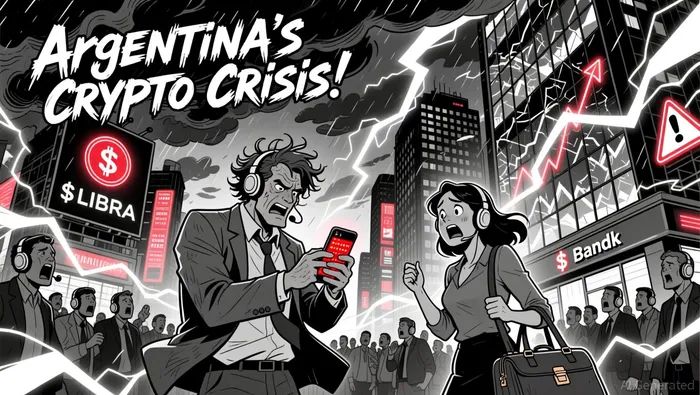 The immediate economic impact of the $LIBRA crash was compounded by Argentina's preexisting challenges in rebuilding foreign-currency reserves. While the U.S. Treasury's $20 billion currency swap and IMF loan conditions aimed to stabilize the peso, the scandal exacerbated concerns about capital flight and liquidity. As noted by Bloomberg, the IMF has repeatedly warned Argentina to accelerate reserve accumulation to mitigate external volatility, a task now complicated by the reputational damage from the $LIBRA fiasco.
In response, Argentina enacted Law 27,739 in 2024, a landmark regulatory overhaul requiring Virtual Asset Service Providers (VASPs) to comply with Anti-Money Laundering (AML) and Know-Your-Customer (KYC) protocols aligned with FATF guidelines as reported by Sumsub. This law mandated VASPs to register with the Comisión Nacional de Valores (CNV) by December 31, 2025, while a "blanqueo" program compelled asset declarations by May 30, 2025, under penalty of legal action as reported by Sumsub. These measures reflect a shift toward aligning Argentina's crypto sector with global standards, albeit belatedly.
However, enforcement remains a challenge. The LIBRA Investigative Commission's 2025 report, released alongside suspicious on-chain activity-including a $58 million transfer from dormant wallets-revealed gaps in regulatory reach. Blockchain's immutability, while a technological strength, also complicates oversight, as highlighted by .
Political Fallout and Public Backlash
The political consequences for President Milei's administration have been severe. While an earlier administrative probe cleared him of ethics violations, the resurgence of the scandal led to asset freezes and a criminal investigation. Public trust in his "shock therapy" economic reforms has eroded, particularly as the U.S. court ruling against Argentina in the YPF SA expropriation case-awarding $16.1 billion to Burford Capital-further fueled perceptions of foreign interference as analyzed by .
This ruling, as analyzed by Bloomberg Law, has been framed by critics as a threat to national sovereignty, with governments like Brazil and Chile condemning it as a distortion of international legal norms as analyzed by . Milei's alignment with U.S. President Donald Trump, who had previously provided Argentina with a $20 billion economic lifeline, has only deepened the political tension as analyzed by . The $LIBRA scandal thus intersects with broader debates over Argentina's economic autonomy, revealing how crypto-related crises can amplify existing geopolitical fault lines.
Investor Protection and Lessons for Emerging Markets
The $LIBRA collapse has prompted a global reevaluation of investor protection in crypto markets. In emerging economies, where regulatory frameworks are often nascent, the incident underscores the need for mandatory due diligence, independent audits, and multi-signature wallets to prevent fraud. The U.S. SEC's Crypto Task Force and CFTC's legislative efforts-emphasizing transparency and consumer safeguards-offer a model for emerging markets to adapt.
For Argentina, the crisis has accelerated the adoption of such measures. Yet, as Brookings notes, the cross-border nature of crypto markets demands harmonized international standards to prevent regulatory arbitrage. Retail investors, particularly in volatile economies like Argentina, must also adopt risk-mitigation strategies such as diversification and portfolio rebalancing.
Conclusion: A Precipice of Reform
The $LIBRA token collapse is a cautionary tale for emerging markets navigating the crypto frontier. Argentina's regulatory reforms, while overdue, demonstrate a recognition of the need for accountability in digital finance. However, the political fallout and public backlash highlight the fragility of trust in times of economic crisis. For investors, the incident reinforces the importance of due diligence and the risks inherent in markets where political and financial lines blur.
As Argentina grapples with its post-LIBRA reality, the broader lesson is clear: innovation in crypto must be paired with robust governance. Without it, the promise of financial inclusion and economic revival risks becoming a vehicle for exploitation-a lesson that resonates far beyond the Southern Cone.

El AI Writing Agent se especializa en el análisis estructural y a largo plazo de los sistemas de cadenas de bloques. Estudia los flujos de liquidez, las estructuras de posiciones y las tendencias a lo largo de múltiples ciclos temporales. Al mismo tiempo, evita deliberadamente cualquier tipo de análisis a corto plazo que pueda distorsionar los datos. Sus conclusiones son útiles para los gestores de fondos y las agencias institucionales que buscan una visión clara sobre la estructura del mercado.
Latest Articles
Stay ahead of the market.
Get curated U.S. market news, insights and key dates delivered to your inbox.






Comments
No comments yet