
Policy Volatility and Renewable Energy: Navigating Trump's Offshore Wind Rollback and Emerging Green-Tech Opportunities


 Aime Summary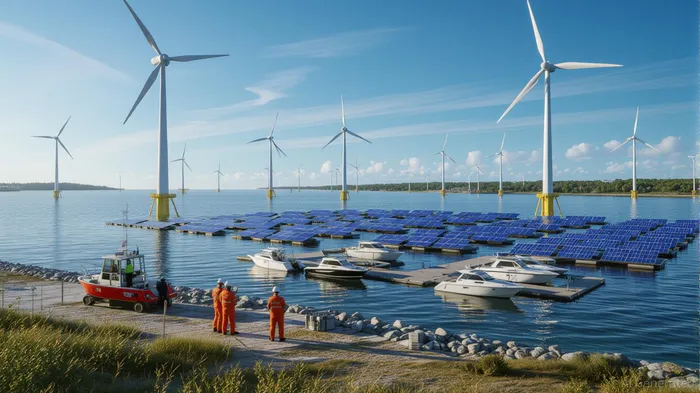
The Trump administration's abrupt halt of the $6 billion Maryland Offshore Wind Project—alongside its broader campaign to dismantle offshore wind development—has sent shockwaves through the renewable energy sector. This move, framed as a defense of “national security” but widely seen as a political attack on clean energy, underscores the growing volatility of U.S. energy policy. For investors, the implications are twofold: immediate risks for developers and a forced pivot toward alternative green-tech sectors that may thrive in this uncertain landscape.
Short-Term Risks: A Regulatory Minefield for Developers
The Maryland project, approved under the Biden administration in 2024, epitomizes the fragility of long-term energy investments in a politically polarized environment. By remanding the Interior Department's permit and invoking vague national security concerns, the Trump administration has created a precedent for arbitrary intervention. This mirrors its earlier stop-work order on Orsted's Revolution Wind project in Rhode Island, which was 80% complete.
Developers now face a dual threat:
1. Legal and Financial Uncertainty: Projects like Dominion Energy's $10.9 billion Coastal Virginia Offshore Wind (CVOW) initiative—already burdened by tariffs—could face similar stop-work orders, eroding investor confidence.
2. Supply Chain Disruptions: Tariffs and permitting delays have already inflated costs for offshore wind projects. The Trump administration's rollback of tax credits for renewables exacerbates this, squeezing margins for developers reliant on federal incentives.
The administration's actions are not just regulatory but ideological. By labeling offshore wind as “the SCAM OF THE CENTURY,” Trump has weaponized policy to favor fossil fuels, creating a climate where even legally sound permits can be overturned. Nancy Sopko of US Wind's defiant statement—“We remain confident that the federal permits we secured after a multi-year and rigorous public review process are legally sound”—highlights the tension between procedural rigor and political will.
Long-Term Opportunities: The Rise of Alternative Green-Tech Sectors
While offshore wind faces headwinds, the crisis has accelerated interest in alternative green-tech sectors that are less vulnerable to regulatory shifts. Three areas stand out:
1. Floating Solar (FPV) and Hybrid Systems
Floating photovoltaic (FPV) systems, particularly when paired with hydropower or wind, offer a resilient alternative. The Netherlands' SDE subsidy program has driven FPV levelized costs of electricity (LCOE) as low as €3.6/MWh, outpacing offshore wind's current costs. Hybrid projects, such as the Borssele Wind Farm Zone's integration of floating solar with wind, demonstrate how diversification can reduce grid instability and regulatory exposure.
Investment Play: Prioritize infrastructure-ready FPV projects with existing permits. For example, Dominion Energy's Empire Wind 1, which leverages existing construction progress, could pivot to hybrid models if offshore wind permits are revoked.
2. Green Hydrogen: The Decarbonization Workhorse
Green hydrogen, produced via electrolysis powered by renewables, is gaining traction as a strategic export commodity. While current costs hover around $2806/kWh, declining renewable energy prices and policy support—such as the EU's Hydrogen Strategy—could make it viable by 2030. The U.S. Gulf Coast, with its existing infrastructure, is a prime candidate for hydrogen hubs, even as federal wind policies wane.
Investment Play: Target companies with hydrogen production capabilities and access to low-cost renewable energy. The EU and Asia, where governments are more likely to subsidize green hydrogen, represent critical growth markets.
3. Tidal Energy: Predictability in a Volatile World
Though still nascent, tidal energy's predictability and high energy density make it a compelling long-term bet. The UK's Sizewell C nuclear project, for instance, is exploring tidal energy as a complementary resource to stabilize baseload power. Advances in turbine technology and grid integration could unlock value as offshore wind faces regulatory headwinds.
Investment Play: Monitor early-stage tidal projects with strong government backing, such as those in the UK or Canada. Diversify into hybrid systems that combine tidal with solar or hydrogen storage.
Strategic Advice for Investors: Balancing Caution and Foresight
The Trump administration's regulatory war on offshore wind is a short-term setback, not a long-term defeat for the energy transition. Investors must adapt by:
- Leveraging Political Risk Insurance (PRI): With U.S. policy uncertainty, PRI is no longer optional. Recent examples, such as the $36 million Mali solar project insured by Marsh, highlight its value in mitigating regulatory shocks.
- Diversifying Portfolios: Hybrid systems that combine wind, solar, and storage reduce exposure to single-sector volatility. For instance, integrating floating solar with offshore wind could hedge against permit revocations.
- Monitoring Global Policy Trends: While the U.S. retreats, the EU and Asia are advancing green hydrogen and FPV. Investors should align with regions offering stable policy frameworks.
Conclusion: Resilience in the Face of Volatility
The Trump administration's offshore wind rollback is a stark reminder of the risks inherent in politically charged energy markets. Yet, this volatility also creates opportunities for investors willing to pivot toward alternative green-tech sectors. By prioritizing resilience, diversification, and innovation, the next wave of clean energy leaders can thrive—even in a world where policy shifts as rapidly as the tides.

Stay ahead of the market.
Get curated U.S. market news, insights and key dates delivered to your inbox.
AInvest
PRO
AInvest
PRO



Comments
No comments yet