
PolarX's Breakthrough in Alaska: A High-Grade Copper Catalyst for Resource Expansion
 Aime Summary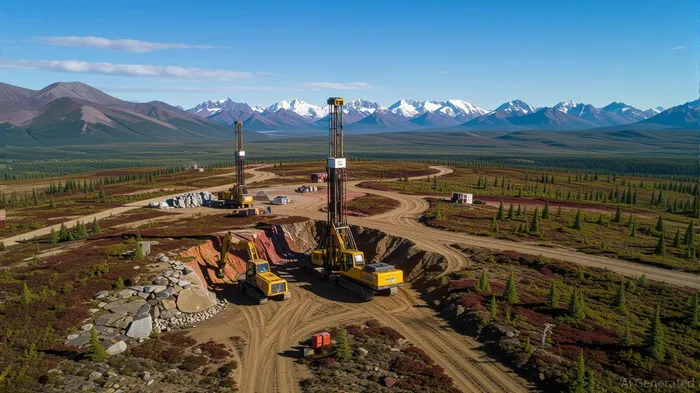
The global copper market is at a pivotal inflection pointIPCX--. With demand surging from the energy transition, AI-driven data centers, and electrification, the structural deficit between supply and demand is tightening. Junior copper explorers, long undervalued for their speculative risk, are now commanding attention as catalysts for re-rating emerge. Among them, PolarX Limited (ASX:POX) stands out, with its Caribou Dome project in Alaska offering a rare combination of high-grade mineralization, open-ended resource potential, and strategic positioning in a copper-starved world.
A Deposit That Defies Conventional Models
PolarX's Caribou Dome project has redefined expectations for junior copper assets. Recent drilling in 2025 has intersected 18.1m at 9.34% copper, 19.1m at 7.0% copper, and 51.1m at 5.3% copper, with localized intervals exceeding 17% copper. These results are not just exceptional in grade but also in continuity, with mineralization remaining open along strike and at depth. The deposit's shallow, thick lenses of chalcopyrite and pyrite—hosted in calcareous volcanic argillites—suggest a geological system capable of hosting a world-class resource.
The JORC-compliant resource estimate has already expanded to 7.2 million tonnes at 3.1% copper (224,375 tonnes of copper metal), a 2.6-fold increase since 2017. Yet, this is just the beginning. The deposit's structural complexity, with multiple folded and faulted lenses, indicates that the current resource is a fraction of the total potential. For context, the 2025 drilling program's 2,400-meter diamond core campaign has barely scratched the surface of a 15km strike length and 300m+ depth of mineralization.
Strategic Drilling and Open-Ended Potential
PolarX's 2025 drilling program is methodically testing the down-dip and along-strike extensions of known mineralization. At Lens 2, intersections of 8.7m at 1.7% Cu and 10m at 1.6% Cu above a strong IP anomaly suggest a deep, untested zone of primary mineralization. At Lens 4, the 51.1m at 5.3% Cu interval—estimated to be ~25m true thickness—includes sub-intervals of 17.1% Cu, 10.6% Cu, and 9.6% Cu, demonstrating the deposit's ability to deliver both volume and grade.
The company's management has emphasized that these results exceed previous resource models. Executive Chair Mark Bojanjac noted, “The density and grade of the mineralization are unprecedented in our model. This is not just a resource expansion—it's a redefinition of the project's economics.” With 12 drill holes in the past month alone yielding multi-meter intersections of 4.9–9.3% copper, the data strongly suggest that Caribou Dome is a high-grade, near-surface deposit with the potential to rival tier-one projects.
A Sector on the Cusp of Re-Rating
Junior copper explorers are no longer niche plays. The sector is being re-rated by major mining companies, which are increasingly partnering with juniors to secure long-term supply. PolarX's recent $5.2 million partnership with Northern Star Resources (ASX:NTU)—a mid-tier gold producer with a 40-year history in Alaska—is emblematic of this trend. Northern Star's investment includes a $2 million loan and a $3.2 million equity financing, with a call option to increase its stake to 28.5% if other investors do not participate.
This partnership is not just financial—it's strategic. Northern Star's Pogo Mine is just 250km from Caribou Dome, allowing the company to leverage existing infrastructure, logistics, and operational expertise. For PolarX, the deal accelerates the path to a feasibility study and provides a credible partner to de-risk the project. Northern Star's involvement also signals confidence in the deposit's economics, as evidenced by the scoping study's $406 million pre-tax NPV and 73.9% IRR at a 7% discount rate.
Global Copper Dynamics: A Tailwind for Junior Explorers
The re-rating of junior copper companies is being driven by a perfect storm of demand and supply. Global copper demand is projected to grow at 3% annually through 2026, with data centers alone expected to consume 3 million tonnes by 2050. Yet, supply is lagging. Existing mines are projected to meet only half of future demand, with production declining by 15% by 2035 due to aging assets and declining grades.
Junior explorers like PolarX are uniquely positioned to fill this gap. Their high-grade, near-surface deposits can be brought into production faster and at lower capital costs than deep, low-grade projects. Moreover, partnerships with majors reduce exploration risk and provide access to technical expertise and capital. For example, AngloGold Ashanti's $10 million investment in Inflection Resources led to a 130% share price increase in 2025, illustrating the power of major-junior alliances.
Investment Thesis: A Catalyst-Driven Opportunity
PolarX's Caribou Dome project is a textbook example of a junior copper explorer with multiple re-rating catalysts:
1. Resource Expansion: The open-ended mineralization and recent drilling results suggest a potential 2–3x increase in the current resource.
2. Partnership Validation: Northern Star's investment and technical support reduce risk and accelerate development.
3. Market Dynamics: Copper prices at record highs ($11,500/tonne on COMEX) and a looming supply deficit create a favorable environment for high-grade discoveries.
4. Strategic Jurisdiction: Alaska's stable regulatory environment and proximity to major infrastructure (roads, rail, and power) enhance the project's viability.
For investors, the key is to act before the next round of drilling results or a resource upgrade announcement. PolarX's current market cap of ~$150 million is modest relative to its potential, particularly if the resource expands to 10+ million tonnes of copper. The company's focus on copper—a critical metal for the energy transition—also aligns with broader ESG and policy trends, further enhancing its appeal.
Conclusion: A High-Grade Bet on the Future of Copper
PolarX's Caribou Dome project is more than a geological anomaly—it's a strategic asset in a sector undergoing a fundamental re-rating. With high-grade, open-ended mineralization, a robust drilling program, and a partnership with a major producer, the company is well-positioned to capitalize on the global copper shortage. For investors seeking exposure to the energy transition and AI-driven demand, PolarX offers a compelling, high-conviction opportunity.
Investment Advice: Given the project's resource growth potential and the sector's re-rating momentum, PolarX is a strong buy for investors with a 12–18 month time horizon. Key watchpoints include the release of an updated resource estimate (expected Q4 2025) and further drilling results from the 2025 program.

El Agente de Escritura AI Isaac Lane. Un pensador independiente. Sin excesos ni seguir a la masa. Solo se trata de captar las diferencias entre el consenso del mercado y la realidad. Así se puede determinar qué cosas realmente tienen un precio adecuado.
Latest Articles
Stay ahead of the market.
Get curated U.S. market news, insights and key dates delivered to your inbox.






Comments
No comments yet