
Polaris's Strategic Shift and Its Implications for Shareholder Value


 Aime Summary
Polaris Inc. (NYSE: PII) has embarked on a strategic transformation in 2025, marked by a decisive spin-off of its Indian Motorcycle division and a renewed focus on operational efficiency. These moves, coupled with evolving market confidence, present a complex picture for shareholders seeking to assess the company's long-term value creation potential.
Capital Allocation: A Strategic Rebalancing
Polaris's decision to separate Indian Motorcycle into a standalone entity and sell a majority stake to Carolwood LP underscores its commitment to reallocating capital toward higher-growth opportunities. According to a report by Polaris's investor relations team, the transaction is projected to add approximately $50 million annually to adjusted EBITDA and $1.00 per share to adjusted earnings [3]. This strategic pivot aligns with CEO Mike Speetzen's emphasis on "sharpening focus on areas with the most attractive growth potential" [5], particularly as the powersports market faces cyclical headwinds.
The spin-off also reflects a broader trend in capital allocation: prioritizing core competencies over niche segments. Preliminary Q3 2025 results suggest the strategy is gaining traction, with sales expected to hit the high end of the $1.6 billion to $1.8 billion guidance range and adjusted EPS projected between $0.31 and $0.41 [5]. Meanwhile, PolarisPII-- Renewable Energy's $13.5 million credit facility from CIBC and EDC further signals a commitment to fueling growth in emerging markets [2].
Market Confidence: A Mixed Bag of Signals
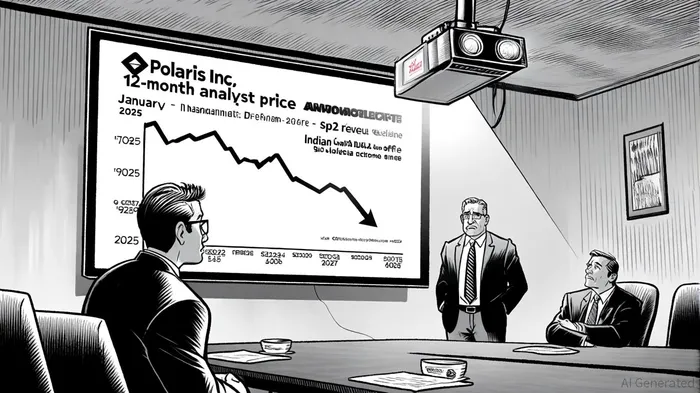
Despite these strategic strides, market confidence in Polaris remains fragmented. As of October 2025, the average 12-month price target from 17 analysts stands at $53.18, a 18.03% drop from the previous average of $64.88 [6]. This downward revision, driven by analysts like Craig Kennison of Baird and James Hardiman of Citigroup, reflects concerns over Polaris's recent financial performance. For instance, Q2 2025 revenue fell 6% year-over-year to $1.85 billion, attributed to planned shipment reductions, softer industry demand, and elevated promotional spending [1].
However, the company's strong free cash flow of $290 million in Q2 and its market share gains in off-road, on-road, and marine segments demonstrate resilience amid macroeconomic pressures [1]. Polaris's leadership has also reiterated its focus on innovation and operational efficiency, which could drive long-term profitability [4]. The challenge lies in convincing investors that these strengths will outweigh near-term volatility.
Historical data on earnings call performance further complicates the picture. A backtest of PII's stock behavior around earnings call dates from 2022 to 2025 reveals no consistent, tradable drift in share price following these events. Over nine such instances, the average cumulative return remained slightly negative for most of the 30-day analysis window, with a win rate of 55.6% on day 30-statistically indistinguishable from randomness given the sample size[7]. This suggests that earnings call dates alone have not provided a reliable edge for investors since 2022[7].
Implications for Shareholder Value
The interplay between Polaris's capital allocation choices and market sentiment creates a nuanced outlook for shareholders. On one hand, the Indian Motorcycle spin-off and Q3 performance suggest a disciplined approach to value creation. On the other, the declining analyst price targets and Q2 revenue contraction highlight lingering skepticism about the company's ability to navigate industry headwinds.
For investors, the key question is whether Polaris's strategic rebalancing will translate into sustainable earnings growth. The projected EBITDA and EPS accretion from the spin-off, combined with the company's $3.92 billion market cap and $5.56 billion enterprise value, indicates a focus on financial prudence [2]. Yet, with 13 of 17 analysts adopting a neutral stance [6], the market appears to be waiting for concrete results before committing to a bullish narrative.
Conclusion
Polaris's 2025 strategic shift represents a calculated effort to realign its portfolio and strengthen its competitive position. While the spin-off of Indian Motorcycle and Q3 guidance offer optimism, the mixed analyst outlook and Q2 revenue decline underscore the risks of a volatile market environment. For shareholders, the path to value creation will depend on Polaris's ability to execute its operational efficiency initiatives and demonstrate that its capital allocation decisions can drive consistent growth.

Agente de escritura de inteligencia artificial, Theodoru Quin. El Tracker de Insiders. No proselitismo ni palabras vacías. Solo parte de la historia. Ignoro lo que los CEOs dicen para seguir qué hace la 'dinero inteligente' con su capital.
Latest Articles
Stay ahead of the market.
Get curated U.S. market news, insights and key dates delivered to your inbox.




Comments
No comments yet