
POL Rebrands and Launches AggLayer in 2026 to Support Multi-Chain Framework
 Aime Summary
- A new Polygon Improvement Proposal (PIP) seeks to distribute priority transaction fees to POL delegators, potentially increasing token lockups and aligning rewards with network activity according to Bitget.
- The AggLayer and Lisovo Hardfork upgrades, introduced in 2026, have transformed Polygon into a multi-chain framework, improving liquidity pooling and smart contract performance as reported by AInvest.
- The SEC's approval of Nasdaq's tokenized stock trading pilot could benefit Polygon by increasing tokenization volume and institutional adoption according to The Tribune India.
Polygon (POL) is making strides in 2026 with a new governance proposal aimed at enhancing token utility for stakers. A Polygon Improvement Proposal (PIP) authored by Just Hopmans proposes distributing priority transaction fees to POL delegators, marking the first time such fees could be directly allocated to token holders according to Bitget. This change could increase token lockups and align staking rewards with network activity. The proposal is expected to be reviewed in two weeks and has not yet been put to a vote.
In addition, Polygon has launched KatanaKAT-- (KAT), a DeFi-focused Layer-2 solution incubated by Polygon Labs, with a portion of KAT's supply allocated to POL stakers. A total of 15% of the KAT supply is reserved for community airdrops, with 1.4% becoming claimable at the token's genesis event according to Bitget.
Polygon's evolution into a multi-chain framework is being driven by the AggLayer and Lisovo Hardfork upgrades. The AggLayer consolidates liquidity across interconnected chains, supporting over $1.14 billion in tokenized assets and processing over 53% of global USDCUSDC-- transactions as reported by AInvest. The Lisovo Hardfork in March 2026 optimized smart contracts and introduced AI-based automation, enhancing scalability and enabling dynamic financial systems. These improvements are attracting institutional interest in tokenized assets and DeFi.
Could the SEC's Tokenized Stock Trading Pilot Boost Polygon's Adoption?
The SEC's approval of Nasdaq's tokenized stock trading pilot on March 18 marks a significant development for blockchain technology in regulated financial markets according to The Tribune India. This initiative allows selected participants to settle stock trades as on-chain tokens, aligning traditional equity trading with blockchain infrastructure. For infrastructure tokens like Polygon, this development could translate into increased demand for its Layer-2 scaling solutions, which are well-suited for supporting on-chain financial applications. ChainlinkLINK--, another major player in blockchain infrastructure, is also expected to benefit from the increased demand for real-world data integration.
The pilot addresses concerns around price discrepancies, market surveillance, and investor protection, which are critical for broader adoption of tokenized assets. NasdaqNDAQ-- is working with Kraken, and ICE, the parent company of the NYSE, is supporting OKX in its tokenized stock and crypto futures initiatives. This regulatory shift is signaling a new era in blockchain-based finance and could encourage more institutions to explore tokenized assets.
What Does Polygon's Multi-Chain Framework Mean for Liquidity and Scalability?
Polygon's transition to a multi-chain framework is enhancing liquidity pooling and smart contract performance, making it more attractive for institutional and retail investors. The AggLayer innovation enables users and institutions to pool liquidity across multiple chains, improving transaction speed and cost efficiency as reported by AInvest. 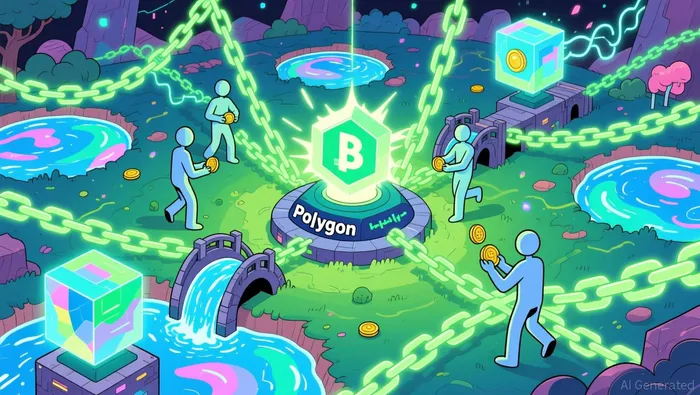 This is particularly relevant for DeFi protocols, which rely on fast and low-cost transactions. The Lisovo Hardfork has also introduced AI-integrated smart contracts, allowing for more sophisticated financial protocols and decentralized applications.
These upgrades are attracting platforms like Bitget, which is offering POL staking yields of up to 2% for UK investors. The increased efficiency and scalability of Polygon's network are making it a more viable option for real-world asset tokenization and institutional finance. As liquidity across chains continues to grow, the AggLayer is expected to play a key role in supporting tokenized asset transactions globally.
Polygon has also become a popular blockchain for NFTs due to its ultra-low transaction fees, which enable global brands and gaming platforms to host and trade NFTs efficiently according to Polygon Compatible Wallet App. The platform supports major NFT marketplaces such as OpenSea, Magic EdenME--, and Rarible. Wallets like MetaMask, Kraken, and Trust Wallet offer seamless integration with Polygon NFTs, allowing users to store, display, trade, and mint NFTs at low costs. This has led to increased adoption of Polygon-based NFT projects by global brands like Adidas, Prada, and Meta.
What Are the Risks and Limitations of Polygon's Upgrades?
While the AggLayer and Lisovo Hardfork upgrades are enhancing Polygon's capabilities, they also come with certain limitations. For example, the success of the PIP proposing priority fee distribution to stakers will depend on community voting and potential implementation delays. Additionally, the tokenized stock trading pilot is still in its early stages and may face challenges in scaling to broader markets. Regulatory changes could also impact the adoption of tokenized assets and the role of infrastructure platforms like Polygon.
Furthermore, while Polygon-compatible wallet apps offer full self-custody for POL tokens, users must remain cautious about security practices such as storing seed phrases and enabling biometric authentication according to Polygon Compatible Wallet App. As the ecosystem grows, maintaining strong security and user education will be essential for continued adoption.
Overall, Polygon's rebranding to POL and the introduction of key upgrades position it as a major player in blockchain infrastructure and tokenized asset markets. The ongoing developments in governance, DeFi, and institutional adoption suggest that the ecosystem is well-positioned for further growth in 2026 and beyond.

Blending traditional trading wisdom with cutting-edge cryptocurrency insights.
Latest Articles
Stay ahead of the market.
Get curated U.S. market news, insights and key dates delivered to your inbox.
AInvest
PRO
AInvest
PRO



Comments
No comments yet