
POL Rebounds as AggLayer Adoption and Deflationary Tokenomics Drive Price Targets
 Aime Summary
- POL's price has dropped 91% from its 2024 ATH of $1.24 to $0.111 as of March 2026.
- Realistic price targets suggest a potential range of $0.15–$0.80 in 2026 and $0.25–$7.00 by 2035+, depending on AggLayer adoption and network performance according to analysis.
- Polygon has evolved into a multi-chain ecosystem with POLPOL-- as its upgraded token for gasGAS--, staking, and governance as reported.
The price of POL, formerly known as MATIC, has seen a significant decline from its 2024 all-time high of $1.24 to $0.111 as of March 2026. This represents a 91% drop in value over nearly two years. Analysts and market observers are monitoring POL closely for potential recovery signals as the ecosystem evolves.
Polygon's transition into a multi-chain environment has positioned POL as the central token for gas, staking, and governance within the network. This evolution marks a strategic shift from its prior role as a Layer 2 scaling solution to a broader multi-chain infrastructure provider.
AggLayer v0.3, launched in June 2025, has unified liquidity across EVM and non-EVM chains according to reports. This upgrade is a critical milestone for Polygon as it enhances interoperability and opens the platform to a wider array of blockchain ecosystems. AggLayer supports payments and the tokenization of real-world assets, expanding the use cases for POL within the ecosystem.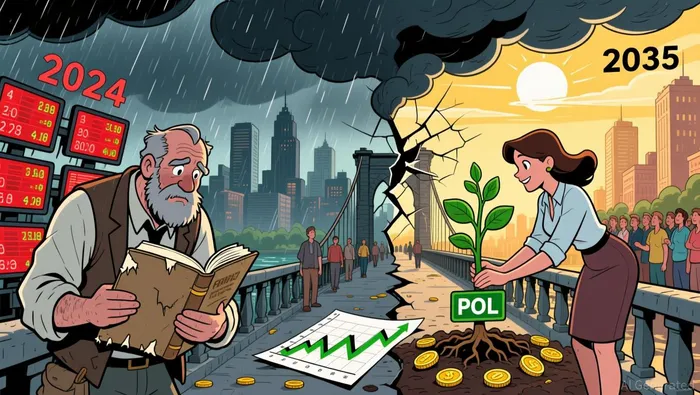
What Is the Current Price Outlook for POL?
As of March 2026, POL is trading at $0.111 according to market data. Despite the sharp decline from its 2024 peak, some analysts have outlined potential price targets ranging from $0.15 to $0.80 for the remainder of the year, contingent on key developments. Looking ahead, the token's price could move upward to $0.25–$7.00 by 2035+ if AggLayer adoption accelerates.
What Factors Are Driving POL's Value Potential?
The growth of Polygon's payments volume and the adoption of its AggLayer protocol are key drivers. The network has seen 399% year-over-year growth in payments and rising transaction fees, which bode well for the ecosystem's long-term sustainability. Additionally, the platform's deflationary tokenomics, including token burns, are expected to reduce supply over time, potentially increasing value.
Polygon's Gigagas roadmap aims to scale throughput to 100,000 transactions per second by 2026, which would further enhance the network's appeal for developers and enterprises according to projections. The platform has already achieved over 1,000 TPS with near-zero fees, making it a competitive option for high-volume applications.
What Are the Risks to Consider?
Despite these positive developments, several risks could impede POL's growth trajectory as noted. The intense competition in the Layer 2 space remains a challenge, with other projects vying for developer and enterprise adoption. Additionally, Polygon's annual inflation rate of 2% could limit the deflationary impact of token burns, especially if adoption does not outpace supply growth.
Polygon's ecosystem is also facing the challenge of scaling real-world asset tokenization beyond current limits. While integrations with major players like Stripe and Mastercard are a positive sign, further institutional adoption will be necessary to sustain long-term growth.

Blending traditional trading wisdom with cutting-edge cryptocurrency insights.
Latest Articles
Stay ahead of the market.
Get curated U.S. market news, insights and key dates delivered to your inbox.


AInvest
PRO
AInvest
PRO



Comments
No comments yet