
POL (ex-MATIC) Price Surges 51% on Q4 2025 Upgrades and Deflationary Tokenomics
 Aime Summary
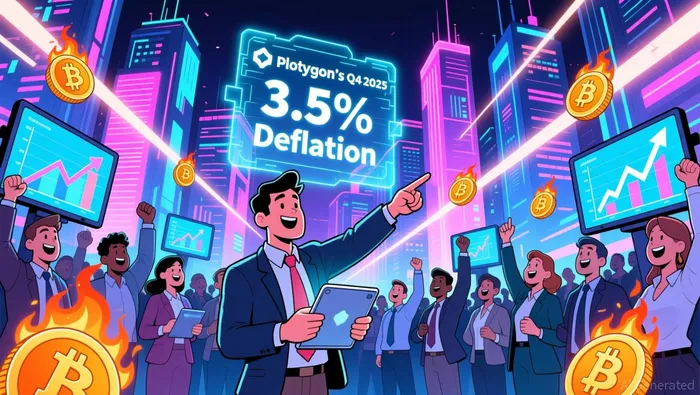
Polygon’s native token POLPOL-- saw a 51% price increase in Q4 2025 due to strategic upgrades and token design that emphasize utility and scarcity according to analysis. Network enhancements, including the Bhilai and Madhugiri hardforks, increased throughput to 5,000 TPS, making the platform more attractive to institutional partners like Santander and Revolut according to reports. The tokenomics of POL include daily burns of 1 million tokens, creating an estimated 3.5% annual supply deflation, which has drawn institutional attention and fueled optimism for long-term growth as detailed.
Polygon’s POL token is central to the platform’s ecosystem, facilitating staking, governance, and transaction fees. The token’s deflationary mechanism, which includes 100% base transaction fee burns, could lead to an annual supply reduction of around 5%, according to Polygon Foundation CEO Sandeep Nailwal. These burns have occurred at a rate of up to 3 million tokens per day, with an average of 1.5 million daily burns expected as noted.
Nailwal highlighted three primary benefit streams for POL holders: transaction fees, staking rewards, and future interoperability fees from the Agglayer initiative according to his statement. The platform’s Open Money Stack aims to drive global on-chain payments and position Polygon as a leader in this space. Analysts from Bitget have noted that POL’s deflationary mechanisms, enhanced utility, and staking incentives support its long-term potential according to analysis.
Polygon continues to explore the possibility of reverting to the original MATIC ticker, based on community feedback. While Nailwal acknowledges the historical significance of MATIC, he sees logistical hurdles in reverting to it and believes POL is now more familiar in many markets as stated. Despite this, the transition to POL has provided more utility to the Agglayer system, which aims to enhance cross-chain interoperability according to reports.
Why is Polygon’s Upgrade to POL Significant?
Polygon’s upgrade from MATIC to POL in September 2024 marked a shift toward enhanced utility and scalability as reported. This transition enabled POL to power gas, staking, and governance across the Polygon PoS chain according to analysis. Upgrades such as the Bhilai and Rio hardforks increased transaction throughput to 5,000 TPS and improved finality times, enhancing the platform’s appeal as detailed. These improvements have attracted major players, including Revolut, Flutterwave, and Santander, who now use Polygon for real-time crypto transfers and instant settlements according to reports.
Polygon’s AggLayer, launched in February 2025, leverages zero-knowledge (ZK) proofs to enable secure cross-chain communication and asset transfers as described. This has driven stablecoin growth, with Polygon capturing 52% of the omnichain USDT0 supply according to data. The platform processes $1 billion in transactions monthly through partners like Avenia Pay, further solidifying its role in global finance as reported.
What Drives POL’s Investment Potential?
POL’s investment appeal lies in its deflationary design and real-world adoption according to analysis. Daily burns of 1 million tokens contribute to an estimated 3.5% annual supply reduction as detailed. This scarcity model, combined with utility in staking and governance, supports POL’s long-term value proposition according to Polygon Foundation CEO Sandeep Nailwal.
Institutional adoption is also a key driver. Santander and Cypher Capital now offer exposure to POL, reflecting growing confidence in its future according to reports. Additionally, the platform’s ability to process high volumes of transactions at low costs makes it a valuable solution for global payment systems and prediction markets as noted.
Polygon’s roadmap includes integrating its PoS network with Agglayer, aiming to bring POL into the broader aggregated network according to plans. This integration could further enhance POL’s utility and demand as stated. The platform’s Chain Development Kit (CDK) also enables developers to create custom blockchains for specific use cases, expanding its ecosystem and reinforcing POL’s role as a key asset within it according to documentation.
What Are the Risks for POL Investors?
Despite its growth, POL investors face certain risks as reported. The transition from MATIC to POL, while largely complete, could face challenges if exchanges are reluctant to support a potential ticker revert according to analysis.
Market volatility remains a factor, as is true for most crypto assets. POL’s value is tied to the success of the Polygon ecosystem, and any setbacks in adoption or technical progress could affect its performance according to reports.
Additionally, while deflationary mechanics create scarcity, they do not guarantee demand. If broader market conditions shift or alternative scaling solutions emerge, POL could face pressure as noted.
In summary, POL’s position as a key asset in the Polygon ecosystem, supported by strategic upgrades and deflationary tokenomics, suggests a strong long-term investment case. However, investors should remain mindful of market dynamics and the broader crypto landscape.

La combinación de la sabiduría tradicional en el comercio con las perspectivas más actuales relacionadas con las criptomonedas.
Latest Articles
Stay ahead of the market.
Get curated U.S. market news, insights and key dates delivered to your inbox.


AInvest
PRO
AInvest
PRO



Comments
No comments yet